Png’S Fresh, New Face
pp. 13-14 · Read in the full issue
The Scars Of Change On
From GUS SMALES in Port Moresby One year of Popua New Guinea independence and the five years of intense change which preceded it are marked indelibly on the capital Port Moresby. Some of the marks - rising crime figures, the frustrations of unskilled drifters drink problems, occasional racial incidents, and a degree of community in ejjiciency are the scars of change.
Balancing them is the emergence of a new Papua New Guinean elite in control, the movement of women into the workforce and community affairs, the acceptance of whites who have something to offer as partners instead of bosses, and the development of a home-grown nucleus of urban respon sibility.
But for good or bad, people, buildings, crime patterns, road traffic, social attitudes, the workforce and the very scenery itself have passed through dramatic change.
It comes as a surprise, then, to get out of Port Moresby which was never typical of the real PNG, anyway and to discover how little obvious change appears to have taken place in the rest of the country.
The peasant activities of unchanged villages still exist by the sea and on the highland slopes, bowed-down women still cart home the firewood while they keep a simultaneous eye on children and pigs, men with spears still fight and kill over land and flock disputes, white planters still make line in the mornings, and the pace of life and most of its relationships are un altered.
The egalitarian and much-vaunted Eight-point Plan of the Prime Minister, Mr Somare, would appear to have barely dented the surface despite its sweeping guidelines of social and economic reform. And for every villager, who may now have an inkling of what nationhood and cen tral government are all about, there are still a score who neither know nor seem to care.
In the rural communities and remote settlements central govern ment is still largely recognised at one or another erroneous extreme.
One extreme recognises central government -as. an aJJ-powerful, god like but generally benevolent body divorced from rural society. The other
extreme sees it as a sort of big foreign council operating in opposition or at best in troubled liaison with the local council.
Far too many Members of Parlia ment still exercise a sort of mystic bluff over their constituents, not necessarily by intent, but by a com bination of circumstances. An unfor tunate side to this attitude is that next year’s general election could well cost the country some of its more valuable nationalists. Because too many villagers still miss the point of national government, they could well vote out men who have been “spen ding too much time on big govern ment business instead of our business”.
This attitude is unlikely to general ly affect the more obvious national leaders, but it could mow down the ranks of the middle-level politicans who are effectively just completing
their apprenticeships and who repre sent future potential.
There’s a tendency, too, among many electors to believe that a request to parliamant usually for a bridge, or a road, or a school is automatically granted.
If what you ask for doesn’t materialise, then obviously the local member forgot to ask for it. So out he goes.
But the more important issue as PNG enters its second year of nationhood is whether or not the absence of obvious change is a bad thing in a new nation. And that, in turn, depends on what were the past circumstances.
There’s strong evidence to suggest that the situation reflects a strength rather than a weakness in the con solidation of PNG as a nation.
“Easy, easy,” as Mr Somare said in a double answer to his critics of pre independence days. It was a double answer because it was directed at the radicals who wanted to go faster, and at the conservatives who feared sudden change.
Mr Somare has always had an un canny ability to strike a middle line which in the long run has proved the best way of getting what he wants. He is still a disjointed speaker, he is still vague about facts and figures (some say deliberately) and he lacks the trendy charisma which is popularly believed to go with new nation leadership.
But for all that or maybe because of it he has well-arranged priorities, he knows what he is after, and he knows how to go about getting It would have been very easy in the interests of alleged nationalism, or in response to some political pressures, for the Somare government to have put a great big axe through the entire
fabric of PNG in the past year or so.
Outside investors, whites and Asians who regarded PNG as their home, and puzzled or conservative Papua New Guineans themselves waited in some trepidation to see where or how the axe would fall.
Some tough guidelines emerged about foreign investment and involve ment and the new “foreigners” were told exactly where they stood, but no axe was ever wielded.
The results have been interesting in a number of directions.
There was an obvious increase in foreign confidence, even if the pickings seemed less attractive. But the real bonus for PNG came in the reaction of many of its own radicals, who suddenly realised that controlled investment meant something for them. There are still radical voices calling for instant economic revolu tion, even amounting to calls for un compensated acquisition, but the government is sitting solidly in con trol.
Mr Alex Gordon, a Scottish-born university lecturer in Port Moresby has publicly advocated, for instance, that all white planters should be
tipped off their properties.
Instead of the present govern ment policy paying compensation for any acquisitions, he believes the planters should compensate the government for nearly a century of “disrupting and exploiting the natural economic system”.
His remarks prompted an angry critic (another white, but not a planter) to suggest that doctors and health workers should pay compensa tion “for disrupting the natural en vironment by reducing malaria and child mortality”.
Of all the factors which have
emerged from the policies, the problems, the squabbles and (let’s face it) the inefficiencies of the first year of independence, one has emerg ed clearly as an indication of national strength. This is a basic integrity towards national financial manage ment, coupled with a recognition that no country, politically independent or otherwise, can exist today in isolation.
By adopting this attitude, and coupling it with responsible budget policies, PNG has traded speed for stability in making the wider changes which will surely come.
The forces, which will change the obvious face of society but even then not as quickly as many people believe are already at work and are contained in the Eight-point Plan and the voluminous National Constitution (one of the biggest in the world).
In the meantime, content with a type of national and domestic co existence policy, PNG continues to accept nearly half its budget revenue in untied Australian aid, putting the money into projects which will pay off when aid tapers away.
There have been fears, mainly from foreign investors, that the structure is still shaky because it stands or falls with the Somare government. This is true enough in a superficial sort of way, but it ignores the influence which any foundation government and parliament cannot help but impress on the immediate future of its coun try.
Mr Somare himself and his hard core supporters in government may indeed be difficult to replace im mediately as people, but there is nothing to suggest that the flavour of national politics contains a significant or even a potentially-significant force of counter-thought.
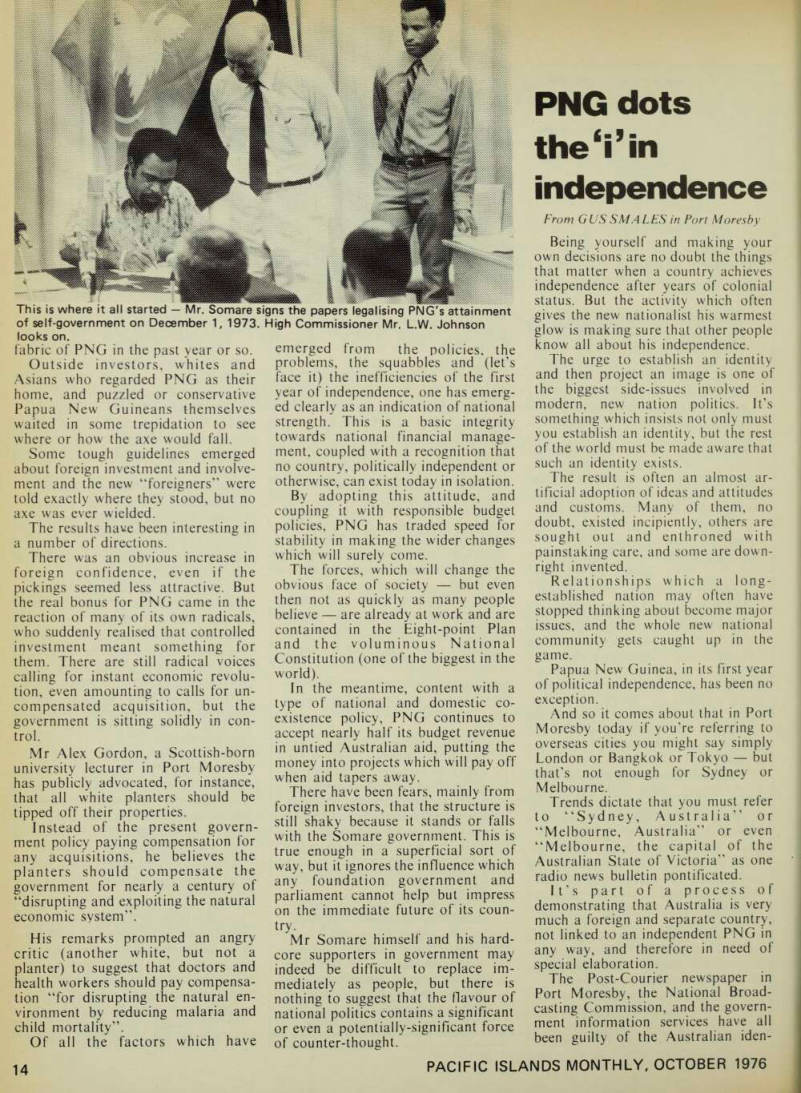
This is where it all started - Mr. Somare signs the papers legalising PNG's attainment of self-government on December 1, 1973. High Commissioner Mr. L.W. Johnson looks on.