Weren’T All Smooth Flying
pp. 57-65 · Read in the full issue
Pacific Transport
Air Pacific’S First 25 Years
From ROBERT KEITH-REID in Suva Aviation is, today, practically synonymous with high-level international politics as nations squabble over share-outs of lucrative landing rights for their national airlines.
Getting involved in such affrays must have been the last thing pioneer Australian aviator Harold Galty had in mind when he formed Fiji Airways in 1951 and began shuttling people between Suva and Nadi in dc Havilland Rapide biplanes.
Garry never did see his company climb up into the realms of airline politics. He died in 1957 and his widow sold the com pany to Qanlas for $107,000 the following year.
Thai's when Fiji Airways did begin to become a political animal, since Qantas realised its potential as a tool for con trolling the direction of South Pacific avia
tion development.
Qantas brought British Airways and Air New Zealand into the scheme of things in 1960 and the company's organisation was reshuffled with a capital of $500,000.
It was then making about 350 local flights a month carrying about 1,500 passengers in three-engined Drovers.
The first of what was to become a fleet of seven four-engined Herons, each carry ing up to 17 passengers, arrived in 1960 and with these the company expanded its services out of Fiji to Tonga, Western Samoa, the New Hebrides, and the Gilbert and Ellice Islands.
The Fiji Government became an equal shareholder in the company in 1965, and was followed in the next few years, each taking a 2% slake, by Tonga, Western Samoa, Nauru and what in the 1960 s were labelled the British Western Pacific High Commission countries the Solomons, and (filbert and Ellice.
Qanlas throughout remained in direct managerial control of the airline, providing seconded executive and
engineering staff.
By 1968 the structure of Fiji Airways’ ownership, its regional route network and the policies set for it made it obvious that it had become an instrument with which Bri tain, Australia and New Zealand hoped to keep the South Pacific their own particular aviation reserve as much as possible.
Modern planes were introduced to ser vice in 1967 with the arrival of the first of three HS-748 turboprop planes. These cut flight times on all routes by more than half.
International ownership and operations of the company made a change of name desirable for it especially in view of the small Pacific Island shareholders.
In 1971, a deal was done with another small Fiji airline by which Fiji Airways look over the name of Air Pacific from a company which now operates as Fiji Air.
Rechristened, Air Pacific also assumed an aquamarine blue livery and prepared in April of that year for the delivery of its first jet, a $5 million, 74-passenger, 500 mph BAG 111-475.
The jet, followed by a second 18 months later, wrought further big cuts in flight times and brought a vast increase in passenger comfort.
The service to Honiara was extended to Papua-New Guinea but this was later cut back to Honiara since the extension prov ed to be a loss-maker.
In July, 1973, Air Pacific for the first time reached out of the Pacific Islands by opening a service to Brisbane, Australia, via Honiara. Its jets began a service to
Auckland, New Zealand, via Tonga in May, 1974, and, in 1975, began further services to Brisbane via New Caledonia.
Extension of services to Brisbane and Auckland appear to have for the moment satisfied the airline’s route ambitions, save for its failure to extend its service from Fiji to Tarawa and on to Majuro in the Trust Territory because of a landing rights dis pute between Fiji and the United States Government.
The last of the 20-year-old Herons were phased out of service this year and have been replaced on some of the company's internal Fiji routes and on the internal ser vice it runs for the Gilbert Islands by three engined Trislanders.
Air Pacific has never made big money in fact it has been flying well into the red for the last three years.
Its best years were $lBB,OOO profit in 1969/70 and $317,036 for 1971/72. Then soaring costs brought a run of thumping losses, the last one of $644,000 reported for the 1974/75 financial year.
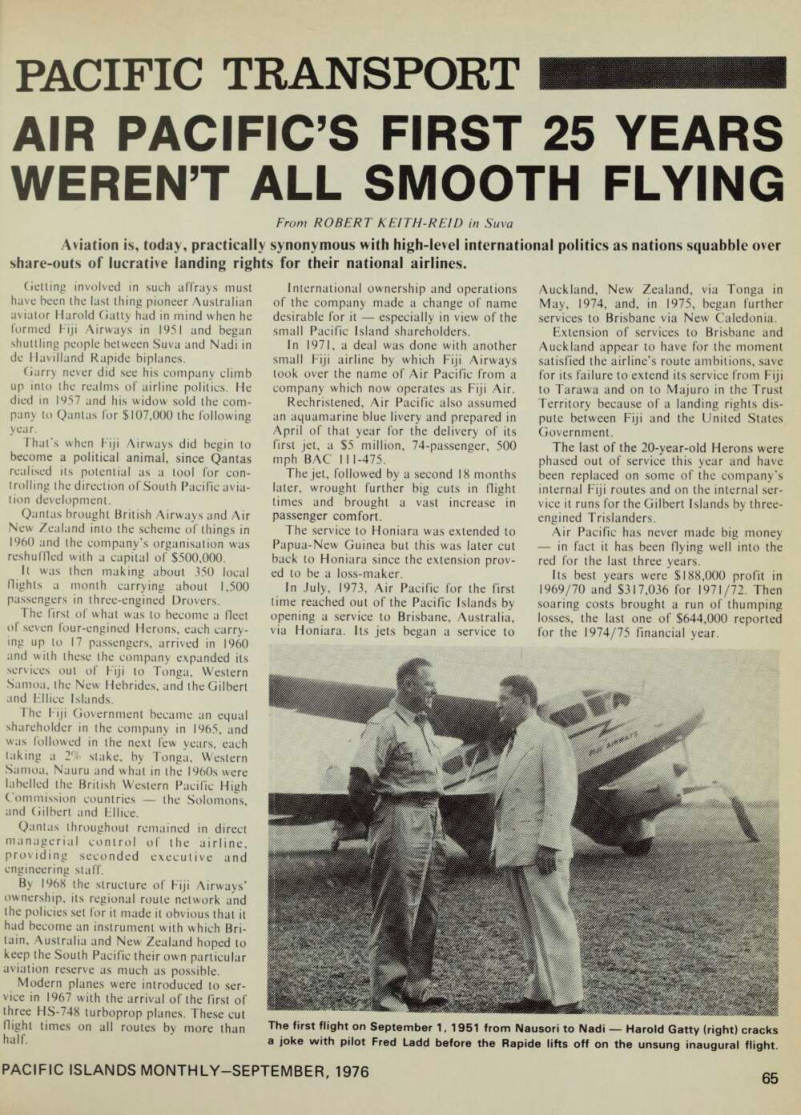
The first flight on September 1. 1951 from Nausori to Nadi - Harold Gatty (right) cracks a joke with pilot Fred Ladd before the Rapide lifts off on the unsung inaugural flight.
Fiji’s independence in 1970 and in dependence for Tonga, Nauru and Western Samoa have made Air Pacific’s progress in the 1970 s a far more complex matter than was the case in the 19605.
The airline was one of the first ex periments in the realm of South Pacific co operation a regionally-owned airline running regional services and as such ex
pecting protection from shareholding
governments as a virtual monopoly.
But Nauru’s ambitions for its own national airline caused it to withdraw from Air Pacific’s board in 1972.
And, Irom 1974 onwards, Tonga's desire for its own national airline, and Western Samoa's increasing concern for the welfare ol its Apia-based Polynesian Airlines, have reduced the Air Pacific consortium to a gaggle of uneasy bedfellows.
Fiji has been irritated by Samoan and Tonga actions in promoting their own aviation interests at the expense of support for Air Pacific. And it has never really been happy with the extent of Qanlas, Air New Zealand and British Airways involve ment in regional airline politics.
The unspoken feeling is that Qanlas and Air New Zealand, in particular, may have used their position on the Air-Pacific board to quietly stifle any growth by it that could impinge on their own direct interests.
All this has led to Fiji steadily acquiring a greater slake in Air Pacific, and in 1976 its holding grew to a controlling 66.75%.
The three other airlines now hold 8.75% each: Tonga, Samoa andlhe Gilberts 1.6% each; Western Samoa 0.76% and Nauru 0.51%.
British Airways has signified that it would like to withdraw entirely while Fiji has intimated that it would like Pan American to join the consortium.
Recognising the causes and dangers of friction, the shareholding governments agreed in May this year to call on indepen dent consultants to carry out a study to decide Air Pacific's future status, in a regional role in particular.
Despite political strains and stresses. Air Pacific is preparing for its second 25 years ol service with a background that a lot of airlines would like to have.
None ol the passengers carried by it has ever been killed or seriously hurl.
In its last financial year it carried 192,000 on its Fiji services and 68,000 on
regional flights.
A stall ol 513 people is drawn, in the case ol nearly 90%, directly from the Pacific Island countries the company serves.
A Pacific Islander has yet to command a jet or HS 748, but one is Hying as first of ficer on a jet and will soon get command of
a turboprop.
Thirteen other local pilots are following in his vapour trail.
Air Pacific changed its livery again in June this year. Aquamarine blue gave way to a dramatic rainbow slash of tropical red and yellow hues along a snow-white hull.
The format is an exhuberant one which, Air Pacific staff say, indicates their op timism about the vitality of the airline’s future.
The Fiji Government decided late in July to invest $500,000 immediately in Air Pacific and another $150,000 in February.
Ratu Sir Penaia Ganilau, acting Prime Minister, said operating costs had in creased, and the trend was likely to con tinue throughout 1976.
He said that an independent survey of Air Pacific was being sought, but it was clear that the future viability of the airline was not dependent on its getting new and/or additional routes which had traffic potential and growth allowing the fleet to be used to the maximum and allowing a far more economical spread of fixed overheads over total route structure.
“Routes can only become available for Air Pacific through government to govern ment negotiations and air service agreements”, Ratu Sir Penaia said. “Such negotiations are a long drawn-out process and cannot, therefore, in the short term be considered a solution to Air Pacific’s im mediate cash flow problem”.
Pan American Airways has been holding talks with Air Pacific over the possibility of the US airline taking a small interest in the Fiji-based operator.
In answer to a query from PIM in late July, Mr A. B. “Sky” Magary, Pan Am’s regional managing director for the South- West Pacific, said Pan Am was “interested in the possibility of becoming a partner in the Air Pacific consortium”. Pan Am has a long-standing route authority from the US CAB authorities, extending from Tahiti to Vila. This did not mean the com pany has local governments' authority or planes to operate on regional routes.
Moreover, the US airline does not want to set up competition to weaken the establish ed networks, but rather wants to con tribute in a positive way to present operations, in a way which may strengthen Air Pacific a little, Mr Magary said.
Fiji Licenses
Charter Flights
Air Hibiscus, a UK-based air charter company, has been granted a licence by the Fiji Government to operate charter flights between Fiji and the Bahamas, and Fiji and Iceland. Under the licence, which is for 12 months, Air Hibiscus will be authorised to operate two Nadi-Nassau return flights each week.
There are several conditions attached to the licence. One is that people booking for the flight must spend at least four days in Fiji. Another is the provision of a bond against people being stranded in Fiji.
The company will use Boeing 7075. It will be a few months before the service operates.
Three More Lines
‘Going Container’
Three shipping lines operating from Australia to Papua New Guinea are plan ning to introduce container services. They are New Guinea Express Line, New Guinea Australia Line and Conpac. Other lines operating to PNG, Karlander and Nauru Pacific, already provide container services to PNG. Karlander carries on to Singapore and Nauru Pacific to Micronesia, after unloading in PNG.
New Guinea Express Line expects to make its first sailing in October with a 248container ship of 7330 tons deadweight and a service speed ol 16 knots. Twenty-four of the containers will be refrigerated. The ships are fitted with Gemini cranes to enable them to unload directly on to carriers at the wharves.
New Guinea Express Line expects to add another container ship later, following evaluation of the new service. The first container ship will operate out of Melbourne and either Sydney or Brisbane and will unload at Port Moresby and Lae, and possible Rabaul. The line will also continue to operate its present conven tional cargo ships for cargo not suitable for containers.
NGAL, part of the China Navigation group, and Conpac, owned by Australia
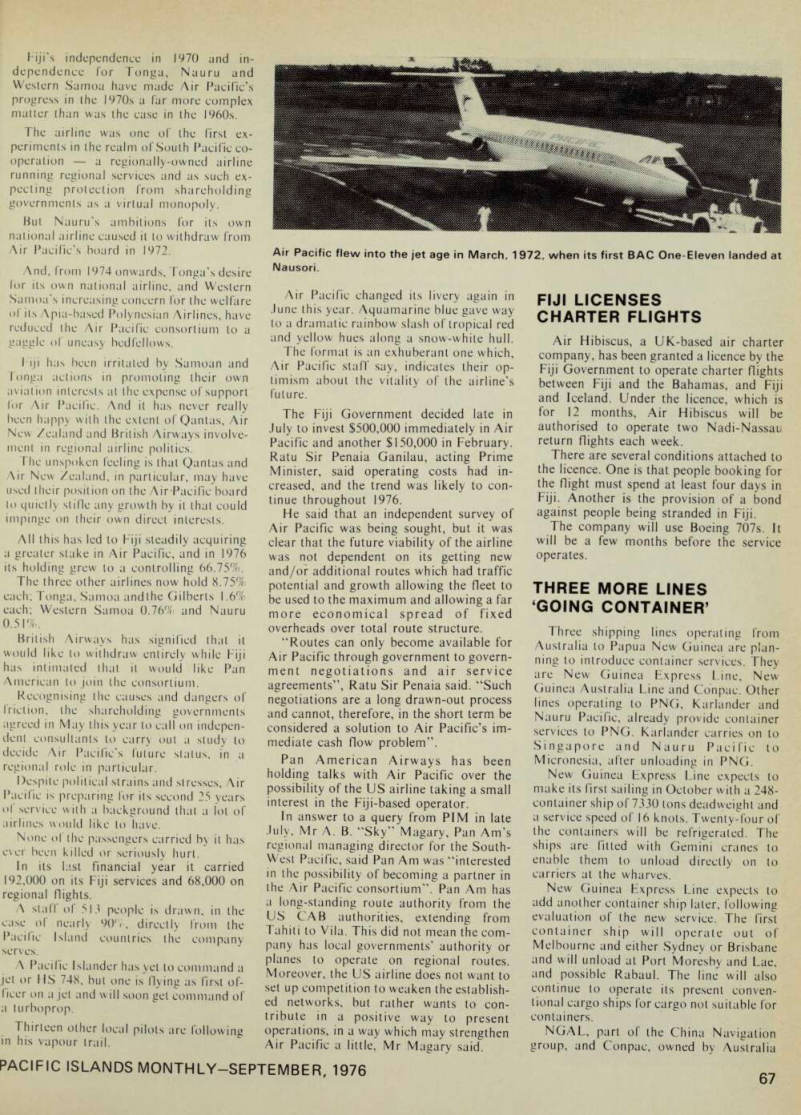
Air Pacific flew into the jet age in March, 1972, when its first BAC One-Eleven landed at Nausori.
West Pacific Line and Burns Philp, will charter two container ships, which are now being built in Japan by Miko Shipyard Co Ltd, Tokyo, for a Swire company. They will operate the ships, which will cost about $5 million each, as a joint venture.
The first ship is expected to go into service about July, 1977, and the second about two months later.
Each ship will carry 320 containers (20 ft x 8 ft x 8 ft). There will be 40 refrigerated containers on each voyage.
The overall investment in the two ships will be about $2O million. The $5 million cost of each ship does not include transverse gantry cranes, containers and other equip ment required for container ships. It will be necessary to have 960 containers for each ship 320 being loaded in Australia while the ships are in transit and carrying 320, and 320 at Port Moresby and Lae be ing unloaded and awaiting return to Australia.
The NGAL-Conpac ships will operate from Sydney and Brisbane. Conpac is almost certain to withdraw the Nimos, and NGAL could withdraw one of the three ships at present on the service. However, conventional cargo ships will still be re quired to operate from Melbourne, and to serve PNG ports, other than Port Moresby, and Lae and also the Solomons.
It is possible another container ship will be ordered to replace a conventional cargo
ship operating out of Melbourne.
However, that move is unlikely before there is a complete assessment of the con tainer services.
The container ships are being introduced in an effort to contain costs, and stop them rising as sharply as they have in the last two or three years.
Unloading the container ships at Port Moresby may present some technical problems because of lack of space for big vehicles to manoeuvre easily. Lae and Rabaul are well-equipped to handle con tainer ships.
Dock Strike
Threatened In Png
The Central District Waterside Workers’ Union in Papua New Guinea threatened to stop work early in August unless Steamships Trading Co recon sidered a decision to suspend three members of the union. The union secretary, Mr R. McAlister, said the com pany had one to two weeks to reconsider its decision. He claimed Steamships Trading had refused to carry out a decision of a Department of Labour officer, who recommended the three men be reinstated.
The award, handed down recently, provid ed that a suspension be investigated by an officer of the department, and that on his recommendation a worker be reinstated or dismissed.
More Talk About
A Regional Airline
The South Pacific Air Transport Coun cil, meeting recently in Suva, agreed that South Pacific air routes should be rationalised, but will Nauru, Western Samoa and Tonga go along with the idea?
Papua New Guinea’s Transport Minister, Mr Bruce Jephcott, simply summed up the case for rationalisation the South Pacific region did not have enough people or cargo for intensive competition.
The council discussed the possibility ol setting up a single regional airline for the South Pacific and the possibility of stan dardising aircraft and facilities. But against that ideal this sort of thing is going on: • South Pacific Airways, of American Samoa, is seeking rights for a direct link between Vavau and Pago Pago; • Polynesian Airlines, encouraged by Tonga, is pushing for a service to New Zealand, via Tonga, which would compete on the Tonga-Auckland “leg” with Air Pacific; • Air Nauru, with a fleet of four jet aircraft is operating an extensive network in the Pacific, but competition with Air Pacific is minimal; • The Cook Islands, after initial qualms, wants to get into the South Pacific
network through Polynesian Airlines ser vices from Western Samoa and Niue to Rarotonga.
But Polynesian Airlines has run into a snag over rights in New Zealand. High level talks between civil aviation officials from New Zealand and Western Samoa were held recently to discuss technical issues rising from a NZ National Airways Corporation report on a proposal to ex pand Polynesian Airlines.
Figures showed that in the last six years, traffic between Pago Pago and Auckland comprised mainly people from Western Samoa, carried by Air New Zealand or
Paa.
South Pacific Island Airways of American Samoa is after a two-flights-a week service from Pago Pago to Vavau and then to Nukualofa, using a Cessna air craft, equipped to carry seven passengers.
Mr George Wray, president of SPIA, recently went to Tonga to discuss the proposed service with King Taufa’ahau
Tupou.
Mr Jephcott’s comments were highly relevant, for Air Niugini, while having a few troubles itself, does not compete with other airlines in the Islands, although in time it may seek to extend its services.
Air Niugini will soon have to decide whether to continue its “wet lease” charter of a Boeing 7208 from Tempair for its in ternational services. The lease is due to ex pire in February, 1977, but PNG has to give the airline six months notice of renewal or termination. Air Niugini has had informal talks with Qantas about buy ing a Boeing 707. Qantas is phasing out its 707 s in favour of the larger jumbo 7475.
Air Niugini also, recently, dispensed with the services of its Sydney-based advertising agent, Hansen Rubensohn- McCann Erickson Pty Ltd. It was a K 250,000 annual account. A spokesman for Air Niugini said the airline was not satisfied with the agency which previously held the account. Air Niugini will expand its public relations staff to take advertising
responsibility.
Jal Offers
Planes To Tonga
King Taufa’ahau Tupou, of Tonga, is again flirting with Japan Airlines. He said late in July that Mr Manichi Matsumoto, a prominent Japanese businessman, told him it would be beneficial to Japan Airlines and to Tonga to have two DC9s readily available to cater for the demands of Japanese tourists wishing to get from Fiji to Tonga.
Japan Airlines intended to resume a jumbo jet service for tourists into Fiji in September. Many of those tourists were expected to visit Tonga. The king said Mr Matsumoto told him the airline company
would provide four pilots, as well as a team of mechanics and stewardesses to serve the operations in Tonga. The airline would train Tongan hostesses to take over from the Japanese.
The king also said Mr Matsumoto had made a special trip to Tonga to tell him of Japan Air Lines’ offer. The airline was prepared to provide prefabricated buildings to accommodate the Japanese pilots, mechanics and stewardesses. It was interested in building a new hotel either in Pelehake or on Fua’amotu beach to cater for the demand for accommodation.
Fiji's Prime Minister, Ratu Sir Kamisese Mara, commenting on the suggestion, said he was “puzzled” that Japan Air Lines thought two DC9s, each with 100-seat capacity, could operate economically between Fiji and Tonga. He said Fiji would have to examine the ques tion of landing rights at Nadi and Suva if the proposal went ahead. Fiji had a “gentlemen’s agreement” with Tonga about landing rights. A regular tourist shuttle between Fiji and Tonga would take business away from the struggling Air Pacific.