a blessing or a death trap?
pp. 49-55 · Read in the full issue


Business
Fiji’s new road - a boon and a blessing or a death trap?
From ROBERT KEITH-REID in Suva.
Veteran Fiji motorists can summon up enough tales between them to tell for every bend in the 130 mile (209 km) long gravel terror trail linking Suva and Nadi that masquerades under the title of Queens Road. “That’s where I hit the cow,” one might say. “Here’s where I collected a chicken.”
“Say, a cane train nearly wiped me there. And I spent a night stranded here with a busted axle.”
“Three dead on this corner,” another could recall. “They were in a taxi which rammed a truck.”
Many of these memories are fading for good now as the landmarks that trigger them are erased by the advent of what, by Fiji standards, is a positive super-way. By the end of this year a 71 km bitumen rib bon, much of it already in use, should be carrying traffic between Nadi and
Sigatoka.
If the contractors are lucky they are already well behind schedule a similar 45 km long stretch should be open between Suva and Deuba by the end of next year.
About 81 km of the original horror will remain between Deuba and Sigatoka for some years yet, to be cursed by travellers as a relic of a slight bit of cost
underestimating.
It will be rebuilt at the leisure of the Fiji Public Works Department and ultimately :ompleted, many years after the departure af the three companies now labouring to finish the first two sections.
The labouring began three years ago ifter a decade of agitation for it, mostly from the Fiji tourist industry. Hotel and our companies envisaged that a sealed lighway would whop up profits by bring ng drastic cuts in vehicle-operating costs ind eliminating the loss of business caused ay customers vowing never to rebook for he adventure of riding the Queens Road lotel trail.
Naturally, the government’s decision to ebuild the road drew criticism that it was vrong to spend so much on giving tourists i smooth ride when many other parts of he country had no roads at all.
The government answer was that to :laim that the new road would benefit only
tourism was “nonsense”. Calculations were produced to show that a sealed road would cut wear and tear on vehicles, and fuel consumption to the tune of around $BOO,OOO a year in reduced spare-part and
fuel-import costs.
And a highway was bound, it added, to stimulate general agricultural, industrial, commercial, recreational and residential development in the areas it passed
through.
The World Bank agreed and put up $lO million of the $13,777,000 that British
engineering consultants estimated that the Nadi-Sigatoka and Suva-Deuba sections would cost to reconstruct. Came January, 1972, and a horrid shock for the govern ment when tenders were opened; the lowest was $26 million and the highest $37 million.
The next 12 months saw frantic efforts to bring the price down and raise more finance.
A contract finally went to a consortium which the Australian subsidiary of Hawaii’s Dillingham Corporation formed
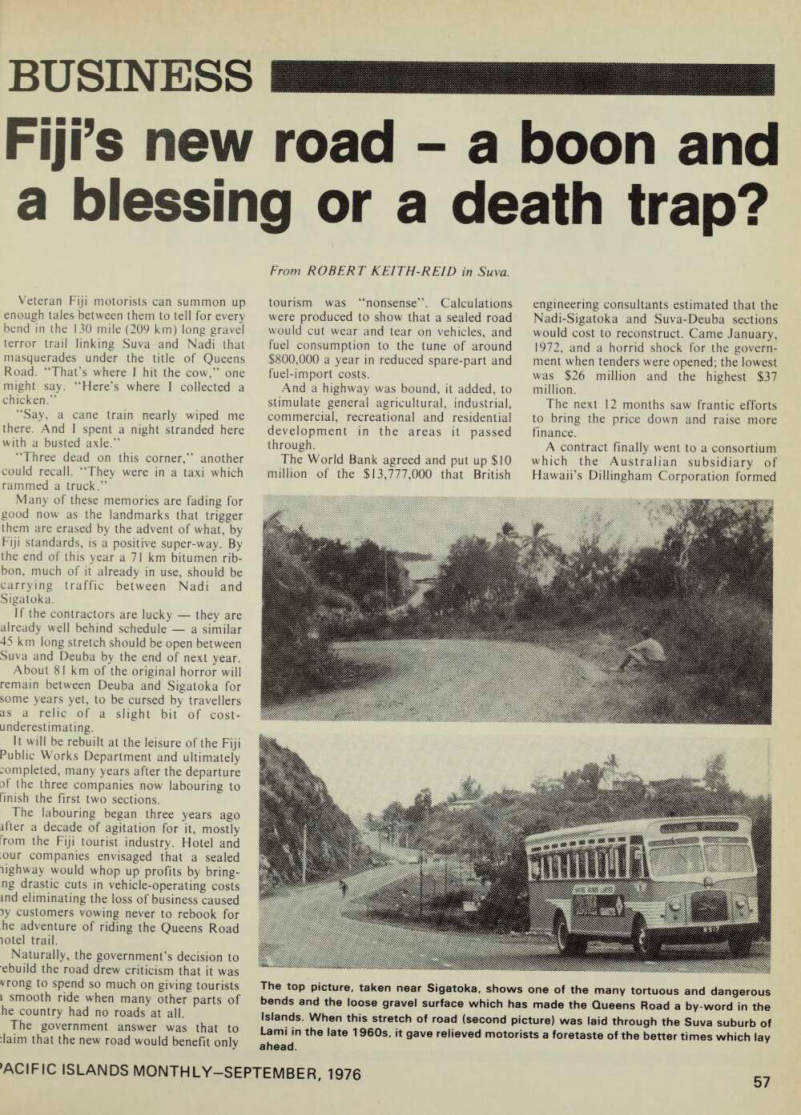
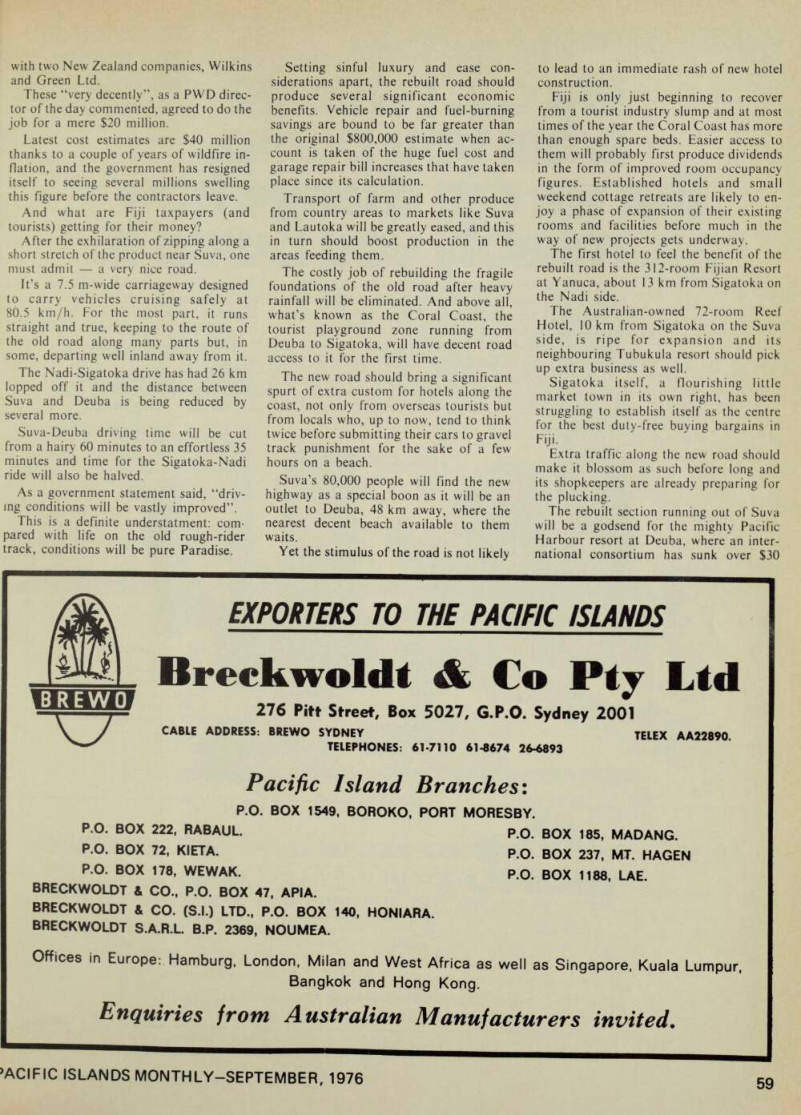
The top picture, taken near Sigatoka, shows one of the many tortuous and dangerous bends and the loose gravel surface which has made the Queens Road a by-word in the Islands. When this stretch of road (second picture) was laid through the Suva suburb of Lami in the late 1960s, it gave relieved motorists a foretaste of the better times which lay ahead.
with two New Zealand companies, Wilkins and Green Ltd.
These “very decently”, as a PWD direc tor of the day commented, agreed to do the job for a mere $2O million.
Latest cost estimates are $4O million thanks to a couple of years of wildfire in flation, and the government has resigned itself to seeing several millions swelling this figure before the contractors leave.
And what are Fiji taxpayers (and tourists) getting for their money?
After the exhilaration of zipping along a short stretch of the product near Suva, one must admit a very nice road.
It’s a 7.5 m-wide carriageway designed to carry vehicles cruising safely at 80.5 km/h. For the most part, it runs straight and true, keeping to the route of the old road along many parts but, in some, departing well inland away from it.
The Nadi-Sigatoka drive has had 26 km lopped off it and the distance between Suva and Deuba is being reduced by several more.
Suva-Deuba driving time will be cut from a hairy 60 minutes to an effortless 35 minutes and time for the Sigatoka-Nadi ride will also be halved.
As a government statement said, “driv ing conditions will be vastly improved”.
This is a definite understatment: com pared with life on the old rough-rider track, conditions will be pure Paradise.
Setting sinful luxury and ease con siderations apart, the rebuilt road should produce several significant economic benefits. Vehicle repair and fuel-burning savings are bound to be far greater than the original $BOO,OOO estimate when ac count is taken of the huge fuel cost and garage repair bill increases that have taken place since its calculation.
Transport of farm and other produce from country areas to markets like Suva and Lautoka will be greatly eased, and this in turn should boost production in the areas feeding them.
The costly job of rebuilding the fragile foundations of the old road after heavy rainfall will be eliminated. And above all, what’s known as the Coral Coast, the tourist playground zone running from Deuba to Sigatoka, will have decent road access to it for the first time.
The new road should bring a significant spurt of extra custom for hotels along the coast, not only from overseas tourists but from locals who, up to now, tend to think twice before submitting their cars to gravel track punishment for the sake of a few hours on a beach.
Suva’s 80,000 people will find the new highway as a special boon as it will be an outlet to Deuba, 48 km away, where the nearest decent beach available to them waits.
Yet the stimulus of the road is not likely
to lead to an immediate rash of new hotel construction.
Fiji is only just beginning to recover from a tourist industry slump and at most times of the year the Coral Coast has more than enough spare beds. Easier access to them will probably first produce dividends in the form of improved room occupancy figures. Established hotels and small weekend cottage retreats are likely to en joy a phase of expansion of their existing rooms and facilities before much in the way of new projects gets underway.
The first hotel to feel the benefit of the rebuilt road is the 312-room Fijian Resort at Yanuca, about 13 km from Sigatoka on the Nadi side.
The Australian-owned 72-room Reef Flotel, 10 km from Sigatoka on the Suva side, is ripe for expansion and its neighbouring Tubukula resort should pick up extra business as well.
Sigatoka itself, a flourishing little market town in its own right, has been struggling to establish itself as the centre for the best duty-free buying bargains in Fiji.
Extra traffic along the new road should make it blossom as such before long and its shopkeepers are already preparing for
the plucking.
The rebuilt section running out of Suva will be a godsend for the mighty Pacific Harbour resort at Deuba, where an inter national consortium has sunk over $3O
million into creating a hotel-villa-golf complex that needs a lot more customers if it’s to become viable.
The decision to defer the reconstruction of the central sections technically the most difficult bit of country along the Queens Road route has left one of Fiji’s best known beach resorts and the first Korolevu, and some of its immediate neighbours out in the dust.
They are about 32 km from either end of the sealed sections and it will be at least five years before the new highway flows past them.
Nevertheless, they are bound to draw extra business from the wave of increased business which the first two sections will generate along the road’s entire length.
The new road will not be a blessing en tirely.
Accustomed to dirt track driving, few Fiji motorists are educated in the different attitudes needed for safe steering along a modern highway.
As the perils of the old Queens Road have not deterred many of them from striving for the Suva-Nadi record, traffic
authorities, recalling some appalling
crack-ups, are shuddering at the thought of what some grand prix aspirants will do when they are let loose on the new road.
Fiji’s police force has mentioned that it is thinking of instituting a highway patrol but has not yet disclosed what it has in mind.
But radar speed traps are bound to be part of the patrol’s equipment and as the absolute speed limit for travel on any Fiji road is 112 km/h there’s not much doubt that traffic courts will be kept busy.
The new road’s construction has not eliminated all the hazards that make travel on the old one an adventure. Blind corners, hairpin bends, and suicide gradients might be going but cattle, pigs, poultry and goats will still wander at will out of villages and settlements along the road. The higher speeds that cars will be reaching will make jaywalking livestock an even greater hazard than before.
And what about the village children?
Safety drill should become an integral part of the curriculum in schools along the way.
Higher speeds could also increase the likelihood of catastrophes between Sigatoka and Nadi at points where sugar cane locomotives drag their 100 metre long line of loaded trucks across the road on the way to Lautoka mill.
Carpenter’s big
spending in Fiji
W. R. Carpenter (South Pacific) Ltd is putting its money where its mouth is in a practical demonstration of the oft repeated
phrase, “Faith in Fiji”. The managing director, Mr Lyle Cupit, recently an nounced a $3.5 million programme for in
dustrial expansion involving shipyard and
ship repair facilities ($1.9 million), heavy
earthmoving equipment sales and servicing
centre ($770,000), erection of a silo for the copra mill ($265,000), and a new showroom and service centre for Suva Motors at Walu Bay ($600,000).
No one will regret the removal of the Suva Motors complex from Victoria Parade to the industrial area. With Suva developing as rapidly as it is there is a de mand for more commercial premises closer to the heart of the city. The Suva Motors office and showroom in Victoria Parade have been acquired by an overseas property developer.
Mr Cupit, announcing the expansion,
said that although the Fiji economy was still burdened with problems of recession, that did not mean commerce should stand still. Carpenters believed Fiji’s economic prospects were good and that commerce could tailor its growth to help meet
development goals.
He said the shipyard would be
dramatically transformed by the installa- r
tion of a syncrolift dry dock system. That' would enable the shipyard to repair as many as 200 ships a year. At present it could handle 50. Ships up to 330 tons
would be lifted from the water by the syn crolift, and transported by rail trolley to the repair areas. The syncrolift would also be used to launch new ships.
The main repair customers will be Japanese, Korean and Taiwanese who operate fishing ships.
The industrial subdivision will be transferred from Walu Bay in Suva to a bigger sales and service centre at Raiwai.
The company expects an expansion of its heavy earth-moving equipment for such projects as the development of the Seaqaqa sugar project, the Nadrau hydro-electricity scheme and forestry plantations.
Tonga’s bank
is doing well
In its first full year of trading, in 1975, the Bank of Tonga earned a net profit of P 373,491. The net profit for the first six months of operation, to December 31, 1974, was P 98,639. The chairman, Mr E.
C. Tait, said the most pleasing feature about the excellent 1975 result was that it was obtained from banking business formerly conducted outside the kingdom.
The Bank of Tonga was now established and providing modern banking facilities for Tonga. The profits were retained in Tonga. In turn, that helped to build up the bank’s strength for the people’s benefit.
The bank now has general reserves of P 325,000 and is building up to a position of solid strength. • Fiji will build a medical training ship with part of a grant of $BOO,OOO from the United Nations Fund for Population Ac tivities. The ship will be used primarily for training medical workers, carrying
teaching and training equipment and
carrying medical staff.