Tropicalities
pp. 42-45 · Read in the full issue

A Yankee Odyssey: The Islands
Through A 'Green' Hand's Eyes
By Thomas Starr Terrill
On a line day in May, 1844, the whaling vessel Pocahontas hoisted sail. Departing the USA’s northeast coast, manned by a crew that included many “green” hands, she set a course that would eventually take her round the Cape of Good Hope to New Holland (Australia), Van Diemen’s Land (Tasmania), Olahila (Tahiti), and New Zealand. She would return in two years and two months.
One of the “greenies” in the crew was an 18-year-old North American named Charles La Fayette Brown. A native of the Stale of Vermont, thus a “Yankee”, his fortunate (for us) habit of writing down what he saw and thought makes it possible, some 130 years later, to “see” much of the South Pacific as he found it.
Pocahontas dropped anchor off Otahita in the Spring of 1845, remained there several weeks, and gave Brown “a good
opportunity for learning considerable
about those people.”
Bearing the name “La Fayette”, Brown might be expected, logically, to be sym pathetic toward the French, who physically occupied Tahiti the previous year.
Not so; Brown wrote, “What is the state of that once-beauliful valley facing the fine bay of Otahita? It is sadly changed from its natural beauty; the fine fruit trees have been levelled to the ground; and in their places French houses, barracks, and prison stand. The favourite spot where they were to hold their jubilees and “hooloohooloos” is converted into prison‘ground; and where the bread-fruit tree flourished, forts and
palaces stand.
“Otahita can never return to her original beauty and grandeur; no more will the friendly ‘hooloohooloos’ sound as of yore; no more will the chiefs and warriors meet in solemn and sacred counsel, as they formerly did. Queen Pomare will never tread her once-favourite home again, for the French Governor caused it to be levell ed to the ground to make a place to erect a palace for his august person to reside in.
“I spent many hours on that fair island; for it was certainly refreshing after so long a siege on shipboard to roam amid the orange groves, to feast upon the rich fruits,
which grow so spontaneously o’er hill and dale.
“We visited several of the Society Islands, and always found the natives of the most friendly disposition. The natives generally are quite good-looking, of a light copper colour. Most of them wear articles of foreign clothing; and some still wear nothing but the native tapa manufactured from the bark of trees.”
Upon leaving the Societies, Pocahontas made for whaling water to the north of New Zealand, but somewhere along the way. Brown felt compelled to write something about the “Pitcarians.” (Pit cairners) “It is astonishing to see so happy a com munity as the Pitcarians are. I believe there is not a person living on that Island who is not a Christian. We may search in vain for another community like this. A few years since, most of them moved to Norfolk Island (ceded to them by the English Government) to the northwest of New Zealand; but it did not suit them so well as their native one did; and they mourned for their original home so much that they went back to Pitcairn Island (as they say) to live and die there.
"I once had the pleasure of passing a Christmas among that interesting people, and it was a day most devotedly and con sistently passed that it has been my pleasure to witness. The Pitcarians seem to imbibe some of His spirit; yes, very much of it on that sacred day.”
In February, 1846, the whaler was pointed in the direction of the Bay of Islands, “a harbour on the NE coast of New Zealand”. Finding it blockaded by “several English men-of-war,” Pocahontas made for Auckland, where Brown learned more about the situation at the Bay of Islands: “The natives thought the English were encroaching on their rights, taking their land, etc. The natives, taking advan tage of the occasion, concentrated their forces at the Bay of Islands, built a fort or ‘pa’ as they term it, and made every preparation in their power to give the English a warm reception, and from what I could learn, did it.
“It is true that the natives had the ad vantage, for they were well-sheltered by a fort built of wood, stone, and mud, which answered their purpose very well.
“The first battle lasted about seven minutes, the English losing 130 soldiers in the affray besides a large number of
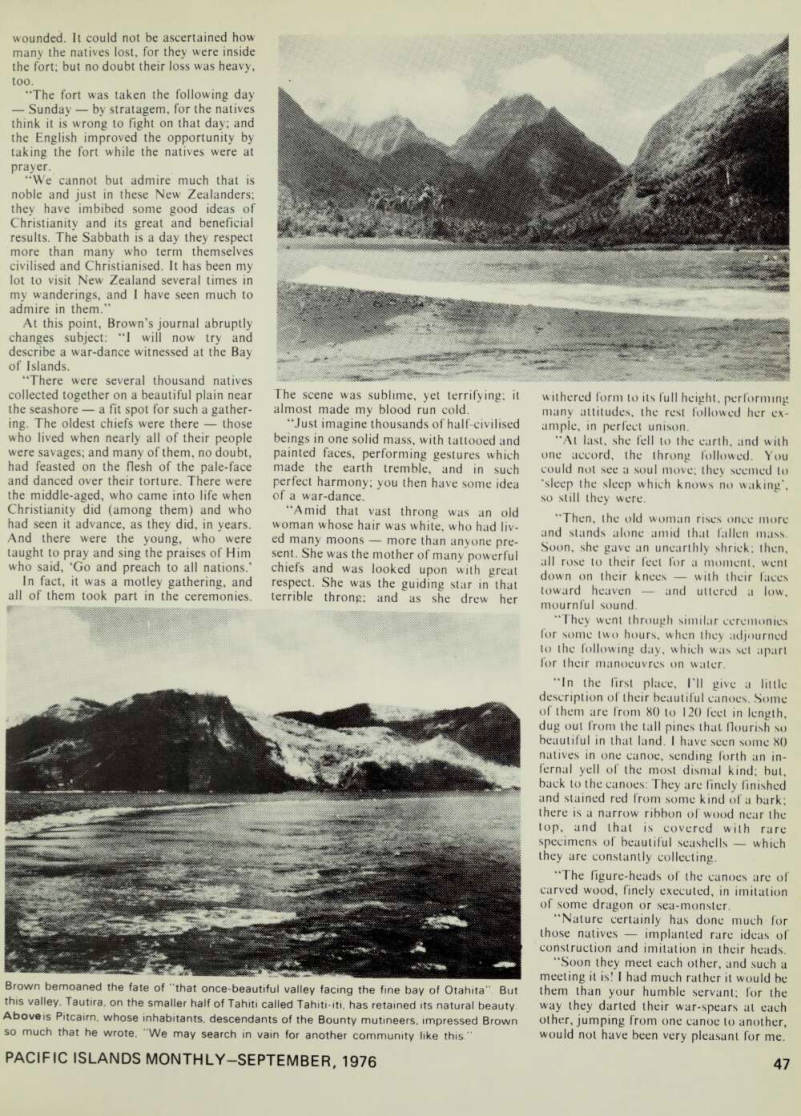
Left. Queen Pomare. who reigned for 50 years and her son. Pomare V, the last monarch of Tahiti who succeeded his mother on her death in 1877. He reigned only three years before, un der great pressure, and on certain conditions, he yielded his throne to France.
wounded. It could not be ascertained how many the natives lost, for they were inside the fort; but no doubt their loss was heavy, too.
“The fort was taken the following day Sunday by stratagem, for the natives think it is wrong to fight on that day; and the English improved the opportunity by taking the fort while the natives were at prayer.
“We cannot but admire much that is noble and just in these New Zealanders; they have imbibed some good ideas of Christianity and its great and beneficial results. The Sabbath is a day they respect more than many who term themselves civilised and Christianised. It has been my lot to visit New Zealand several times in my wanderings, and I have seen much to admire in them.”
At this point, Brown’s journal abruptly changes subject: “I will now try and describe a war-dance witnessed at the Bay of Islands.
“There were several thousand natives collected together on a beautiful plain near the seashore a fit spot for such a gather ing. The oldest chiefs were there those who lived when nearly all of their people were savages; and many of them, no doubt, had feasted on the flesh of the pale-face and danced over their torture. There were the middle-aged, who came into life when Christianity did (among them) and who had seen it advance, as they did, in years.
And there were the young, who were taught to pray and sing the praises of Him who said, ‘Go and preach to all nations.’
In fact, it was a motley gathering, and all of them took part in the ceremonies.
The scene was sublime, yet terrifying; it almost made my blood run cold.
“Just imagine thousands of half-civilised beings in one solid mass, with tattooed and painted faces, performing gestures which made the earth tremble, and in such perfect harmony; you then have some idea of a war-dance.
“Amid that vast throng was an old woman whose hair was white, who had liv ed many moons more than anyone pre sent. She was the mother of many powerful chiefs and was looked upon with great respect. She was the guiding star in that terrible throng; and as she drew her
withered form to its full height, performing muny altitudes, the rest followed her ex
ample, in perfect unison.
“At last, she fell to the earth, and with one accord, the throng followed. You could not see a soul move; they seemed to ‘sleep the sleep which knows no waking', so still they were.
“Then, the old woman rises once more and stands alone amid that fallen mass.
Soon, she gave an unearthly shriek; then, all rose to their feel for a moment, went down on their knees with their faces toward heaven and uttered a low, mournful sound.
“They went through similar ceremonies for some two hours, when they adjourned to the following day, which was set apart for their manoeuvres on water.
“In the first place. I'll give a little description of their beautiful canoes. Some of them are from 80 to 120 feet in length, dug out from the tall pines that flourish so beautiful in that land. I have seen some 80 natives in one canoe, sending forth an in fernal yell of the most dismal kind; but, back to the canoes: They are finely finished and stained red from some kind of a bark; there is a narrow ribbon of wood near the lop, and that is covered with rare specimens of beautiful seashells which
they are constantly collecting.
“The figure-heads of the canoes are of carved wood, finely executed, in imitation of some dragon or sea-monster.
“Nature certainly has done much for those natives implanted rare ideas of construction and imitation in their heads.
“Soon they meet each other, and such a meeting it is! I had much rather it would be them than your humble servant; for the way they darted their war-spears at each other, jumping from one canoe to another, would not have been very pleasant for me.
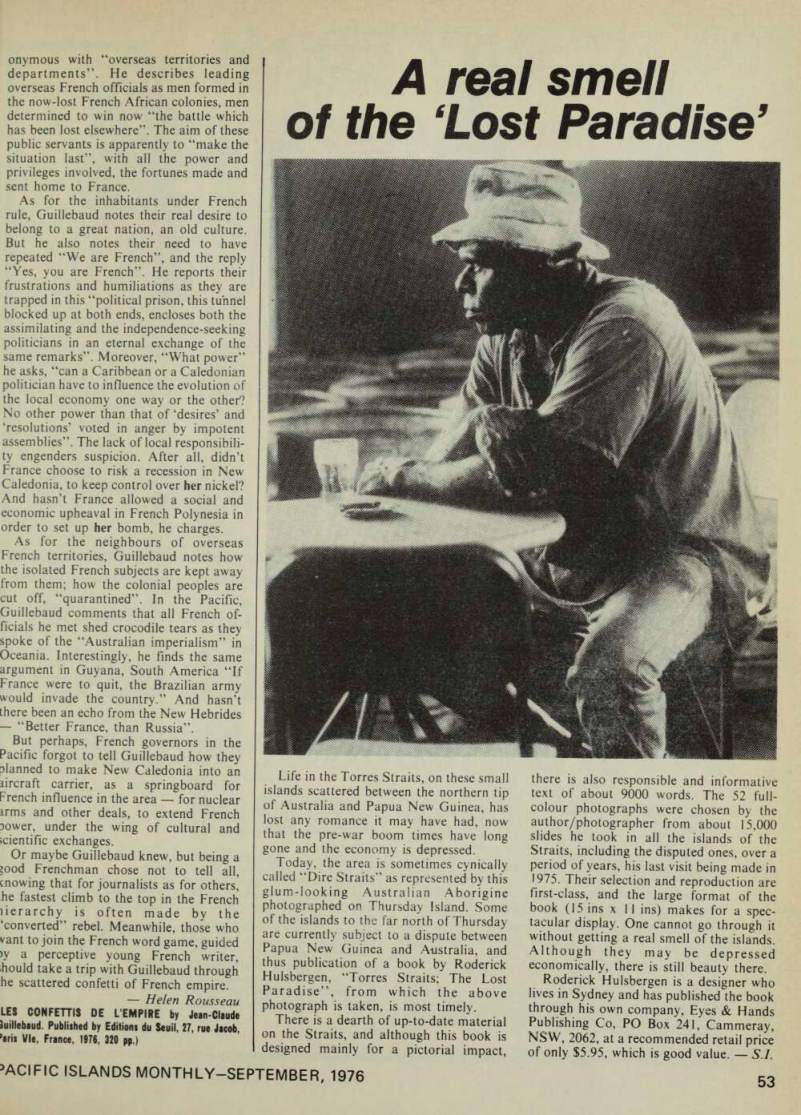
Brown bemoaned the fate of that once-beautiful valley facing the fine bay of Otahita But this valley, Tautira, on the smaller half of Tahiti called Tahiti-iti, has retained its natural beauty Aboveis Pitcairn, whose inhabitants, descendants of the Bounty mutineers, impressed Brown so much that he wrote. "We may search in vain for another community like this "
onymous with “overseas territories and
departments”. He describes leading
overseas French officials as men formed in the now-lost French African colonies, men determined to win now “the battle which has been lost elsewhere”. The aim of these public servants is apparently to “make the situation last”, with all the power and privileges involved, the fortunes made and sent home to France.
As for the inhabitants under French rule, Guillebaud notes their real desire to belong to a great nation, an old culture.
But he also notes their need to have repeated “We are French”, and the reply “Yes, you are French”. He reports their frustrations and humiliations as they are trapped in this “political prison, this tunnel blocked up at both ends, encloses both the
assimilating and the independence-seeking
politicians in an eternal exchange of the same remarks”. Moreover, “What power” he asks, “can a Caribbean or a Caledonian politician have to influence the evolution of the local economy one way or the other?
No other power than that of ‘desires’ and ‘resolutions’ voted in anger by impotent assemblies”. The lack of local responsibili ty engenders suspicion. After all, didn’t France choose to risk a recession in New Caledonia, to keep control over her nickel?
And hasn’t France allowed a social and economic upheaval in French Polynesia in order to set up her bomb, he charges.
As for the neighbours of overseas French territories, Guillebaud notes how the isolated French subjects are kept away from them; how the colonial peoples are cut off, “quarantined”. In the Pacific, Guillebaud comments that all French of ficials he met shed crocodile tears as they spoke of the “Australian imperialism” in Oceania. Interestingly, he finds the same argument in Guyana, South America “If France were to quit, the Brazilian army would invade the country.” And hasn’t there been an echo from the New Hebrides “Better France, than Russia”.
But perhaps, French governors in the Pacific forgot to tell Guillebaud how they planned to make New Caledonia into an aircraft carrier, as a springboard for French influence in the area for nuclear arms and other deals, to extend French Dower, under the wing of cultural and
scientific exchanges.
Or maybe Guillebaud knew, but being a »ood Frenchman chose not to tell all, mowing that for journalists as for others, he fastest climb to the top in the French lierarchy is often made by the ‘converted” rebel. Meanwhile, those who vant to join the French word game, guided )y a perceptive young French writer, hould take a trip with Guillebaud through he scattered confetti of French empire.
Helen Rousseau
LEB CONFETTIS DE LEMPI RE by Jean-Claude iuillebaud. Published by Editions du Seuil, 27, rue Jacob, •aril Vie, France, 1976, 320 pp.)