Tropicalities
pp. 24-27 · Read in the full issue

Head tax
on science
survey
A Papua New Guinea government of ficer is demanding K. 500 a head from a team of US students planning to study marine life on the island of Wuvulu, 200 miles out to sea from Wewak.
He wants the money to go to the local council on the island “as some payment from people who use the island to promote their own reputation”.
Angry organisers of the expedition “we are scientific investigators, not tourists” may have to cancel the visit because they can’t foot the bill.
The US Embassy in Port Moresby was investigating the situation at the end of Ju ly, and considering an approach to the PNG Government for a ruling on the
legality of the charge.
The man in the centre of the controversy is Mr Tony Bais, the Provincial Com missioner at Wewak on the north coast of the PNG mainland. As a provincial com missioner Mr Bais has wide powers delegated by the government to deal with
on-the-spot matters.
A group of 41 doctors, lecturers and students from Pepperdine University in Los Angeles planned to make their third visit shortly to Wuvulu.
But Mr Bais put his foot down and said that, from now on, he intended to charge K5OO a head “assistance” fee from members of expeditions coming into his province, The East Sepil, home province of the Prime Minister, Mr Somare, and a target of many cultural and scientific ex
peditions.
Mr Bais said that too many people were coming into the area and studying the peo ple and places purely to promote their own reputations. They left the people of the area without any benefit.
Mr Bais said his proposed fee would help the local people to finance many
urgently-needed projects.
The organiser of the expedition, Mr Francois Brenot, said the university was a non-profit organisation and that the students paid $2OOO each to join the ex pedition. They couldn’t afford any more.
Mr Brenot claimed that the expeditions
promoted cultural links between the two countries, that the students became “great ambassadors” for PNG, and that the ex peditions paid fully for all services and
supplies.
The Yanks: in
loving memory
Plans are unfolding in Noumea to con struct a World War II memorial at Nouville, the former island in Noumea harbour now attached to the mainland by a causeway. The memorial, to com memorate America’s role in wartime New Caledonia, has long been talked of by the Caledonians, who remember with great fondness and admiration the American servicemen who defended the island and dramatically introduced modern transport and communications.
The French authorities have been slow to encourage the memorial project.
However, de Gaulle’s wartime leadership of the Free French has been com memorated by the large Cross of Lorraine, built on top of Mt Coffyn two years ago.
Now the scale model of a memorial for Nouville has been released, together with plans to build a museum nearby. This could exhibit American wartime relics and thus act as an attraction for US tourists and others interested in retracing New Caledonia’s role in the Pacific War.
When money
is a nuisance
Mr Matiabe Yuwi, a cheerful political extrovert, is worried about the size ol Papua New Guinea’s biggest coin, the kina. After eight years in parliament, most of them in opposition, Mr Yuwi has something of a reputation for the olf-beat nature of causes he champions.
His latest complaint to parliament is that the one-kina coin is too big, too heavy and too much of a nuisance.
It’s wearing holes in his constituents’ pockets, he believes.
The kina is nearly 35mm in diameter, it shows a picture of two crocodiles, and its value is a shade over the value of the Australian dollar. It was introduced 16
months ago when PNG began phasing out Australian coins and notes.
My Yuwi told Finance Minister Mr Julius Chan that a recent currency revalua tion “was all very well, but the kina is too heavy already”.
He also claimed that the l()-kina note, the highest denomination on issue, had too low a value for people who carried large sums of money. (He didn’t confide to parliament whether this was a problem affecting only politicians, or whether it was affecting their constituents as well.) Mr Chan told Mr Yuwi the government had no intention of getting rid of the one kina coin, or of changing it, and a 20-kina note was due for issue later this year, probably in November.
Come in
Curry Pot
There are a few jokes Hying around Vila and district over the new livery adopted by Air Melanesiae a dazzling signal yellow and sunset gold.
Most people are puzzled over the choice of colour though some suggest it might be for safety reasons. If, unfortunately, there was a ditching in the drink, the plane would be spotted with ease. The Islander now carries the nickname of the Curry Pot
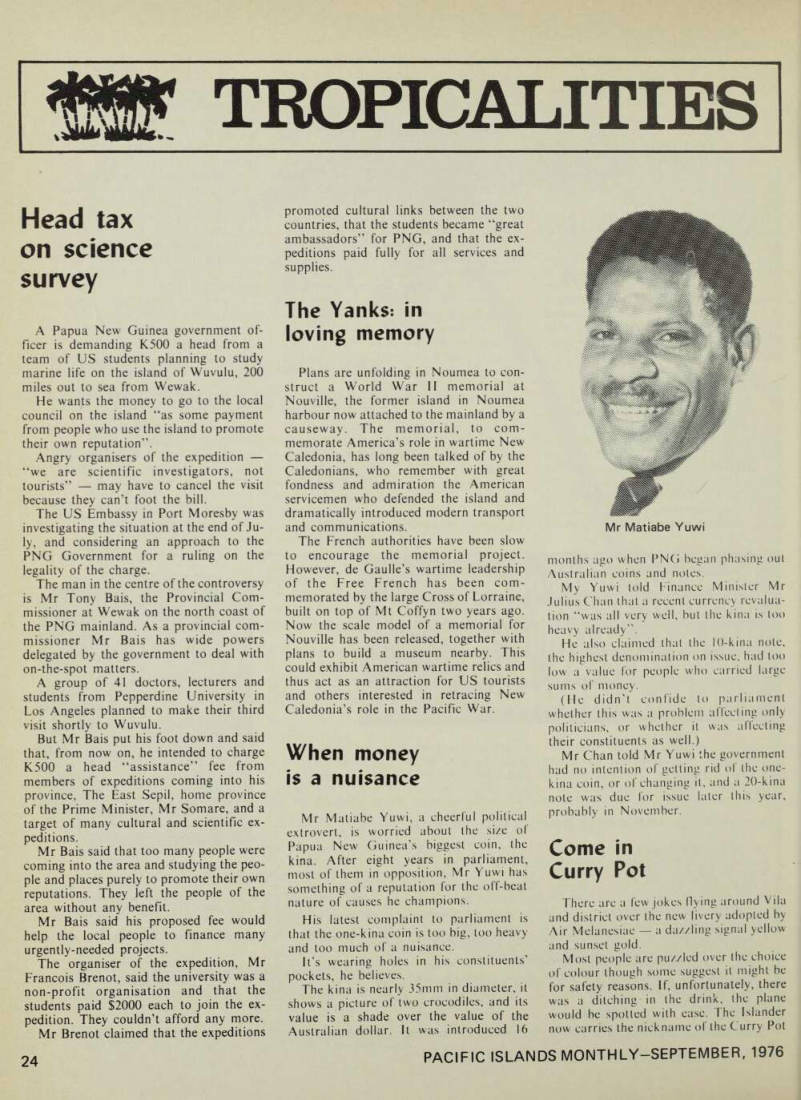
Mr Matiabe Yuwi
and some wags have named the airline Chunderous Airlines.
Even Air Traffic Control thinks it’s fun ny. They’ve been heard to address the air craft with “Foxlrot-exray-canary” after someone asked over the radio, on ap proach to land, “Does it tweet?”.
But, all is not well with Air Melanesiae which is experiencing an internal power struggle over which some of the pilots are unhappy. UTA has taken over the management from Qanlas and installed a frenchman as manager. Some of the Australian pilots have resigned.
Some Fiji
unsinkables
Some men from Fiji are bidding to rival the Gilbertese in surviving ordeals at sea.
In separate cases recently, three out of four men got ashore to safety after being in the water for 12 to 49 hours, and six Suva fishermen drifted helplessly for eight days on the high seas between Fiji and the New Hebrides before they were rescued.
Sam Smith, 18, his father Joe, Josefa Cama and Esala Luvunakoro were in a boat about 30 miles off Suva when it holed and overturned. Joe Smith, after a 12-hour swim, struggled ashore on Beqa Island and raised the alarm. Josefa was in the water for 24 hours when he was picked out of the sea by the crew of a game fishing boat from Pacific Harbour. Sam, after clinging to the overturned boat with Josefa for 19 hours, set off for land, using an empty oil drum as a float.
Thirty hours, later he struggled ashore on Stuart Island. Next day he was able to attract the attention of people at Lawaki, about three miles away on Beqa Island. He was rescued by punt. Esala disappeared while trying to swim to Beqa with Joe Smith.
Six Suva fishermen left in a 30 ft launch, the C 914, to fish in Bligh Water. The launch was previously a source of trouble.
In 12 months the group had to be rescued seven times because the launch broke down. In rough seas, in the latest incident, they were driven to the outer Yasawas and after anchoring, the launch broke its moor ing and drifted on to rocks. The men towed it to sea, and then, using sails made from blankets they were able to keep away from rocks and a reef.
But strong winds blew the sails away and hey drifted at the mercy of the winds and current for eight days before being picked jp by the crew of a tug, the Tui Tawake, vhich already had another tug, the Palmar, in tow. Their launch was also aken in tow, but was later cut adrift in :ase it sank during darkness and en langered the tugs. The tug took the men to santo in the New Hebrides. Later they lew back to Suva, keen to build another
"ishing boat.
Dog’s life of a
college principal
Fiji residents can take up with great venom the telling of tales about packs of
wandering dogs, of the havoc they
perpetrate and the difficulties of dealing with them. In general the presence of offending packs should be drawn to the notice of the police, who will assume the responsibility of laying poison baits and disposing of the corpses.
Apropos of this and the doggy tale in the August PIM (p 23), there was a large college where the expatriate principal thought that the processes of red tape were too cumbersome and that he should con duct his own secret campaign to reduce the dog population. With great care and without allowing any others to know, he would prepare poison pellets, spread them by dead of night, then in the wee small
hours would take a wheelbarrow, patrol the campus, pick up all his canine victims, and then surreptitiously bury them in the
college rubbish dump. Our phantom dog
killer struck successfully on a number of occasions but then came his undoing.
One evening the plan was once more put into action, the baits were laid, and as dawn was breaking the wheelbarrow began its rounds. The evening’s haul had been impressive, the load was heavy and our man felt the strain as he trundled up a hill, to pass by the kitchen and dining-hall block. He decided to sit and rest for a mo ment or two before making his stealthy way on to the doggy cemetery. But sad to say, tiredness got the better of him and soon he was deep in well-earned slumber.
He woke to the sound of agitated stu dent chatter. For there he sat, between the handles of a wheelbarrow, laden to
overflowing with sundry nondescript and
very dead dogs, and at the door of the kitchen. It took a great deal of shame faced explanation to persuade the doubting students that he had not been delivering a week’s rations of meat for student con sumption.
The three Rs,
plus sly grogging
Education officials have threatened to close several Papua New Guinea primary schools unless the teachers stop selling beer! Schools in some remote areas were
becoming sly-grog joints, they said.
Children were being used to carry car tons and bottles of beer to customers who came to the school grounds.
The trouble is in the Enga Province, a
densely-populated but little-developed area
in the Central Highlands.
The Enga Superintendent of Education, Mr K. Pitts, said that black marketing of beer had become prevalent at many rural primary schools in the province. The trou ble was caused because school teachers were often the only people in their areas who had regular cash incomes.
They succumbed to the temptation to make a quick profit by using their ready cash to buy beer, and then selling to parents of their school children. The situa tion was particularly bad after government pay days, when the teachers received their cheques, Mr Pitts said.
One school had already been closed for a week because of what had been disclosed on a visit of inspection on the morning after government pay day.
It was mid-morning before all the teachers arrived for work and they seemed “too tired’’ to do anything.
Mr Pitts said it was obvious that ex cessive beer drinking was causing lack of
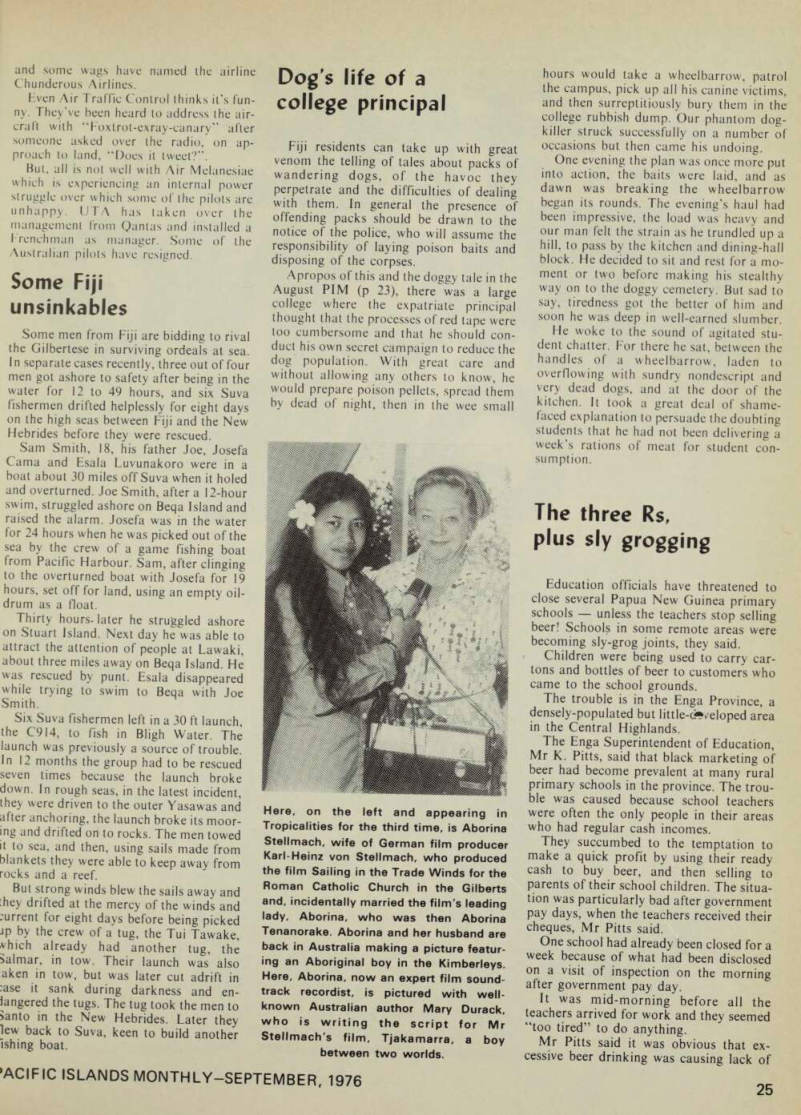
Here, on the left and appearing in Tropicalities for the third time, is Aborina Stellmach, wife of German film producer Karl-Heinz von Stellmach, who produced the film Sailing in the Trade Winds for the Roman Catholic Church in the Gilberts and, incidentally married the film's leading lady, Aborina, who was then Aborina Tenanorake. Aborina and her husband are back in Australia making a picture featur ing an Aboriginal boy in the Kimberleys.
Here, Aborina, now an expert film sound track recordist, is pictured with well known Australian author Mary Durack, who is writing the script for Mr Stellmach's film, Tjakamarra, a boy between two worlds.
efficiency in some village areas, and that some school teachers were contributing to the situation.
Mr Pitts said he believed community leaders were largely to blame, because they had encouraged the teachers to become part of a black market supply system. He did not believe that black market sales of beer could flourish to the extent they did unless there was tacit support from some
community leaders.
He said that education officials were now establishing adult classes for members of school boards. The classes would im press on parents and members of the public their responsibility towards school management. But, in the meantime, any school found to be a centre of black market beer sales would be closed im
mediately.
Too many
Fiji shoeshiners
Suva has about 100 shoeshine boys, which is far too many. The trade was launched about 15 years ago by an enter prising young Fijian who sensed it would be profitable with the tourist industry about to take off. Others seeing him do so well, got into the act. Soon, with so many offering the service, there was little in it for anyone.
The plight of the shoeshine boys at tracted the attention of Mr Dennis Oliver, a welfare officer attached to the YMCA, who did some research about them, and had a paper published by the School of Social and Economic Development at the University of the South Pacific. Most of the shoeshine boys are young, of school age, who went to Suva to further their education. About four-fifths are Fijian, the remainder Indian and mixed race.
Eight boys taken on by the “Y”, when they asked permission to sleep there, said they had left their homes months before and had been sleeping under bridges, in copra sheds and under old houses. But cold and wet weather and constant police harassment made their lives miserable.
The boys live rather a nomadic life. Their ages range from 14 to 17. They work in groups of three or four, and sleep, eat, work and travel together. Most are from fairly large families, often living in crowd ed homes. Most have problems with the police, and claim the police beat and harass them. The YMCA had made of ficial complaints about the police in some cases, but agreed that 12 boys had been helped by the police.
Suva’s shoeshine boys operate mainly outside the Metropole Hotel and around Victoria Arcade. When a tourist ship is in their daily earnings range from 50c to $7