A varied life ‘lived
p. 68 · Read in the full issue
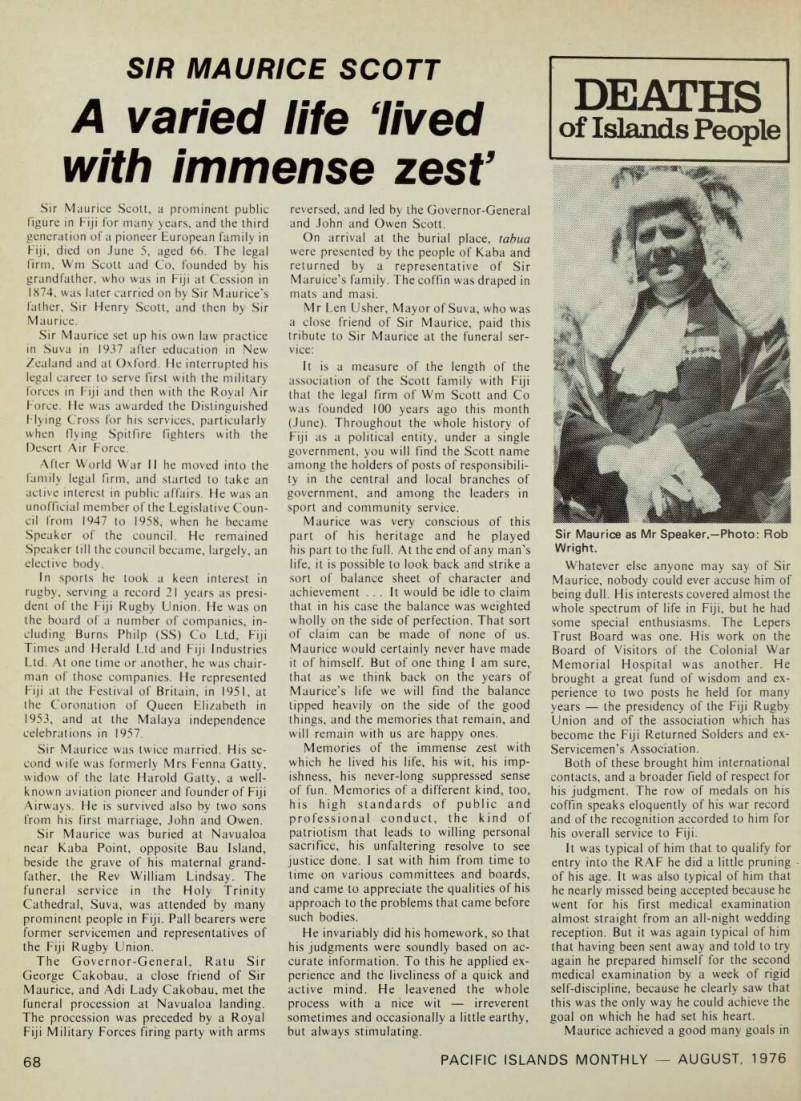
Sir Maurice Scott
A varied life ‘lived with immense zest’
Sir Maurice Scott, a prominent public figure in Fiji for many years, and the third generation of a pioneer European family in Fiji, died on June 5, aged 66. The legal firm, Wm Scott and Co, founded by his grandfather, who was in Fiji at Cession in 1874, was later carried on by Sir Maurice’s father. Sir Henry Scott, and then by Sir Maurice.
Sir Maurice set up his own law practice in Suva in 1937 after education in New Zealand and at Oxford. He interrupted his legal career to serve first with the military forces in Fiji and then with the Royal Air Force. He was awarded the Distinguished Flying Cross for his services, particularly when flying Spitfire fighters with the Desert Air Force.
After World War II he moved into the family legal firm, and started to take an active interest in public affairs. He was an unofficial member of the Legislative Coun cil from 1947 to 1958, when he became Speaker of the council. He remained Speaker till the council became, largely, an
elective body.
In sports he took a keen interest in rugby, serving a record 21 years as presi dent of the Fiji Rugby Union. He was on the board of a number of companies, in cluding Burns Philp (SS) Co Ltd, Fiji Times and Herald Ltd and Fiji Industries Ltd. At one time or another, he was chair man of those companies. He represented Fiji at the Festival of Britain, in 1951, at the Coronation of Queen Elizabeth in 1953, and at the Malaya independence celebrations in 1957.
Sir Maurice was twice married. His se cond wife was formerly Mrs Fenna Gatty, widow of the late Harold Gatty, a well known aviation pioneer and founder of Fiji Airways. He is survived also by two sons from his first marriage, John and Owen.
Sir Maurice was buried at Navualoa near Kaba Point, opposite Bau Island, beside the grave of his maternal grand father, the Rev William Lindsay. The funeral service in the Holy Trinity Cathedral, Suva, was attended by many prominent people in Fiji. Pall bearers were former servicemen and representatives of the Fiji Rugby Union.
The Governor-General, Ratu Sir George Cakobau, a close friend of Sir Maurice, and Adi Lady Cakobau, met the funeral procession at Navualoa landing.
The procession was preceded by a Royal Fiji Military Forces firing party with arms
reversed, and led by the Governor-General and John and Owen Scott.
On arrival at the burial place, tabua were presented by the people of Kaba and returned by a representative of Sir Maruice’s family. The coffin was draped in mats and masi.
Mr Len Usher, Mayor of Suva, who was a close friend of Sir Maurice, paid this tribute to Sir Maurice at the funeral ser vice: It is a measure of the length of the association of the Scott family with Fiji that the legal firm of Wm Scott and Co was founded 100 years ago this month (June). Throughout the whole history of Fiji as a political entity, under a single government, you will find the Scott name among the holders of posts of responsibili ty in the central and local branches of government, and among the leaders in sport and community service.
Maurice was very conscious of this part of his heritage and he played his part to the full. At the end of any man’s life, it is possible to look back and strike a sort of balance sheet of character and achievement ... It would be idle to claim that in his case the balance was weighted wholly on the side of perfection. That sort of claim can be made of none of us.
Maurice would certainly never have made it of himself. But of one thing I am sure, that as we think back on the years of Maurice’s life we will find the balance tipped heavily on the side of the good things, and the memories that remain, and will remain with us are happy ones.
Memories of the immense zest with which he lived his life, his wit, his imp ishness, his never-long suppressed sense of fun. Memories of a different kind, too, his high standards of public and professional conduct, the kind of patriotism that leads to willing personal sacrifice, his unfaltering resolve to see justice done. I sat with him from time to time on various committees and boards, and came to appreciate the qualities of his approach to the problems that came before such bodies.
He invariably did his homework, so that his judgments were soundly based on ac curate information. To this he applied ex perience and the liveliness of a quick and active mind. He leavened the whole process with a nice wit irreverent sometimes and occasionally a little earthy, but always stimulating.