Hebrides Presbyterianism
pp. 46-47 · Read in the full issue
Misi Gete, Apostle Of New
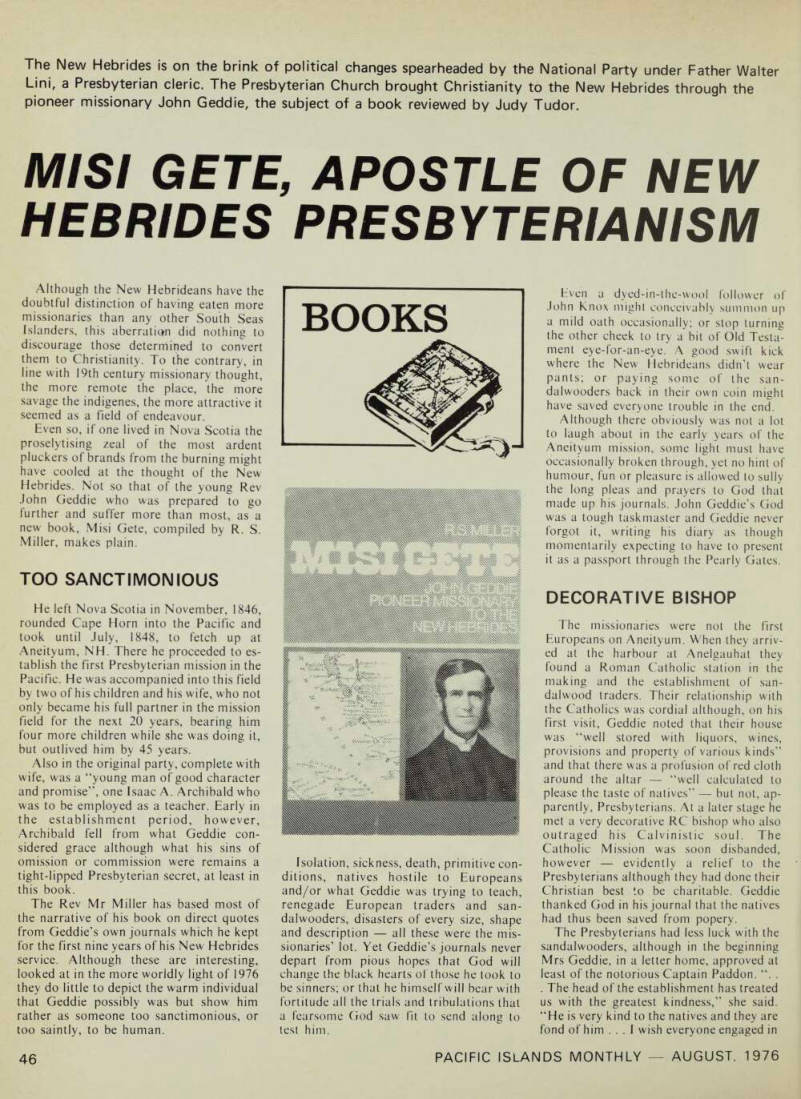
The New Hebrides is on the brink of political changes spearheaded by the National Party under Father Walter Lini, a Presbyterian cleric. The Presbyterian Church brought Christianity to the New Hebrides through the pioneer missionary John Geddie, the subject of a book reviewed by Judy Tudor.
Although the New Hebrideans have the doubtful distinction of having eaten more missionaries than any other South Seas Islanders, this aberration did nothing to discourage those determined to convert them to Christianity. To the contrary, in line with 19th century missionary thought, the more remote the place, the more savage the indigenes, the more attractive it seemed as a field of endeavour.
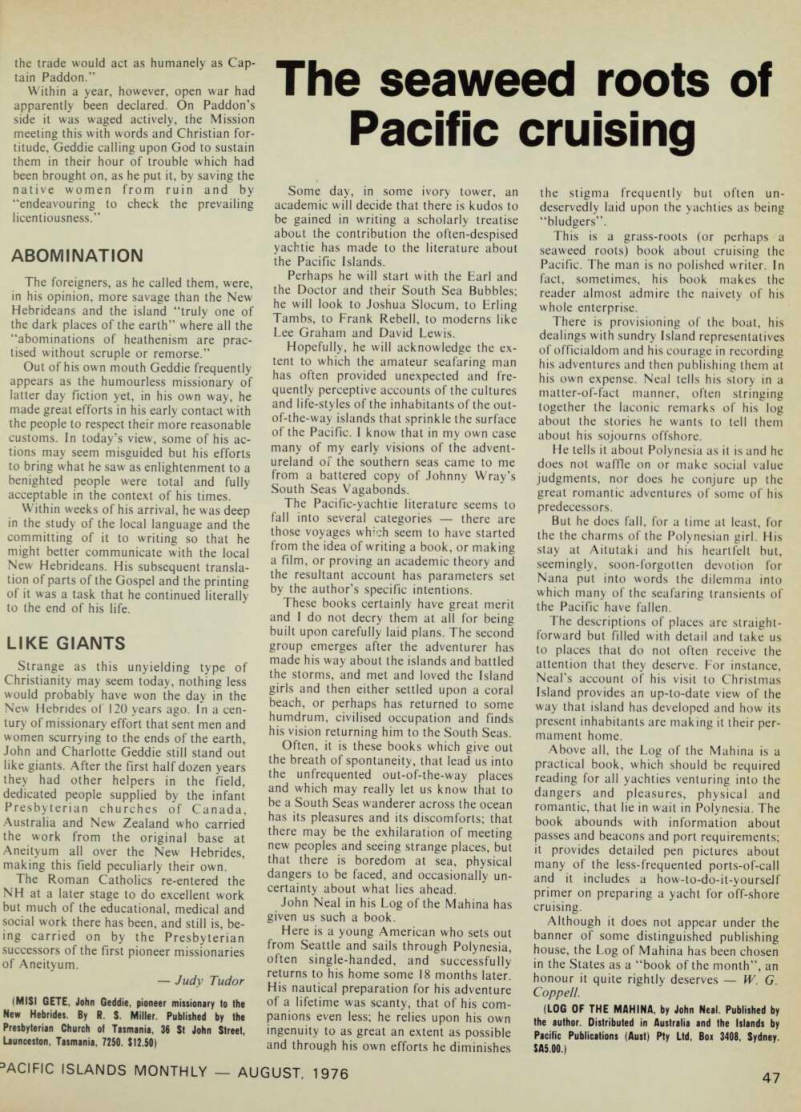
Even so, if one lived in Nova Scotia the proselytising zeal of the most ardent pluckers of brands from the burning might have cooled at the thought of the New Hebrides. Not so that of the young Rev John Geddie who was prepared to go further and suffer more than most, as a new book, Misi Gete, compiled by R. S.
Miller, makes plain.
Too Sanctimonious
He left Nova Scotia in November, 1846, rounded Cape Horn into the Pacific and took until July, 1848, to fetch up at Aneityum, NH. There he proceeded to es tablish the first Presbyterian mission in the Pacific. He was accompanied into this field by two of his children and his wife, who not only became his full partner in the mission field for the next 20 years, bearing him four more children while she was doing it, but outlived him by 45 years.
Also in the original party, complete with wife, was a “young man of good character and promise”, one Isaac A. Archibald who was to be employed as a teacher. Early in the establishment period, however, Archibald fell from what Geddie con sidered grace although what his sins of omission or commission were remains a tight-lipped Presbyterian secret, at least in this book.
The Rev Mr Miller has based most of the narrative of his book on direct quotes from Geddie’s own journals which he kept for the first nine years of his New Hebrides service. Although these are interesting, looked at in the more worldly light of 1976 they do little to depict the warm individual that Geddie possibly was but show him rather as someone too sanctimonious, or too saintly, to be human.
Books
Even a dyed-in-the-wool follower of John Knox might conceivably summon up a mild oath occasionally; or stop turning the other cheek to try a bit of Old Testa ment eye-for-an-eye. A good swift kick where the New Hebrideans didn’t wear pants; or paying some of the san dalwooders back in their own coin might have saved everyone trouble in the end.
Although there obviously was not a lot to laugh about in the early years of the Aneityum mission, some light must have occasionally broken through, yet no hint of humour, fun or pleasure is allowed to sully the long pleas and prayers to God that made up his journals. John Geddie’s God was a tough taskmaster and Geddie never forgot it, writing his diary as though momentarily expecting to have to present it as a passport through the Pearly Gates.
Decorative Bishop
The missionaries were not the first
Europeans on Aneityum. When they arriv
ed at the harbour at Anelgauhat they found a Roman Catholic station in the making and the establishment of san dalwood traders. Their relationship with the Catholics was cordial although, on his first visit, Geddie noted that their house was “well stored with liquors, wines, provisions and property of various kinds” and that there was a profusion of red cloth around the altar “well calculated to please the taste of natives” but not, ap parently, Presbyterians. At a later stage he met a very decorative RC bishop who also outraged his Calvinistic soul. The Catholic Mission was soon disbanded, however evidently a relief to the Presbyterians although they had done their Christian best to be charitable. Geddie thanked God in his journal that the natives had thus been saved from popery.
The Presbyterians had less luck with the sandalwooders, although in the beginning Mrs Geddie, in a letter home, approved at least of the notorious Captain Paddon. “. . . The head of the establishment has treated us with the greatest kindness,” she said.
“He is very kind to the natives and they are fond of him ... I wish everyone engaged in
Isolation, sickness, death, primitive con ditions, natives hostile to Europeans and/or what Geddie was trying to teach, renegade European traders and san dalwooders, disasters of every size, shape and description — all these were the mis sionaries’ lot. Yet Geddie’s journals never depart from pious hopes that God will change the black hearts of those he look to be sinners; or that he himself will bear with fortitude all the trials and tribulations that a fearsome God saw fit to send along to test him.
the trade would act as humanely as Cap tain Paddon.”
Within a year, however, open war had apparently been declared. On Paddon’s side it was waged actively, the Mission meeting this with words and Christian for titude, Geddie calling upon God to sustain them in their hour of trouble which had been brought on, as he put it, by saving the native women from ruin and by “endeavouring to check the prevailing licentiousness.”
Abomination
The foreigners, as he called them, were, in his opinion, more savage than the New Hebrideans and the island “truly one of the dark places of the earth” where all the “abominations of heathenism are prac tised without scruple or remorse.”
Out of his own mouth Geddie frequently appears as the humourless missionary of latter day fiction yet, in his own way, he made great efforts in his early contact with the people to respect their more reasonable customs. In today’s view, some of his ac tions may seem misguided but his efforts to bring what he saw as enlightenment to a benighted people were total and fully acceptable in the context of his times.
Within weeks of his arrival, he was deep in the study of the local language and the committing of it to writing so that he might better communicate with the local New Hebrideans. His subsequent transla tion of parts of the Gospel and the printing of it was a task that he continued literally to the end of his life.
Like Giants
Strange as this unyielding type of
Christianity may seem today, nothing less
would probably have won the day in the New Hebrides of 120 years ago. In a cen tury of missionary effort that sent men and women scurrying to the ends of the earth, John and Charlotte Geddie still stand out like giants. After the first half dozen years they had other helpers in the field, dedicated people supplied by the infant Presbyterian churches of Canada, Australia and New Zealand who carried the work from the original base at Aneityum all over the New Hebrides, making this field peculiarly their own.
The Roman Catholics re-entered the NH at a later stage to do excellent work but much of the educational, medical and social work there has been, and still is, be ing carried on by the Presbyterian successors of the first pioneer missionaries of Aneityum.
Judy Tudor
(MISI GETE, John Geddie, pioneer missionary to the New Hebrides. By R. S. Miller. Published by the Presbyterian Church of Tasmania, 36 St John Street, Launceston, Tasmania, 7250. $12.50)