The Noble With A Nose For Music
p. 33 · Read in the full issue
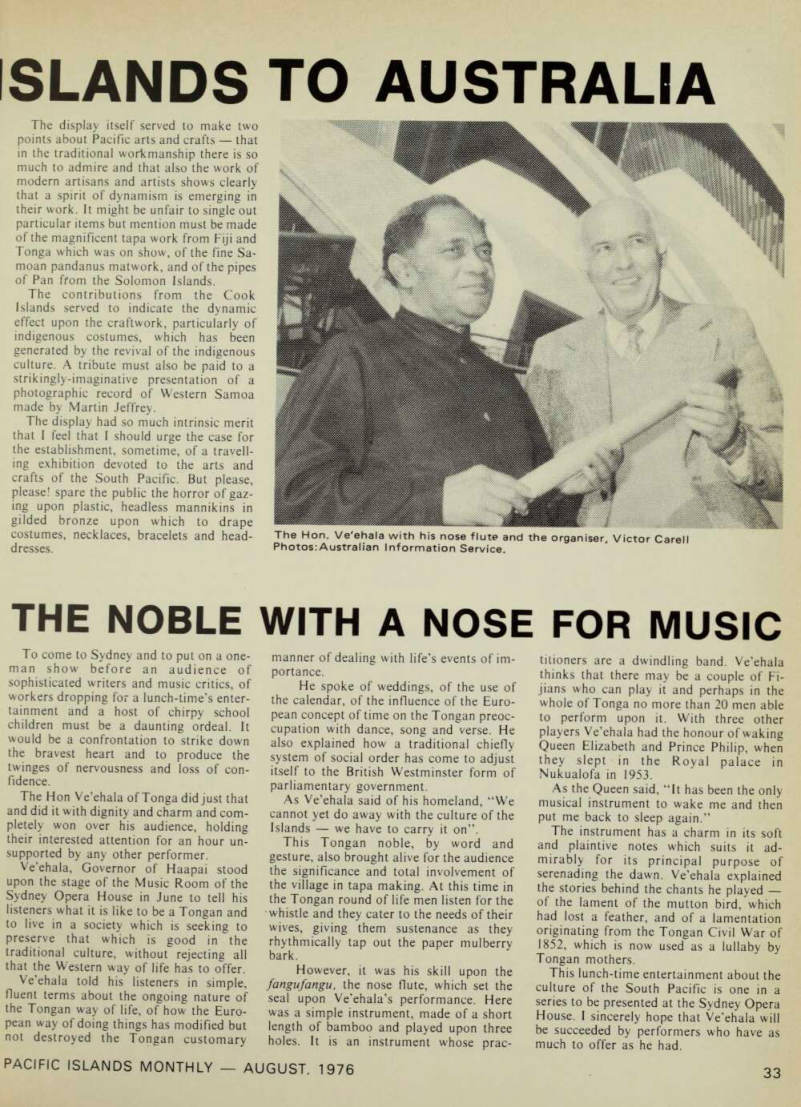
To come to Sydney and to put on a one man show before an audience of sophisticated writers and music critics, of workers dropping for a lunch-time’s enter tainment and a host of chirpy school children must be a daunting ordeal. It would be a confrontation to strike down the bravest heart and to produce the twinges of nervousness and loss of con fidence.
The Hon Ve’ehala of Tonga did just that and did it with dignity and charm and com pletely won over his audience, holding their interested attention for an hour un supported by any other performer.
Ve’ehala, Governor of Haapai stood upon the stage of the Music Room of the Sydney Opera House in June to tell his listeners what it is like to be a Tongan and to live in a society which is seeking to preserve that which is good in the traditional culture, without rejecting all that the Western way of life has to offer.
Ve’ehala told his listeners in simple, fluent terms about the ongoing nature of the Tongan way of life, of how the Euro pean way of doing things has modified but not destroyed the Tongan customary
manner of dealing with life’s events of importance.
He spoke of weddings, of the use of the calendar, of the influence of the European concept of time on the Tongan preoccupation with dance, song and verse. He also explained how a traditional chiefly system of social order has come to adjust itself to the British Westminster form of
Parliamentary government.
As Ve’ehala said of his homeland, “We cannot yet do away with the culture of the Islands - we have to carry it on”.
This Tongan noble, by word and gesture, also brought alive for the audience the significance and total involvement of the village in tapa making. At this time in tbe Tongan round of life men listen for the whistle and they cater to the needs of their w u lve u s ’ them sustenance as they rhythmically tap out the paper mulberry bark. , However it was his skill upon the fangufangu. the nose flute, which set the seal upon Ve ’ ehala ’ s performance. Here was a simple instrument, made of a short ' en Bth8 th ? f bambo ° and pla y ed upon three holes. It is an instrument whose prac-
titioners are a dwindling band. Ve’ehala thinks that there may be a couple of Fi jians who can play it and perhaps in the whole of Tonga no more than 20 men able to perform upon it. With three other players Ve’ehala had the honour of waking Queen Elizabeth and Prince Philip, when they slept in the Royal palace in Nukualofa in 1953.
As the Queen said, “It has been the only musical instrument to wake me and then put me back to sleep again.”
The instrument has a charm in its soft and plaintive notes which suits it ad mirably for its principal purpose of serenading the dawn. Ve’ehala explained the stories behind the chants he played of the lament of the mutton bird, which had lost a feather, and of a lamentation originating from the Tongan Civil War of 1852, which is now used as a lullaby by Tongan mothers.
This lunch-time entertainment about the culture of the South Pacific is one in a series to be presented at the Sydney Opera House. I sincerely hope that Ve’ehala will be succeeded by performers who have as much to offer as he had.