feared change
pp. 68-69 · Read in the full issue
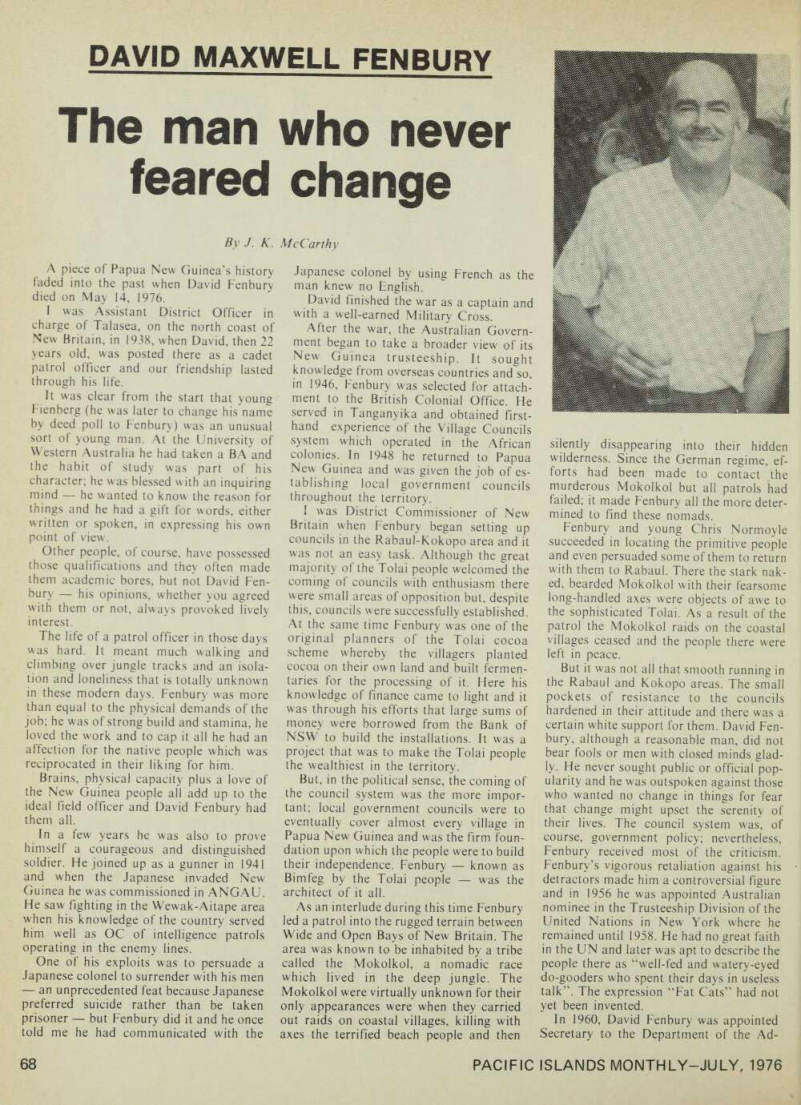
David Maxwell Fenbury
The man who never feared change
By J. K. McCarthy
A piece of Papua New Guinea’s history faded into the past when David Fenbury died on May 14, 1976.
I was Assistant District Officer in charge of Talasea, on the north coast of New Britain, in 1938, when David, then 22 years old, was posted there as a cadet patrol officer and our friendship lasted through his life.
It was clear from the start that young Fienberg (he was later to change his name by deed poll to Fenbury) was an unusual sort of young man. At the University of Western Australia he had taken a BA and the habit of study was part of his character; he was blessed with an inquiring mind he wanted to know the reason for things and he had a gift for words, either written or spoken, in expressing his own point of view.
Other people, of course, have possessed those qualifications and they often made them academic bores, but not David Fen bury his opinions, whether you agreed with them or not, always provoked lively interest.
The life of a patrol officer in those days was hard. It meant much walking and climbing over jungle tracks and an isola tion and loneliness that is totally unknown in these modern days. Fenbury was more than equal to the physical demands of the job; he was of strong build and stamina, he loved the work and to cap it all he had an affection for the native people which was reciprocated in their liking for him.
Brains, physical capacity plus a love of the New Guinea people all add up to the ideal field officer and David Fenbury had them all.
In a few years he was also to prove himself a courageous and distinguished soldier. He joined up as a gunner in 1941 and when the Japanese invaded New Guinea he was commissioned in ANGAU.
He saw fighting in the Wewak-Aitape area when his knowledge of the country served him well as OC of intelligence patrols operating in the enemy lines.
One of his exploits was to persuade a Japanese colonel to surrender with his men an unprecedented feat because Japanese preferred suicide rather than be taken prisoner but Fenbury did it and he once told me he had communicated with the
Japanese colonel by using French as the man knew no English.
David finished the war as a captain and with a well-earned Military Cross.
After the war, the Australian Govern ment began to take a broader view of its New Guinea trusteeship. It sought knowledge from overseas countries and so, in 1946, Fenbury was selected for attach ment to the British Colonial Office. He served in Tanganyika and obtained first hand experience of the Village Councils system which operated in the African colonies. In 1948 he returned to Papua New Guinea and was given the job of es tablishing local government councils
throughout the territory.
I was District Commissioner of New Britain when Fenbury began setting up councils in the Rabaul-Kokopo area and it was not an easy task. Although the great majority of the Tolai people welcomed the coming of councils with enthusiasm there were small areas of opposition but, despite this, councils were successfully established.
At the same time Fenbury was one of the original planners of the Tolai cocoa scheme whereby the villagers planted cocoa on their own land and built fermen taries for the processing of it. Here his knowledge of finance came to light and it was through his efforts that large sums of money were borrowed from the Bank of NSW to build the installations. It was a project that was to make the Tolai people the wealthiest in the territory.
But, in the political sense, the coming of the council system was the more impor tant; local government councils were to eventually cover almost every village in Papua New Guinea and was the firm foun dation upon which the people were to build their independence. Fenbury known as Bimfeg by the Tolai people was the architect of it all.
As an interlude during this time Fenbury led a patrol into the rugged terrain between Wide and Open Bays of New Britain. The area was known to be inhabited by a tribe called the Mokolkol, a nomadic race which lived in the deep jungle. The Mokolkol were virtually unknown for their only appearances were when they carried out raids on coastal villages, killing with axes the terrified beach people and then
silently disappearing into their hidden wilderness. Since the German regime, ef forts had been made to contact the murderous Mokolkol but all patrols had failed; it made Fenbury all the more deter mined to find these nomads.
Fenbury and young Chris Normoyle succeeded in locating the primitive people and even persuaded some of them to return with them to Rabaul. There the stark nak ed, bearded Mokolkol with their fearsome long-handled axes were objects of awe to the sophisticated Tolai. As a result of the patrol the Mokolkol raids on the coastal villages ceased and the people there were left in peace.
But it was not all that smooth running in the Rabaul and Kokopo areas. The small pockets of resistance to the councils hardened in their attitude and there was a certain white support for them. David Fen bury, although a reasonable man, did not bear fools or men with closed minds glad ly. He never sought public or official pop ularity and he was outspoken against those who wanted no change in things for fear that change might upset the serenity of their lives. The council system was, of course, government policy; nevertheless, Fenbury received most of the criticism.
Fenbury’s vigorous retaliation against his detractors made him a controversial figure and in 1956 he was appointed Australian nominee in the Trusteeship Division of the United Nations in New York where he remained until 1958. He had no great faith in the UN and later was apt to describe the people there as “well-fed and watery-eyed do-gooders who spent their days in useless talk”. The expression “Fat Cats” had not yet been invented.
In 1960, David Fenbury was appointed Secretary to the Department of the Ad
mimstrator an appointment which acted like a dose of salts on that rather costive organisation. If Fenbury had no time for fools he had even less for the lazy and inef ficient and he was not slow to point out their deficiencies on what he called “bits of paper” notes written with a vitriolic pen and phrased in equally cutting terms.
Some of the department heads resented it but it did not deter Fenbury.
In 1967, Sir Donald Cleland retired as Administrator of Papua New Guinea and David Hay, a former Australian Am bassador, took his place. Two years later, Fenbury was transferred from the Depart ment of the Administrator and given the secretaryship of the newly-founded Department of Social Development and Home Affairs, a ragbag organisation covering all the minor bits and pieces of the administration and having little real effect on the things that mattered.
I had retired from the service in 1967 and of course don’t know the reason for Fenbury’s sudden removal as the head of the Department of the Administrator. My guess is that David Hay, as a trained diplomat, was a bit shocked at Fenbury’s lack of diplomacy and wanted a more tact ful man.
Fair enough, but in any case Fenbury was disappointed at the decision and the way it had been taken for he had no inkling of his transfer until he returned from leave in Australia.
David Fenbury retired from the service in 1973 a few years before he was due to do so and until his death lived in Western Australia. He married Joan, his first wife, in 1948 and he was a grief stricken man when she died in 1964. There were two children of the marriage, Alan, now a barrister in Perth and Margaret, a graduate of ANU, who was recently teaching aboriginal children in Arnhem Land and in the Northern Territory. In 1966, David married Helen, the ceremony taking place at our house in
Port Moresby.
In my opinion David Fenbury was one of the best administrators Papua New Guinea ever had. He had an excellent brain and the physical stamina to give him an energy that many other men lacked. But through some quirk of fate he was never to attain the fullness to which his talents en titled him. He was not, of course, the ideal public servant, being far too energetic and outspoken to be cast in that role.
And so, perhaps, one will have to wait until history gives him his due.