Islands’ shipping line
pp. 59-63 · Read in the full issue
Pacific Transport
The storm ahead of the Islands’ shipping line
From FRANCIS ROLLEY In Auckland
The long-mooted South Pacific regional shipping line, expected to be launched at the Pacific Forum meeting in Nauru late in July, will be casting off at a time when other South Pacific Ocean carriers face threats to their economic viability.
At the Forum, the Regional Shipping Council will recommend the line’s es tablishment following consideration and acceptance of a “reasonably encouraging’’ report on its potential profitability by Dutch Government shipping adviser Mr B. de Vlaming.
The idea of binding the region more lightly by providing east-west inter-island services along with north-south outlets for Island goods to the metropolitan markets in New Zealand, Australia, and the rest of the world is, of course, sound in principle.
But only Mr de Vlaming knows what prac tical consideration or possible remedy, if any he gave to the trade union troubles which present uncharted obstacles for present Pacific region shippers trying to balance account books in blue.
Industrial disputes involving militant New' Zealand maritime unions are con tinuing to test the profits and patience of existing shipping companies and their export-import consignee clients doing bu si ness in the region. Scheduled Auckland sailings by Island traders have been delayed six times in as many months this year by strikes, black bans, or picket lines. The Seamen's and the Waterside un ions have taken direct action against the Imparma Progress, the Florida, the Luhe sand, and the Oriental Surveyor. The last two ships were affected on two occasions over separate issues.
Although conservatively estimated to be in the double-digil-lhousands, the precise costs ol these recent shipping delays have not yet been tallied by the various interests affected. However, the month-long dispute laying up the Island trader Karepo in Auckland last year taxed the operators about $54,000 and that was before New Zealand's rising inflation rate reached the 15 per cent mark. Cumulative losses to operators, agents, and consignees when the Karepo dispute spread to other vessels in port and caused a rash of freight forwar ding cancellations brought the figure up to around $179,000.
With a mounting unemployment
problem among members, much of the Seamen’s Union dissension centres on
foreign-owned vessels allegedly flying flags
of convenience and breaching established
shipping agreements by cross-trading
between the Islands and Auckland while manned by a non-New Zealand crew.
These Taiwanese or other Asian and Pacific nationals are said to be paid below International Transport Federation wage rates and much less than their New Zealand counterparts.
New Zealand seamen once had a virtual monopoly of the Pacific Islands trade and Islands businessmen had to tolerate dis ruptions or do without their New Zealand imports. But recent years have seen a changed situation with several Islandowned and manned vessels now operating largely free of crew problems.
The unions, however, claim this is because the Island crews know they could quickly lose their jobs and incomes if they “make trouble”. It promises to continue to object strongly to ships manned by seamen signed-on under Nauruan or French- Noumean articles and carrying cargo normally taken by New Zealand-manned
ships. Mr de Vlaming's South Pacific ship ping line report, nevertheless, proposes the use of six or eight small freighters supplied or financed by various Island governments, as well as New Zealand, le Seamen Union campaign of strong objection this year has taken the f° rrn °f a picket around a disputed ships gangway which the Waterside Workers aave refused to cross to unload or load cargo. But the watersiders themselves in stigated two of the six disputes so far this year in protest at shipboard conditions of a different kind.
In January, they claimed a banana boat from Samoa and Tonga arrived in Auckland with human faeces amongst the creates in the ship’s hold. They refused to unload the cargo until the excrement was removed (by someone else), and news of the incident prompted disclaimers from government officials in both Apia and Nukualofa that their people were responsi hie. Less than two months later, in early March, Auckland Watersiders refused to work a freighter just in from Papua New Guinea and the Solomons because they
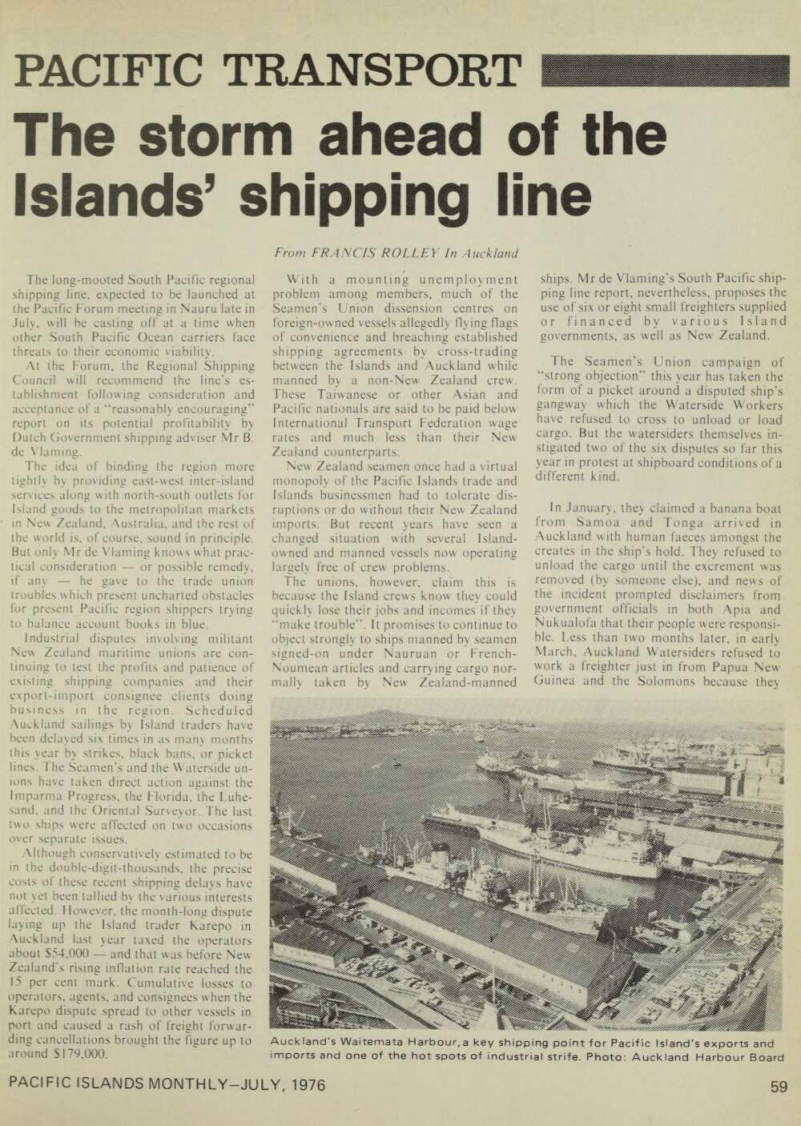
Auckland's Waitemata Harbour,a key shipping point for Pacific Island's exports and imports and one of the hot spots of industrial strife. Photo: Auckland Harbour Board
claimed its holds, containing* fresh fruit and general cargo, were filthy.
“We’d rather go home without pay than work among rats, cockroaches, maggots, and fruit fly,” said a wharfie.
The ship lay idle for four days until arrangements were made to fumigate its holds.
Such delays frequently longer than a week are causing increasing concern among Pacific region business interests. A shipping company manager who has just retired after 48 years in the industry regretted that his biggest problem during that time was dealing with almost con tinuous trade union trouble. In direct op position to what the Seamen’s Union wants, he warns that disputes could rebound on them and put an end to any ships manned by New Zealand crews trading in the Pacific.
His company is losing contracts for perishable cargoes because exporters can not get insurance cover to guard against disputes. An incensed Auckland exporter, who also does not want to be named because of the delicate nature of relations with the unions, says their disputes are costing New Zealand valuable export orders. He says freight ordered by Pacific Island importers is still sitting on the Auckland waterfront at the date of its promised and expected arrival.
New Zealand political commentators say that if anything, the situation will probably get worse before improving. It certainly will be compounded in the months ahead if fears of a looming major confrontation between the trade union movement and the new National Govern ment are realised.
Prime Minister Rob Muldoon’s hard line industrial relations policies containing wage-rise ceilings and no-nonsense at titudes to militant groups, which resist buckling down under his belt-tightening anti-inflation measures, have already angered and alienated large sections of the
country’s workforce.
Some union leaders are even suggesting parallels between the present climate and the situation leading up to the crippling New Zealand waterfront strike of 1951.
The in-built unemployment factor of the government’s strategy on the one hand continues to make enemies of more maritime workers and if this gives rise to more disputes it might reduce efforts by the government’s other economic hand to increase exports.
Wellington, however, remains optimistic that, given a little time, the fight against inflation will bear fruit. And time may well be the one commodity on the side of any South Pacific shipping line. A New
Zealand Foreign Affairs Ministry
spokesman says the line’s formation could take place “fairly soon” after the Forum meeting at Nauru but it will probably be some time before ships are obtained and
operating. If, by then, the feuding parties have managed to weather the brewing storm and get their respective interests on an even keel, the fruits their efforts bear could yet be Pacific Island bananas borne to Auckland by regional shipping line vessels.
Air Niugini
Buys From Ansett
Air Niugini is planning to extend its Fokker Friendship fleet, but it will phase out five DC3s because of increasing dif ficulty in obtaining spare parts. The airline expects to buy four Fokkers from Ansett Airlines for $1.6 million. The aircraft are already operated by Air Niugini under charter. The deal included spare parts and fittings worth more than $250,000.
The charter rates for the four aircraft are $200,000 a year. Air Niugini is also in the market to buy two more Fokkers from Australian sources. This arrangement, however, is still only at the study stage.
Air Niugini, looking at plans to expand, is considering a service to Japan, and ex tending the current Port Moresby-Manila service to Hong Kong. The airline original ly intended to open up a service to Hong Kong when it became an international air line, but Papua New Guinea and the British Government were unable to agree on landing rights. Talks on rights were resumed recently. PNG may have to grant Cathay Pacific reciprocal rights in PNG if it gets the Hong Kong landing rights.
Meanwhile the airline was scheduled, with Qantas, to hike air fares from Port Moresby to Cairns, Brisbane and Sydney from June I. Economy fares went up about four per cent. The increases were necessary to help the airline meet rising costs.
The Altair’S
Afloat Again
Two Fiji salvage firms in May refloated the Altair at the Walu Bay repair berth, where it had sunk four weeks earlier. The firms were Marine Pacific and Salvage Pacific Ltd. Refloating took about three days because the ship was firmly stuck at the bottom of the berth, and most of the hull was covered with mud.
The Altair struck a reef head at the island of Lakeba late in 1975, and started to list. Marine Pacific sent out a salvage team, which towed it back to Suva. While waiting to go on the repair slip she sank.
Waterfront Strike
Looms In Fiji
Fiji was headed for another waterfront strike late in May after talks broke down between the Ports Authority of Fiji and the Waterside Workers’ and Seamen’s Union.
The parties had been negotiating a seven-
point package deal offered by the authori ty. (PIM, June, p 63).
The union’s industrial adviser, Mr Taniela Veitata, said the union would not accept any package deal with the authori ty. It already had many of the conditions offered. It would stick to its original claim for a 60 per cent increase in wages for all waterside workers in the country.
He said that the union had been advised by shipping companies that they would cut down drastically the number of wharf employees after the authority took over the running of Fiji ports. That meant about 70 permanent employees would be laid off.
The union threatened to strike on July 1 in support of pay claims and to protest against the decision of the authority to take over stevedoring operations from private companies on that date. Mr Veitata intended, in June, to fly to New Zealand and Australia to seek the support of dockers’ unions in those countries for the strike. There was some hope he would be able to get those unions to ban the handling of cargo consigned to Fiji when the strike started.
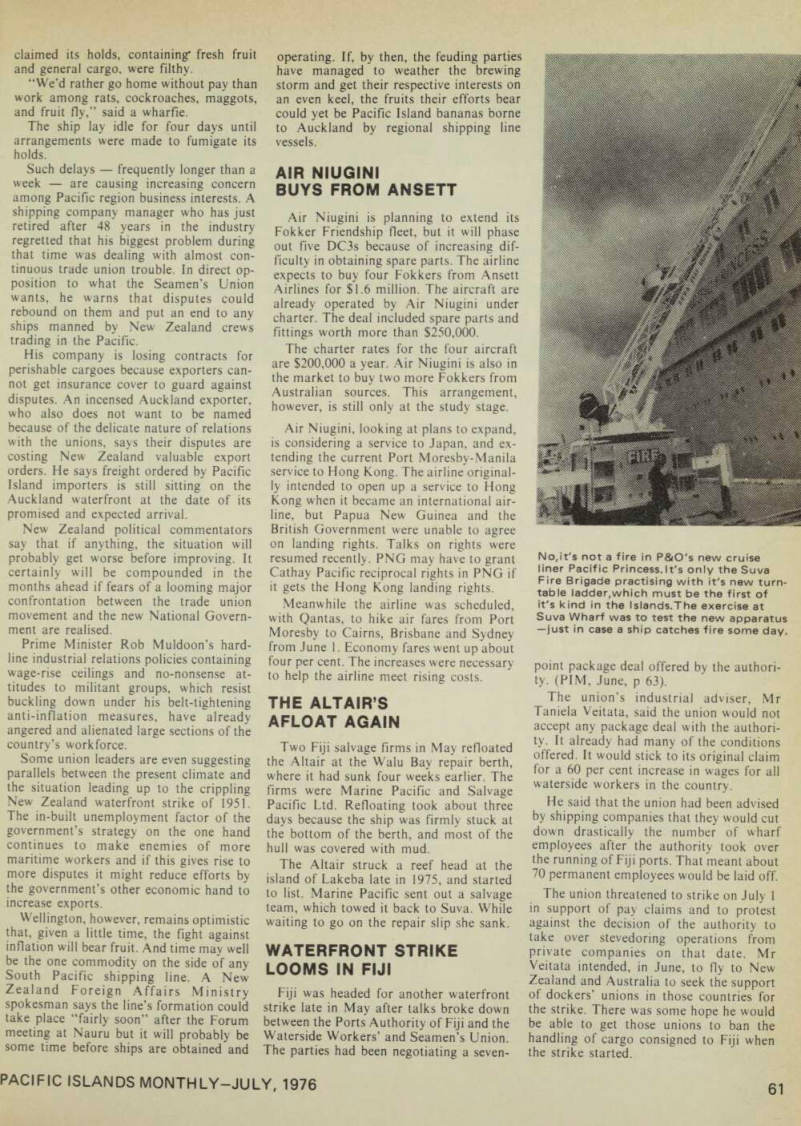
No,it's not a fire in P&O's new cruise liner Pacific Princess. It's only the Suva Fire Brigade practising with it's new turn table ladder,which must be the first of it's kind in the Islands. The exercise at Suva Wharf was to test the new apparatus —just in case a ship catches fire some day.
Nauru Hikes
Cargo Rates
Nauru Pacific Line hiked cargo freight rates from Australia to Fiji, Western Samoa and Papua New Guinea by WV2 per cent on June 1. It was the first rise on the PNG run since June, 1975, and on the Western Samoa service since July, 1974.
Nauru Pacific Line acts independently in fixing its rates.
The new general cargo rates, with those applying before June 1 in brackets, are; To Fiji $72.85 ($60.95) a tonne; $64.94 ($54.35) a cubic metre.
To Western Samoa $66.30 ($55.45) a tonne; $59.10 ($49.45) a cubic metre.
To PNG (Lae and Rabatil) $67.55 ($52.35) a tonne; $60.45 ($46.95) a cubic metre.
The surcharge is unchanged at $2.80 a tonne.
The rates on the runs to Nauru, Guam and Micronesia are unchanged.
Brain Drain From
Maritime School
The Fiji School of Maritime Studies is suffering from a brain drain. The school, which is part of the Derrick Technical Institute, is not yet finished, but, when it is,
it is expected that about $1.2 million will have been spent.
The school is having difficulty in recruiting suitable staff because of the low salary structure. The principal of Derrick Technical Institute, Dr Ankim Swami, said the salary structure for professional people was so low that a lot of good people were being lost to commercial companies, which offered good salaries.
It was difficult to ask lecturers to stay when there were other places where they could work and get better pay. Recently the school lost a professional lecturer, Captain Vollmer, who received advance training in maritime studies in Fiji and overseas. He had been offered a better salary with another company.
“It really hurts to see local professional lecturers like Captain Vollmer leaving for a job with commercial companies, es pecially when great efforts have been made to mould them into what they are now”, Dr Swami said.
The school will soon have a new prin cipal from England to replace the founder, Captain Richard Beaddon. • New jetties are being built at Nabouwalu and Taveuni in Fiji under the country’s rural development scheme. The jetties, which will cost about $lOO,OOO, will make for easier loading of produce. Much of the loading at present is by lighter.