Close To Nature, The Old Fijian
pp. 54-55 · Read in the full issue
Didn’T Need A Gardening Book
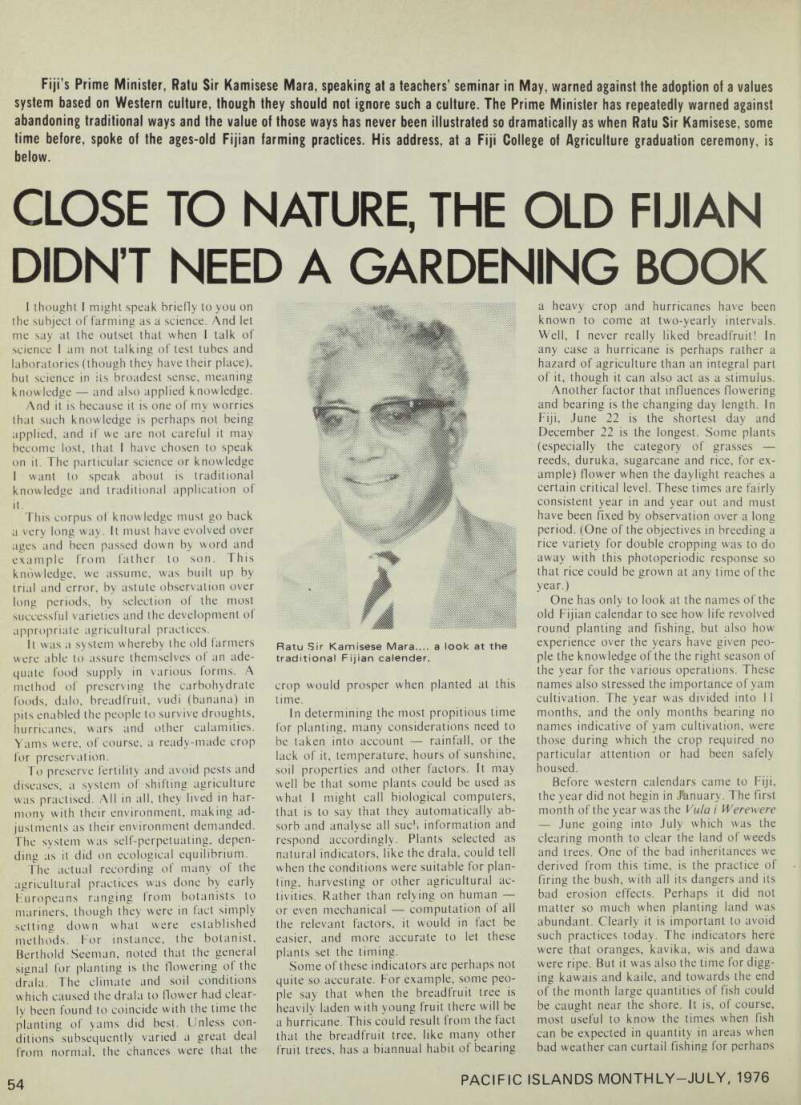
Fiji’s Prime Minister, Ratu Sir Kamisese Mara, speaking at a teachers’ seminar in May, warned against the adoption of a values system based on Western culture, though they should not ignore such a culture. The Prime Minister has repeatedly warned against abandoning traditional ways and the value of those ways has never been illustrated so dramatically as when Ratu Sir Kamisese, some time before, spoke of the ages-old Fijian farming practices. His address, at a Fiji College of Agriculture graduation ceremony, is below.
I thought I might speak briefly to you on the subject of farming as a science. And let me say at the outset that when I talk of science I am not talking of lest tubes and laboratories (though they have their place), but science in its broadest sense, meaning knowledge and also applied knowledge.
And it is because it is one of my worries that such knowledge is perhaps not being applied, and if we are not careful it may become lost, that I have chosen to speak on it. The particular science or knowledge I want to speak about is traditional knowledge and traditional application of it.
This corpus of knowledge must go back a very long way. It must have evolved over ages and been passed down by word and example from father to son. This knowledge, we assume, was built up by trial and error, by astute observation over long periods, by selection of the most successful varieties and the development of
appropriate agricultural practices.
It was a system whereby the old farmers were able to assure themselves of an ade quate food supply in various forms. A method of preserving the carbohydrate foods, dalo, breadfruit, vudi (banana) in pits enabled the people to survive droughts, hurricanes, wars and other calamities.
Yams were, of course, a ready-made crop
for preservation.
To preserve fertility and avoid pests and diseases, a system of shifting agriculture was practised. All in all, they lived in har mony with their environment, making ad justments as their environment demanded.
The system was self-perpetuating, depen ding as it did on ecological equilibrium.
The actual recording of many of the agricultural practices was done by early Europeans ranging from botanists to mariners, though they were in fact simply setting down what were established methods. For instance, the botanist, Berthold Seeman, noted that the general signal for planting is the flowering of the drala. The climate and soil conditions which caused the drala to flower had clear ly been found to coincide with the time the planting of yams did best. Unless con ditions subsequently varied a great deal from normal, the chances were that the
a heavy crop and hurricanes have been known to come at two-yearly intervals.
Well, 1 never really liked breadfruit! In any case a hurricane is perhaps rather a hazard of agriculture than an integral part of it, though it can also act as a stimulus.
Another factor that influences flowering and bearing is the changing day length. In Fiji, June 22 is the shortest day and December 22 is the longest. Some plants (especially the category of grasses reeds, duruka, sugarcane and rice, for ex ample) flower when the daylight reaches a certain critical level. These times are fairly consistent year in and year out and must have been fixed by observation over a long period. (One of the objectives in breeding a rice variety for double cropping was to do away with this photoperiodic response so that rice could be grown at any time of the year.) One has only to look at the names of the old Fijian calendar to see how life revolved round planting and fishing, but also how experience over the years have given peo ple the knowledge of the the right season of the year for the various operations. These names also stressed the importance of yam cultivation. The year was divided into 11 months, and the only months bearing no names indicative of yam cultivation, were those during which the crop required no particular attention or had been safely housed.
Before western calendars came to Fiji, the year did not begin in January. The first month of the year was the Vula i Werewere June going into July which was the clearing month to clear the land of weeds and trees. One of the bad inheritances we derived from this time, is the practice of firing the bush, with all its dangers and its bad erosion effects. Perhaps it did not matter so much when planting land was abundant. Clearly it is important to avoid such practices today. The indicators here were that oranges, kavika, wis and dawa were ripe. But it was also the time for digg ing kawais and kaile, and towards the end of the month large quantities of fish could be caught near the shore. It is, of course, most useful to know the times when fish can be expected in quantity in areas when bad weather can curtail fishing for perhaps
crop would prosper when planted at this time.
In determining the most propitious time for planting, many considerations need to be taken into account rainfall, or the lack of .it, temperature, hours of sunshine, soil properties and other factors. It may well be that some plants could be used as
what I might call biological computers,
that is to say that they automatically ab sorb and analyse all sue!, information and respond accordingly. Plants selected as natural indicators, like the drala, could tell when the conditions were suitable for plan ting, harvesting or other agricultural ac tivities. Rather than relying on human or even mechanical computation of all the relevant factors, it would in fact be easier, and more accurate to let these
plants set the timing.
Some of these indicators are perhaps not quite so accurate. For example, some peo ple say that when the breadfruit tree is heavily laden with young fruit there will be a hurricane. This could result from the fact that the breadfruit tree, like many other fruit trees, has a biannual habit of bearing
Ratu Sir Kamisese Mara... a look at the traditional Fijian calender.
two to three weeks at a time. First you can eat as much as you can while the fish is there, saving other protein, and also it can be smoked for the future.
Next came the Vula i cukicuki July/August when patches of ground were broken up for yam beds, the ground being allowed to lie fallow till the ivi tree bloom ed another indicator. This incidentally was also known as the Vula i liliwa not surprisingly! September was Vula i vavakada, when reeds were put to yams to enable them to climb up. It was the last of
the regular planting months.
Then came four months named after fishing. It is not clear whether the fish were the indicators for the land, or vice versa.
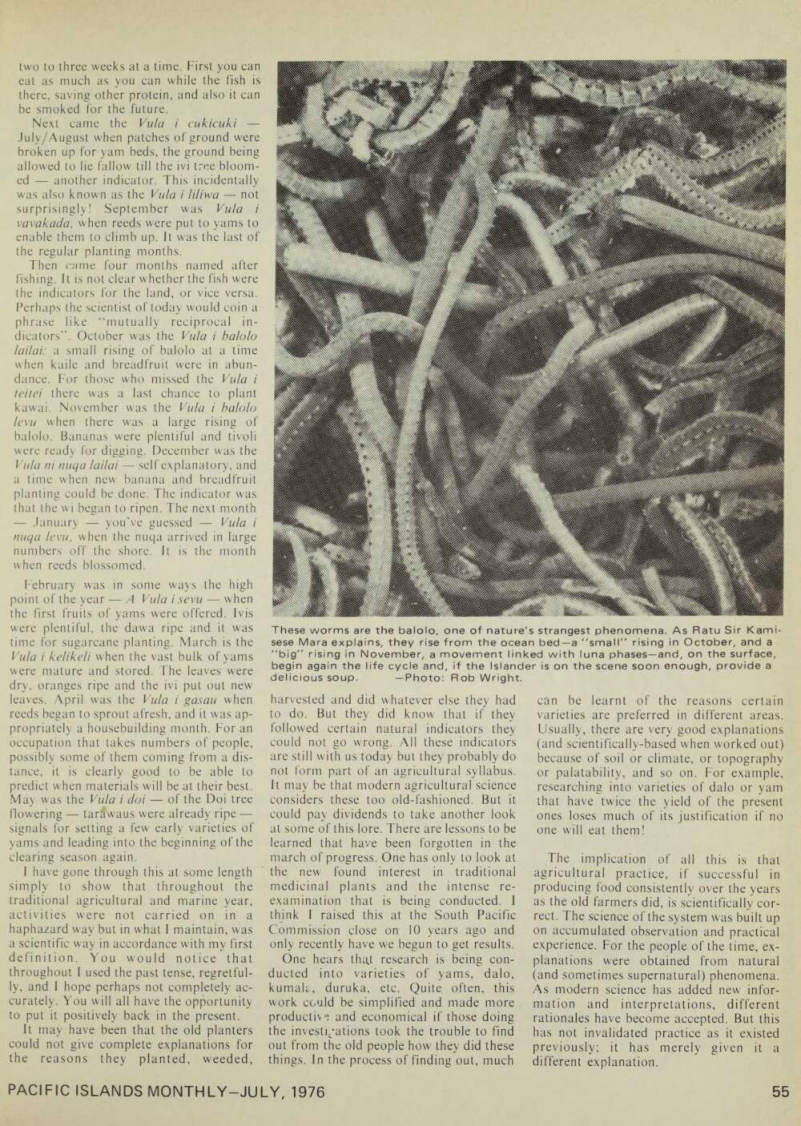
Perhaps the scientist of today would coin a phrase like “mutually reciprocal in dicators". October was the Vula i balolo lailai: a small rising of balolo at a time when kaile and breadfruit were in abun dance. For those who missed the Vula i teitei there was a last chance to plant kawai. November was the Vula i balolo leva when there was a large rising of balolo. Bananas were plentiful and tivoli were ready for digging. December was the Vula ni nuqa lailai self explanatory, and a time when new banana and breadfruit planting could be done. The indicator was that the wi began to ripen. The next month
January - you've guessed Vula i
nuqa leva, when the nuqa arrived in large numbers off the shore. It is the month when reeds blossomed.
February was in some ways the high point of the year A Vula i sevu when the first fruits of yams were offered. Ivis were plentiful, the dawa ripe and it was time for sugarcane planting. March is the Vula i kelikeli when the vast bulk of yams were mature and stored. The leaves were dry, oranges ripe and the ivi put out new leaves. April was the Vula i gasau when reeds began to sprout afresh, and it was ap propriately a housebuilding month. For an occupation that lakes numbers of people, possibly some of them coming from a dis tance, it is clearly good to be able to predict when materials will be at their best.
May was the Vula i doi of the Doi tree
flowering were already ripe
signals for setting a few early varieties of yams and leading into the beginning of the
clearing season again.
I have gone through this at some length simply to show that throughout the traditional agricultural and marine year, activities were not carried on in a haphazard way but in what I maintain, was a scientific way in accordance with my first definition. You would notice that throughout I used the past tense, regretful ly, and I hope perhaps not completely ac curately. You will all have the opportunity to put it positively back in the present.
It may have been that the old planters
could not give complete explanations for
the reasons they planted, weeded,
harvested and did whatever else they had to do. But they did know that if they followed certain natural indicators they could not go wrong. All these indicators are still with us today but they probably do not form part of an agricultural syllabus.
It may be that modern agricultural science considers these too old-fashioned. But it could pay dividends to take another look at some of this lore. There are lessons to be learned that have been forgotten in the march of progress. One has only to look at the new found interest in traditional medicinal plants and the intense re examination that is being conducted. I think I raised this at the South Pacific Commission close on 10 years ago and only recently have we begun to get results.
One hears that research is being con ducted into varieties of yams, dalo, kumalfc, duruka, etc. Quite often, this work could be simplified and made more productive and economical if those doing the investigations took the trouble to find out from the old people how they did these things. In the process of finding out, much
can be learnt of the reasons certain varieties are preferred in different areas.
Usually, there are very good explanations (and scientifically-based when worked out) because of soil or climate, or topography or palatability, and so on. For example, researching into varieties of dalo or yam that have twice the yield of the present ones loses much of its justification if no one will eat them!
The implication of all this is that agricultural practice, if successful in producing food consistently over the years as the old farmers did, is scientifically cor rect. The science of the system was built up on accumulated observation and practical experience. For the people of the time, ex planations were obtained from natural (and sometimes supernatural) phenomena.
As modern science has added new infor mation and interpretations, different rationales have become accepted. But this has not invalidated practice as it existed previously; it has merely given it a different explanation.
These worms are the balolo, one of nature's strangest phenomena. As Ratu Sir Kami sese Mara explains, they rise from the ocean bed—a "small" rising in October, and a "big" rising in November, a movement linked with luna phases—and, on the surface, begin again the life cycle and, if the Islander is on the scene soon enough, provide a delicious soup. —Photo: Rob Wright.