New Hebrides Is Battling
pp. 51-53 · Read in the full issue

Business
To Fill Its Hotel Beds
by Ian McIntyre
A fall of 8% in the New Hebrides’ tourist arrivals for 1975 reflects in part the hindrances there were during the year to anyone wanting to fly to the Con dominium .
According to figures recently released
by the Bureau of Statistics, there were 1 5,838 arrivals compared with the record 17,247 of 1974. Visitors from New Caledonia dropped to 5,761, Australia 4243, New Zealand 1880, United States 828, France 547. Fiji 529, and the United Kingdom 240. Japanese tourists increased from 330 (1974) to 631.
The average length of stay dropped too, from 9.9 to 9.2 days, but cruise ship passengers increased in number with 42,000 coming ashore from 43 ships.
The decrease can be attributed to two factors. The first was the world wide recession which created uncertainty and currency fluctuation particularly in the Americas. Second, and more pertinent for the New Hebrides, was the lack of aircraft seats available on the Australia to Noumea and Noumea to Vila sectors.
In the first half of the year both UTA and Oantas, concentrating on the New Caledonia package market, were reluctant to make seats available for New Hebrides bound traffic. At the same time UTA were having technical problems with their ageing Caravelle that caused the can cellation of many flights and extended delays on others on the Noumea-Vila- Noumea sectors.
This situation was overcome in part by the introduction of the two F 27 Fairchilds in August which replaced the troublesome Caravelle. Although the frequency in creased, from 12 to 16 flights per week, the seating capacity decreased from 1008 to 640.
On top of this was a recurring reser vations problem. Intending passengers found they could not get confirmed bookings, especially on the UTA sectors, or when they did get them and travelled, fouijd on their arrival their return arrangements and confirmed seats did not exist. This factor alone caused a number of tour operators to cancel block bookings and forward arrangements and bypass the New Hebrides in favour of other more ac cessible areas.
This situation unfortunately still exists
in spite of repeated local representations
and assurances from the parties con cerned.
New Hebrides is well able to ac commodate and entertain tourists.
On Efate over 700 hotel beds are available in the Intercontinental Island Inn, Le Lagon, Rossi, Solaise and Hideaway Hotel'Motels. In Santo the new Hotel Santo and Ralaise Bougainville have a further 60 while on Tanna com fortable bungalows accommodate 25 more.
Ground operations in all areas are good with modern hire cars and buses available for tours and transfers.
To help remove the air transport blockage Oantas and UTA were to in crease the number of pool sector flights, Sydney-Noumea-Sydney to 63 as from May this year. UTA will also increase the number of flights on the Noumea-Vila- Noumea sector. She is currently chartering Air Nauru's Boeing 737 for seven movements a week and further capacity is available. Using this same aircraft a fur ther two sectors a week are flown Vila- Wallis and Wallis-Vila, however the
benefits of this UTA service to New Hebrides tourism are small.
As well. Air Nauru has been granted rights in and out of Vila on her own behalf and it is hoped that these will open up ac cess from the North Pacific and Asia for
reciprocal traffic.
Air Pacific currently is offering three flights a week each way, Nadi-Vila-Nadi and three connections to Brisbane and return via Honiara or Noumea. Air Pacific does not have traffic rights on the Noumea-Vila sector. Connecting services are also available to Port Moresby via Honiara.
A bright spot on the horizon for New Hebrides is the cruise ships. Between 65 and 70 are scheduled to call at either Vila or Santo during 1976. Santo is receiving cruise ships for the first lime and visitors are delighting in the warm welcome af forded in this area.
So the tourist trade wait, poised, with good equipment, comfortable beds and the uniqueness of a British, French and New Hebridean society with its varied culinary arts for the travellers who hopefully can find an aircraft seat confirmed both coming and going!
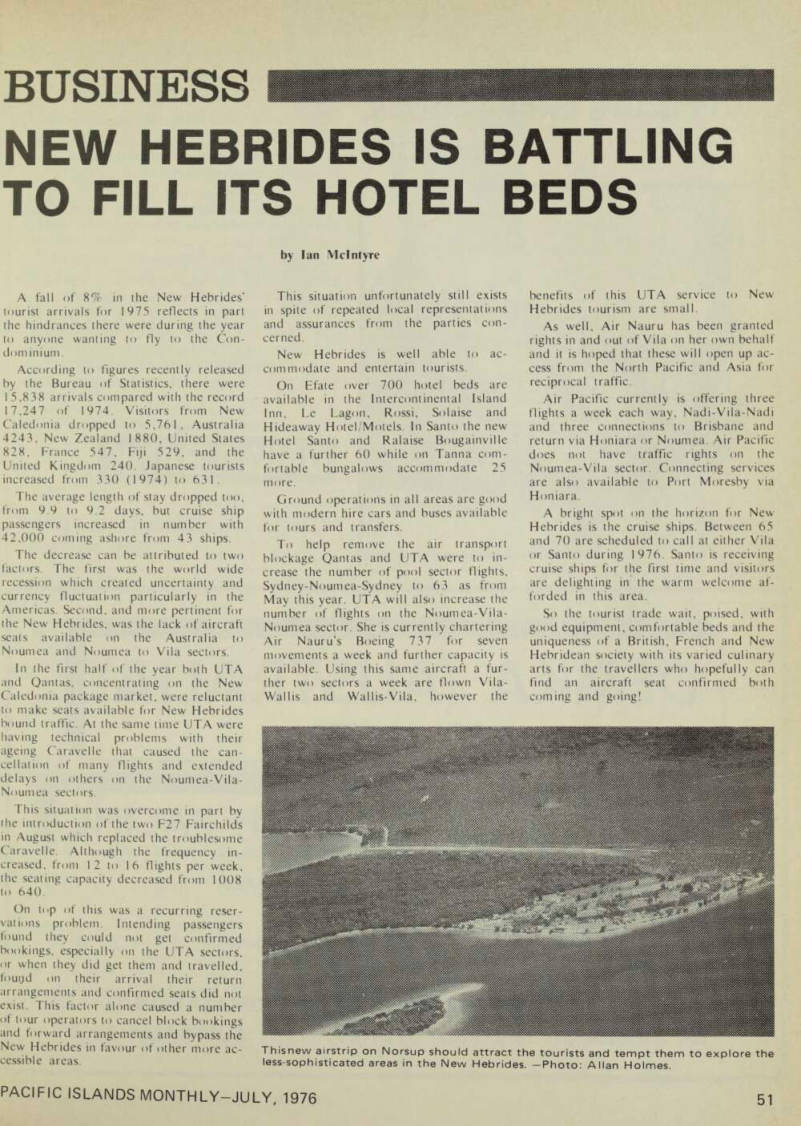
This new airstrip on Norsup should attract the tourists and tempt them to explore the less-sophisticated areas in the New Hebrides. -Photo: Allan Holmes.
NZ gift to Tonga
creates new industry
Tonga is on the way to a new in dustry cutting hardwood timber from coconut logs for furniture and house building materials. A portable mill, which includes saw mill, power saw and tractor, has been given to Tonga under the New Zealand aid scheme. The gift is worth more than P 60.000.
The mill will be operated by the forestry division of the Agriculture Department. It will be available for hire by the local people. A forestry officer, Mr Ted Rooney said tests showed that coconut logs could be processed into a beautiful timber.
Five young Tongans went to New Zealand in January for in-service training in mill operations at the Forestry Industry Training Centre, Rotorua. They will operate the portable mill in Tonga. Their NZ instructors reported they were quickly adapting themselves to the work. The young men are Vaivolo Tu’akalau, Ului Lama, Loketi M. Inoke, Salesi Pili’opo Manu and Tatafu Siope Tupuivaha.
Tonga bridges
salaries gap
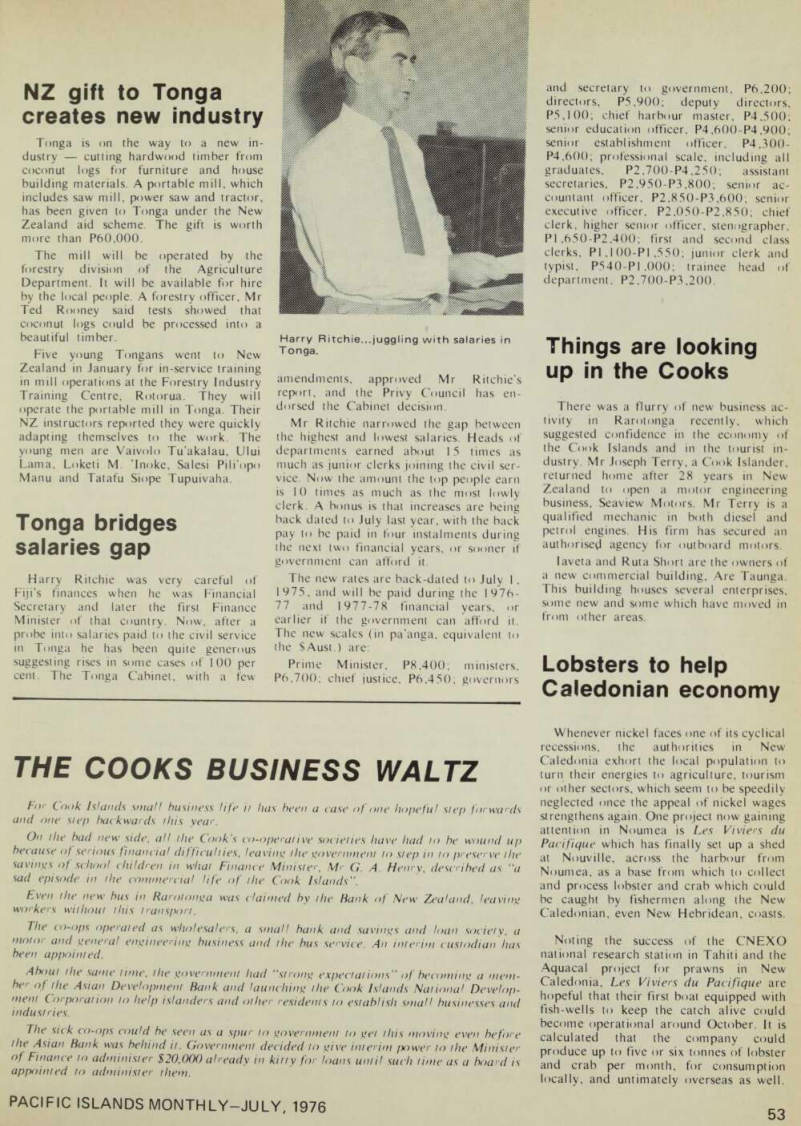
Harry Ritchie was very careful of Fiji’s finances when he was Financial Secretary and later the first Finance Minister of that country. Now, after a probe into salaries paid to the civil service in Tonga he has been quite generous suggesting rises in some cases of 100 per cent. The Tonga Cabinet, with a few
amendments, approved Mr Ritchie's report, and the Privy Council has en dorsed the Cabinet decision.
Mr Ritchie narrowed the gap between the highest and lowest salaries. Heads of departments earned about 15 times as much as junior clerks joining the civil ser vice. Now the amount the top people earn is 10 times as much as the most lowly clerk. A bonus is that increases are being back dated to July last year, with the back pay to be paid in four instalments during the next two financial years, or sooner if government can afford it.
The new rates are back-dated to July 1. 1975, and will be paid during the 1976- 77 and 1977-78 financial years, or earlier if the government can afford it.
The new scales (in pa'anga, equivalent to the sAust.) are: Prime Minister, P 8.400; ministers, P 6,700; chief justice, P 6,450; governors
and secretary to government, P 6,200; directors, P 5,900; deputy directors.
P 5.100; chief harbour master, P 4.500; senior education officer, P4.600-P4,900; senior establishment officer, P 4.300- P 4.600; professional scale, including all graduates, P2.700-P4.250; assistant secretaries, P2.950-P3.800; senior ac countant officer, P2.850-P3.600; senior executive officer, P2.050-P2.850; chief clerk, higher senior officer, stenographer.
PI .650-P2.400; first and second class clerks, PI ,100-P1,550; junior clerk and typist, P540-P1 ,000; trainee head of
department, P2,700-P3,200.
Things are looking
up in the Cooks
There was a flurry of new business ac tivity in Rarotonga recently, which suggested confidence in the economy of the Cook Islands and in the tourist in dustry. Mr Joseph Terry, a Cook Islander, returned home after 28 years in New Zealand to open a motor engineering business, Seaview Motors. Mr Terry is a qualified mechanic in both diesel and petrol engines. His firm has secured an agency for outboard motors. laveta and Ruta Short are the owners of a new commercial building. Are Taunga.
This building houses several enterprises, some new and some which have moved in from other areas.
Lobsters to help
Caledonian economy
Whenever nickel faces one of its cyclical recessions, the authorities in New Caledonia exhort the local population to turn their energies to agriculture, tourism or other sectors, which seem to be speedily neglected once the appeal of nickel wages strengthens again. One project now gaining attention in Noumea is Les Viviers du Pacifique which has finally set up a shed at Nouville, across the harbour from Noumea, as a base from which to collect and process lobster and crab which could be caught by fishermen along the New Caledonian, even New Hebridean, coasts.
Noting the success of the CNEXO national research station in Tahiti and the Aquacal project for prawns in New Caledonia, Les Viviers du Pacifique are hopeful that their first boat equipped with fish-wells to keep the catch alive could become operational around October. It is calculated that the company could produce up to five or six tonnes of lobster and crab per month, for consumption locally, and untimately overseas as well.
Harry Ritchie...juggling with salaries in Tonga.