Getting
p. 18 · Read in the full issue
The Bird
Gilberts
Style
The Gilbert Islands Attorney-General found himself out on a limb during the May session of the House of Assembly because proceedings were conducted almost entirely in Gilbertese. It was not a Gilbertian situation, but it drew a large number of Gilbertese to the public gallery to listen to the debates. Members took ad vantage of the absence of the Governor and Financial Secretary, on leave, to use their native language. The only ex-officio English-speaking member left was the Attorney-General.
Mr G.L. Pimm, 50, the new Attorney- General in the Gilbert Islands, helped Zambia to draw up the constitution it adopted when it received its independence from Britain. He practised as a barrister at the London bar for six years before becom ing a resident magistrate and then senior state advocate in Zambia. When he left Zambia to return to the UK he stopped off for six months in Kenya to practise privately. Four years ago he went to Ber muda where he was parliamentary counsel to the law reform committee. Since then he has been in private practice in the UK.
It was an interesting session enlivened by several bright passages, particularly when the Co-operative Federation Loans Bill, involving $1 million was debated. The bill was passed, but not without spirited opposition from some members.
Mr Abete Merang said that while it was necessary for the government to guarantee funds needed by the federation, he thought $1 million was too high. The federation was suffering from a sickness the main sickness was the high salaries paid to senior staff. The manager’s salary was higher than that of the governor. The federation came into existence three years ago and should be able to stand on its own feet.
Mr Teatao Teannaki said the govern ment should probe the federation’s high expenditure. It had received a bank loan of $532,000 and an overdraft of $277,000.
Co-operative societies owed the federation $996,000. The societies were over-stocked and should be controlled.
Mr Otiuea Tanentoa, Minister for Commerce and Industry, said the federa tion, since it came into existence more than three years ago, suffered from world-wide inflation, and had a liquidity problem.
The loan would be advanced, bit by bit,
as the need arose and would enable the federation to meet the high rise in the cost of imports.
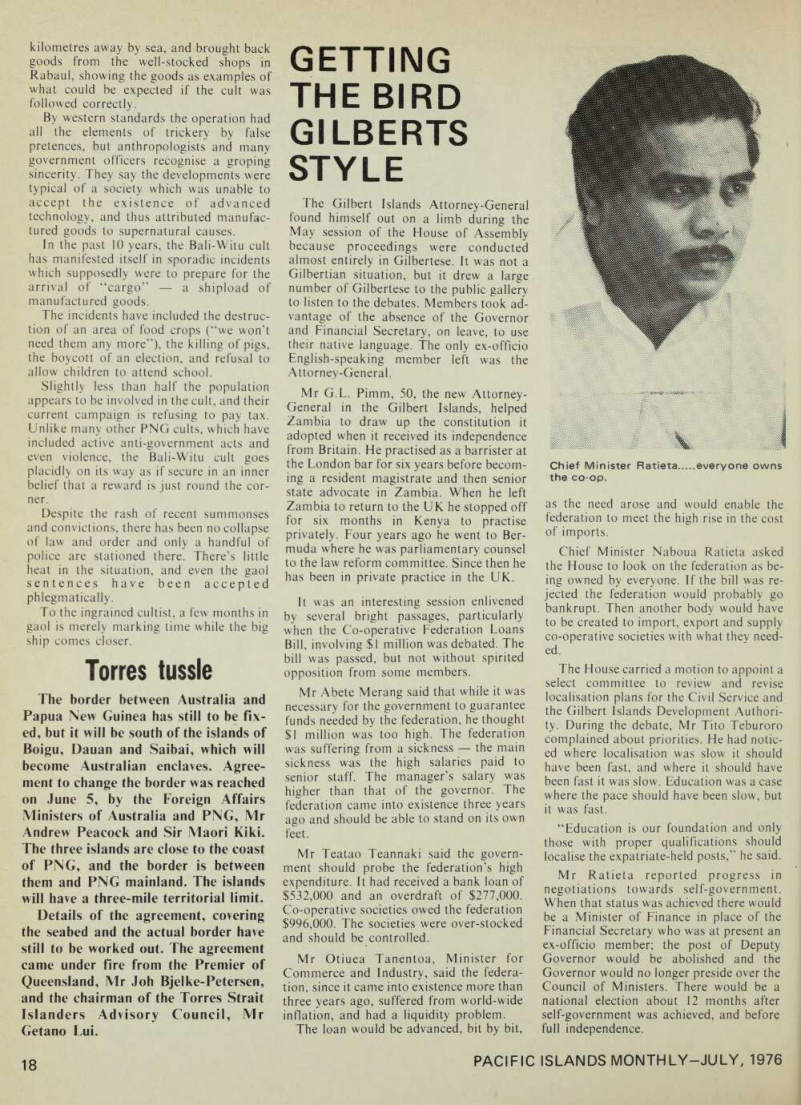
Chief Minister Naboua Ratieta asked the House to look on the federation as be ing owned by everyone. If the bill was re jected the federation would probably go bankrupt. Then another body would have to be created to import, export and supply co-operative societies with what they need ed.
The House carried a motion to appoint a select committee to review and revise localisation plans for the Civil Service and the Gilbert Islands Development Authori ty. During the debate, Mr Tito Teburoro complained about priorities. He had notic ed where localisation was slow it should have been fast, and where it should have been fast it was slow. Education was a case where the pace should have been slow, but it was fast.
“Education is our foundation and only those with proper qualifications should localise the expatriate-held posts,” he said.
Mr Ratieta reported progress in negotiations towards self-government.
When that status was achieved there would be a Minister of Finance in place of the Financial Secretary who was at present an ex-officio member; the post of Deputy Governor would be abolished and the Governor would no longer preside over the Council of Ministers. There would be a national election about 12 months after self-government was achieved, and before full independence.
Chief Minister Ratieta... everyone owns the co-op.