by bureaucracy
p. 10 · Read in the full issue
PNG borrowers bamboozled by bureaucracy
From Lee Mckenzie
in Port Moresby
Papua New Guinea villagers have long suffered a confused frustration in dealings with government, in common with their counterparts elsewhere.
But now, several national leaders in sympathy with their predicament, are calling for radical changes.
This communication gap shows up markedly in the difficulties en countered by those seeking aid. The Development Bank and other agen cies are designed to assist legitimate community groups to establish enter prises of benefit to rural areas. Many have received help but not enough, ac cording to Dr Reuben Taureka. in his new capacity as Minister for Broadcasting and Information, he has spoken out on behalf of the unin formed. They get little help from some national public servants who emulated the worst attitudes of their colonial “masters”. Most village peo ple were afraid of them or did not even know who to approach for a loan or how to go about it, Dr Taureka said.
Mr Gavera Rea, Minister for Commerce, Labour and Industry, condemned the District Village Econ omic Development Fund as a “bureaucratic monster” which obstructed applicants in a tangle of red tape. He said that “what was meant to be a simple, speedy aid scheme, is now useless and should be scrapped to be replaced by a more direct method of aid.”
The PNG public service in its pre sent inherited format is huge, un wieldy and complex. By its nature, any dealings with it involve the filling in of forms, couched in difficult “of ficialese”.
Its adherence to sophisticated ac counting and administrative procedures inhibits the direct ap proach. Thus, the ordinary citizen must undergo scrutiny and be subject to a paper hassle whenever in contact with any aspect of government, be it the law, a local council or district of fice.
Critics call for radical reform of an
overlarge, intrinsically foreign and en trenched bureaucracy.
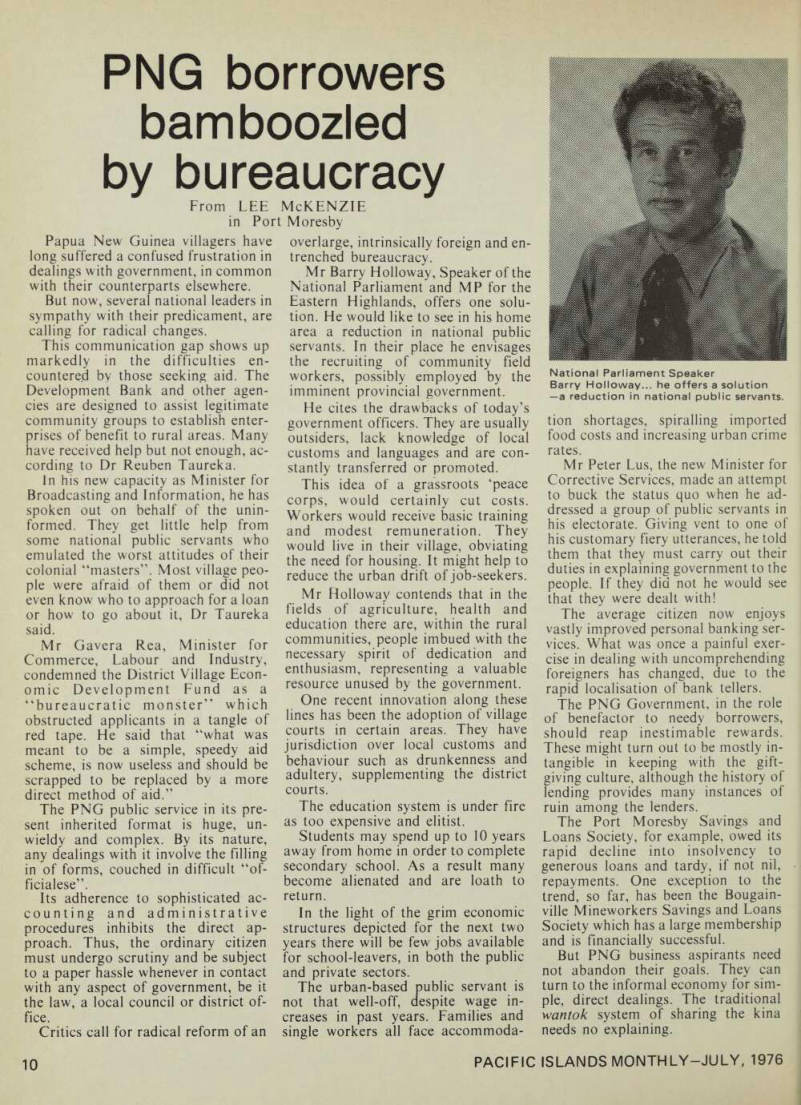
Mr Barry Holloway, Speaker of the National Parliament and MP for the Eastern Highlands, offers one solu tion. He would like to see in his home area a reduction in national public servants. In their place he envisages the recruiting of community field workers, possibly employed by the imminent provincial government.
He cites the drawbacks of today’s government officers. They are usually outsiders, lack knowledge of local customs and languages and are con stantly transferred or promoted.
This idea of a grassroots ‘peace corps, would certainly cut costs.
Workers would receive basic training and modest remuneration. They would live in their village, obviating the need for housing. It might help to reduce the urban drift of job-seekers.
Mr Holloway contends that in the fields of agriculture, health and education there are, within the rural communities, people imbued with the necessary spirit of dedication and enthusiasm, representing a valuable resource unused by the government.
One recent innovation along these lines has been the adoption of village courts in certain areas. They have jurisdiction over local customs and behaviour such as drunkenness and adultery, supplementing the district courts.
The education system is under fire as too expensive and elitist.
Students may spend up to 10 years away from home in order to complete secondary school. As a result many become alienated and are loath to return.
In the light of the grim economic structures depicted for the next two years there will be few jobs available for school-leavers, in both the public and private sectors.
The urban-based public servant is not that well-off, despite wage in creases in past years. Families and single workers all face accommoda-
tion shortages, spiralling imported food costs and increasing urban crime rates.
Mr Peter Lus, the new Minister for Corrective Services, made an attempt to buck the status quo when he ad dressed a group of public servants in his electorate. Giving vent to one of his customary fiery utterances, he told them that they must carry out their duties in explaining government to the people. If they did not he would see that they were dealt with!
The average citizen now enjoys vastly improved personal banking ser vices. What was once a painful exer cise in dealing with uncomprehending foreigners has changed, due to the rapid localisation of bank tellers.
The PNG Government, in the role of benefactor to needy borrowers, should reap inestimable rewards.
These might turn out to be mostly in tangible in keeping with the gift giving culture, although the history of lending provides many instances of ruin among the lenders.
The Port Moresby Savings and Loans Society, for example, owed its rapid decline into insolvency to generous loans and tardy, if not nil, repayments. One exception to the trend, so far, has been the Bougain ville Mineworkers Savings and Loans Society which has a large membership and is financially successful.
But PNG business aspirants need not abandon their goals. They can turn to the informal economy for sim ple, direct dealings. The traditional wantok system of sharing the kina needs no explaining.
National Parliament Speaker Barry Holloway... he offers a solution —a reduction in national public servants.