Tonga’S Church, Outdated Or
pp. 8-9 · Read in the full issue
On The Way To A Renewal?
By a special correspondent in Nukualofa
To consider the Church in Tonga is to look with fascination at an undoubted major institution.
It is also still a 19th century Church, riddled unfortunately with practices which raise questions of depressing magnitude.
Questions I will try to answer here are: What does the Church do for the people and vice versa, and what sort of future does the Church face in Tonga?
There is not space to consider now how the Church became what it is and what ef fect it has had on Tongan social life, nor to what extent the Church cares for the mass of have-nots, to what extent it exerts its authority against increasingly strong in terruptions of the Sabbath, and, further, how deeply it participates in politics?
Suffice it is to say that its deep in volvement in Tongan life must be taken for granted.
The Christian religion has made a deep and permanent impact upon the Tongan people. Most have followed the teachings of the Wesleyan missionaries in their various forms. Wesleyans do not however hold the field entirely unchallenged.
There are Catholics, Seventh-day Ad ventists, Anglicans, Mormans, and others.
The impact has been so profound that even in this day of declining interest in religion it is still true that all Tongans, at least those still residing in Tonga, belong to one religion or another.
Church activities and ceremonies oc cupy an important part of the everyday life of Tongans. Each Sabbath there are at least two services and both are well at tended, even though they often last for an hour or two. There is a Sunday School for the youngsters where they are taught more to memorise than understand the various
dogmas.
In addition there are services on at least three week-days. From time to time during the year additional week night ser vices take place in connection with the public organisation of the Church meetings of various committees making drives for church funds.
The Church provides educational ser vices to a degree unparalleled in the South Pacific. Over three-quarters of the secon dary school population are in church schools financed entirely by the Church.
Years of pleading with the government have so far yielded no positive results in terms of the State sharing the financial burden. Consequently, some of the chur
ches have begun phasing out their primary school systems to hand over the task to the government.
The Church also plays an important role in providing social centres and social gatherings for many of the youth who would otherwise be only passing the time doing nothing. While this movement is still in its infancy there are heartening aspects of the movement which indicate further and promising development.
In some areas, especially in recent years there has also been an awareness of the need for provision of adult education.
But the provision of all these services is very costly.
Each Sabbath the main morning service is generally followed by a sumptuous and very costly feast in honour of the visiting preacher. Practically every family is bur dened with having to provide such a feast
which normally costs approximately $lOO in kind and cash at least once a year.
Most families can ill-afford such ex penditure. As one man put it, “Honestly, I cannot really afford to provide this luxury, but it will be embarrassing if I and my family do not provide one as all the others are doing it.”
Apparently there have been attempts made by the younger and more enlightened ministers to do away with this practice but the opposition has been strong from the old and more conservative elements. In addition there is an annual misinale or (donation) in which the average family contributes roughly a quarter of its annual cash in come of approximately $3OO.
Not having a system of indirect taxation at its disposal the Church must ask the Tongans for contributions for its various purposes such as educational activities.
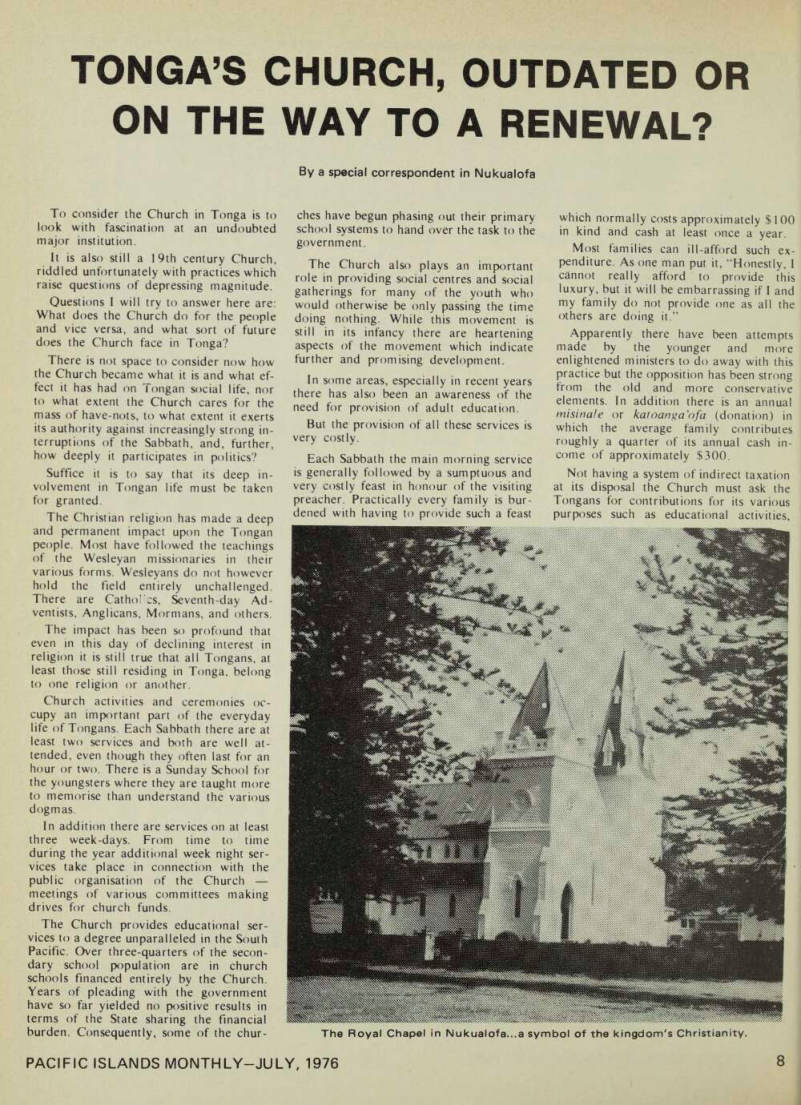
The Royal Chapel in Nukualofa...a symbol of the kingdom's Christianity.
church construction, pastors’ salaries, and missionary activities abroad.
It uses methods of collection which at worst are unjust and at best exceedingly shrewd. The village congregation is divided into several groups with the leaders of each group being the relatively wealthy and more energetic. In general the leaders decide what the group targets should be and allocate what each couple, single adults and even widows should con tribute, very often irrespective of their in dividual sources of income.
On the appointed day, visiting church dignitaries are welcomed with a feast, traditional dances and with a brass band playing “Waltzing Matilda”. Before the collections are made the members are thus effectively put into a truly festive mood so that when the time comes everybody can not help but donate every single cent he or she has. The method of announcing donations (especially if they are con siderable) ensures a spirit of “living for the moment”.
I remember a middle-aged friend telling me last November how, during most of the year, he had saved up $ 1 00 to donate to the “misinale” held towards the end of that month. This very same friend recently asked for $2O to pay for his son’s school fees!
In spite of the financial hardships of the members, church leaders do not seem to appreciate the need to reduce un necessarily heavy burdens now placed on their shoulders. It seems the leaders still
equate one’s donation to, or what it done for, the Church with the intensity of one’s faith.
It cannot be denied that there are im portant social services provided which cost money, but the extent to which Church members are subtly coerced to contribute without due regard to their sources of in come is something that must be deplored.
While the Church provides various social services, it is unfortunate that at this stage many of the pastors have relatively little consciousness of a role for the Church other than the maintenance of the existing machinery. It is rather difficult to draw them out in connection with its social responsibility and their attitude to the questions of the day, to move them from consideration only of their normal village life activities to the influence of ur ban life and the implications of mixed marriages, family planning, and so on.
This is perhaps one of the basic reasons why Christianity is less and less referred to as effective guidelines for behaviour.
There is no doubt that if the Church is to raise its ministers to a reputable position and to play a more lasting and positive role in the development of Tongan society and other Pacific island societies for that matter, seeing conditions there are no different it must embark immediately on an all-embracing adult education programme.
Last year’s seminar on Land and Migration run by the local National Coun cil of Churches was a welcome sign of the
Church’s awareness of some of its role in society. Whether any tangible effects will result from it is another question. What is important is that it was held at all, amidst crying opposition from some of the less enlightened members of parliament.
One of the great challenges to Christianity today is the religion of corr merce whose main commandments are t) value yourself over others, consumption over production, waste over conservation, immediate effects over long-term con sequences.
As one noted writer on Pacific affairs recently stated, “Many aspects of Christianity are ill-adapted to the age of computer, mass communication and com mercialism. Yet 19th century Christianity has become a sheet-anchor for many; a fixed point in a sea of bewildering un certainty. But the anchor is neither fixed, nor as secure, nor even as useful as it used to be.
Some church leaders, particularly the younger and more enlightened ones, see the tremendous task ahead of adapting Christianity to the need and requirements of the 20th century. What some of them appear to recognise is the fact that while all Tongans belong to one religion or another the strength of that faith is not as strong as it used to be. The recent for mation of the National Council of Chur ches in Tonga is perhaps not so much an ecumenical move as an endeavour to provide some solidarity from which to begin the task of rebuilding.