Capitalistic
pp. 63-65 · Read in the full issue
Dockworkers!
The Fiji Waterside Workers’ and Seamen’s Union is blossoming into a profit-making organisation. Members learned at the annual meeting that the union made more than $BO,OOO in 1975, and hoped to make more in 1976. The union has a 26 per cent interest in Pacific Shipping Line, which operates a service covering Auckland, Suva, Lautoka and Apia. The other shareholders are Car penters (26 per cent) and Sofrana Unilines (48 per cent).
In March, the union took up a shareholding in Fiji Stevedores Co Ltd.
The company reported in April there was a net profit of $1 3,000 since it went into business early this year. The union holds 49 per cent in this company. The other shareholder is Seatrans Fiji Ltd.
Mr Taniela Veitata, the union’s in dustrial adviser, said, at the annual meeting the union had other business propositions in line for later this year. He did not elaborate. Profits from the stevedoring company are paid into a trust fund to help members and their families in times of difficulty.
The union apparently feels it is well off for it recently turned down a package of
fer by the Ports Authority of Fiji covering pay and a number of fringe benefits. Mr Veitata said everything in the authority’s package was something the dockers
already had.
The union is closely watching the authority’s takeover of all ports in the country. The takeover is to be completed by July. Mr Veitata does not think the takeover will affect the company (Fiji Stevedores), but if it does the union and' the company “will fight for their rights”.
In one of its first moves the authority in
troduced a cargo-handling equipment
pool for Suva. It has two schemes. Under the first all stevedoring equipment is pooled. It will be operated and controlled by the authority. Those who require equip ment will order it from the wharf manager.
If the wharf manager cannot meet all orders the second scheme comes into operation. This is to allow authorised equipment to enter the wharf and be used on a day-to-day basis. The authority is planning to introduce a similar policy at all Fiji wharves.
The union turned down a pay offer of
$1.12 an hour, which is 3c less than they sought, but 6c more than the authority first offered. Also rejected were an offer of up to 15 per cent of the net stevedoring profits, which could be as much as $67,000 a year; a 5 per cent Christmas bonus for authority staff and dockers out of stevedoring profits for good work and a reduction of cargo damage claims; a fur ther bonus up to 21/2 per cent of the stevedoring profits for a reduction in cargo damage claims; a productivity bonus of up to 5 per cent to be paid out of stevedoring profits; an incentive bonus for working ships fast; a levy on containerised cargo to be negotiated by the authority; and 2'/2 per cent of stevedoring profits to be set aside to provide welfare amenities for dockers and their families.
The authority also plans a com prehensive training scheme in packing and unpacking containers, general wharf work, and driving fork lifts and other vehicles. It claimed its scheme would keep more workers in the port labour force.
Fatter Wages
Packet For Png Seamen
Papua New Guinea seamen serving in overseas ships recently received substantial pay rises, with overtime and several fringe benefits. Under a new award by the Ar bitration Tribunal bosuns received an ex tra K 75 a month. Deckhands, cooks, stewards, messmen, engine-room hands and similar ratings received a rise of K5O a month for the first year of service, K6O in the second year and K5O in the third year.
The weekly hours remained unchanged at 42 a week, to be worked at eight hours a day, Monday to Friday, with two hours on Saturdays before 10 am. Excess time each day will be paid at time and a half.
Double time will be paid for all time over two hours on Saturdays, and on Sun
days and public holidays. Compassionate
leave annually is 14 days. Minimum washing times of five minutes will be allowed before the mid-day meal break.
and before finishing the day’s work.
Mr John Herbert, a member of the tribunal, who the award, said that as the seamen were citizens of PNG, there was no reason why they should not receive cost-of-living adjustments related to the PNG Consumer Price Index. Those adjustments applied to the rest of the work force.
The Seamen’s Union of Australia, which represented the PNG seamen at the hearing, sought a 40-hour week, higher wages, two 30-minute rest periods (one at mid-morning and one at mid-afternoon) and a 10-minute washing time before meals.
Mr Herbert said the tribunal could not ignore the fact that the seamen had not had pay increases since the last award, which expired in January, 1975, was negotiated. The new rates took into ac count changes in wages because of in flation, and other factors. The levels set were well in excess of the present stan dards set by the International Labour
Organisation.
The executive director of the PNG Em ployers’ Federation, Mr. M. Wells, said he was pleased with the tribunal’s decision.
Open Seas’
In Micronesia
Mr Fred Zeder, recently-appointed Director of the Office of Territorial Af fairs, Interior Department, Washington, has ordered an “open seas” policy for the Trust Territory. One of his first acts was to direct the Trust Territory Office of Tran sportation to allow any shipping company, Micronesian or non-Micronesian, to carry cargo to TT ports.
It was a unilateral decision from the Congess of Micronesia’s point of view.
There was just no consultation with it. In the past, Congress was given assurances by Interior Department officials that no changes in shipping policy in Micronesia would be made without consultation.
A subsequent conference on shipping recommended to the retiring High Com missioner, Mr Edward E. Johnston, that no changes be made in the existing system which was scheduled to expire on May 3 1.
The conference was attended by represen tatives of the Department of Tran sportation and Communications, Depart ment of Resources, office of the Attorney- General and members of the Congress of Micronesia joint committee on resources
and development.
Micronesia is at present served by seven
shipping lines Palau Shipping, Saipan
Shipping Co, Tiger Lines (all Micronesian-owned), Daiwa Lines of Japan, Nauru Pacific Lines, and two US carriers, Matson Navigation and Sause Bros. Another Micronesian company, Oceana Lines, has been given permission to enter certain Micronesian ports, but is not yet operating.
The Interior Department, since the start
of the UN trusteeship in Micronesia in 1 947, had virtually closed all TT ports to all ships, except for a single franchised operator. That line, Micronesian In terocean Lines Inc (MI LI), was taken over by the Trust Territory Government and renamed Trans Pacific Lines in 1972. It went into receivership two years later.
Since then a few overseas and local ship ping lines have been allowed to call at TT ports. One of the overseas lines is Nauru Pacific.
Brothers Form
New Fiji Company
Two brothers with long experience in Pacific shipping, have set up a new ship ping enterprise in Fiji with the Komaiwai, which they bought from Rabi Holdings Ltd for $70,000. The brothers are Hugh and Lloyd Williams, aged 75 and 50
respectively. Captain Hugh Williams
traded in the Cook Islands for more than 30 years.
Mr Lloyd Williams is handling the business side of the venture. He said he and his brother felt the shipping industry had a bright future in Fiji. Williams Bros plan a six-weekly service to Rotuma and a monthly service to Funafuti.
New Ship A Gift
To Fiji Sda
The Seventh-day Adventist Mission in Fiji has a new all-steel ship, worth more than $lOO,OOO a gift from the Australian division of the church. The ship, named Ai Talai 11, was built in the Carpenter shipyard at Walu Bay, Suva.
She has an overall length of 15 metres, and a beam of 4.5 metres and is powered by two Caterpillar diesel engines which give her a maximum speed of 15 knots.
There is separate accommodation for the master. Captain Emosi Roko, and crew accommodation and, in the main cabins
sleeping berths for eight. Seating capacity
is available for 30 passengers.
Captain Roko is a member of the Seventh-day Adventist Mission. He was previously in command of another Ai Talai. The Ai Talai II will be used for welfare work in the outlying islands during times of disaster, and as a kind of
floating library, distributing books and
literature in the islands. • Mr Anton Lee, a Papua New Guinea ship-owner, has placed an order with the Carpenter industrial division of Suva to built a 367-ton steel landing craft. The order is worth $300,000. It will be the biggest ship built in a Fiji shipyard for an overseas customer.
Costs And Roads
Knock Off Air Strips
Gone are the days when opening of new airstrips in Papua New Guinea was a regular and proud announcement that yet another remote area had contact with the rest of the country.
Use of the often dicey, hand-constructed strips in many places are giving way to roads for the sake of economy and safety or because they have become disused.
The PNG Department of Transport and Civil Aviation recently closed 13 air strips, and intends to close another nine.
The strips closed were Awar, Baiyer River, Wabag, Banz, Cape Rodney, lalibu, Kerowagi, Kubuna, Loani, Murua, Poroma, Rogers and Wau, although Poroma may continue to be used for mission flights.
Scheduled for closure as soon as roads nearby are finished are Koroba, Lumi, Malalaua, Sila, Kaiapit and Bewani.
Bereina will be closed as soon as an access bridge is finished, and Nuku and Kainantu are going too.
The Transport, Works and Supply Minister, Mr Bruce Jephcott, early this year set out to cut airstrip maintenance costs. Where communities are within 30- 45 kilometres by all-weather road of a major airstrip, minor strips will be closed.
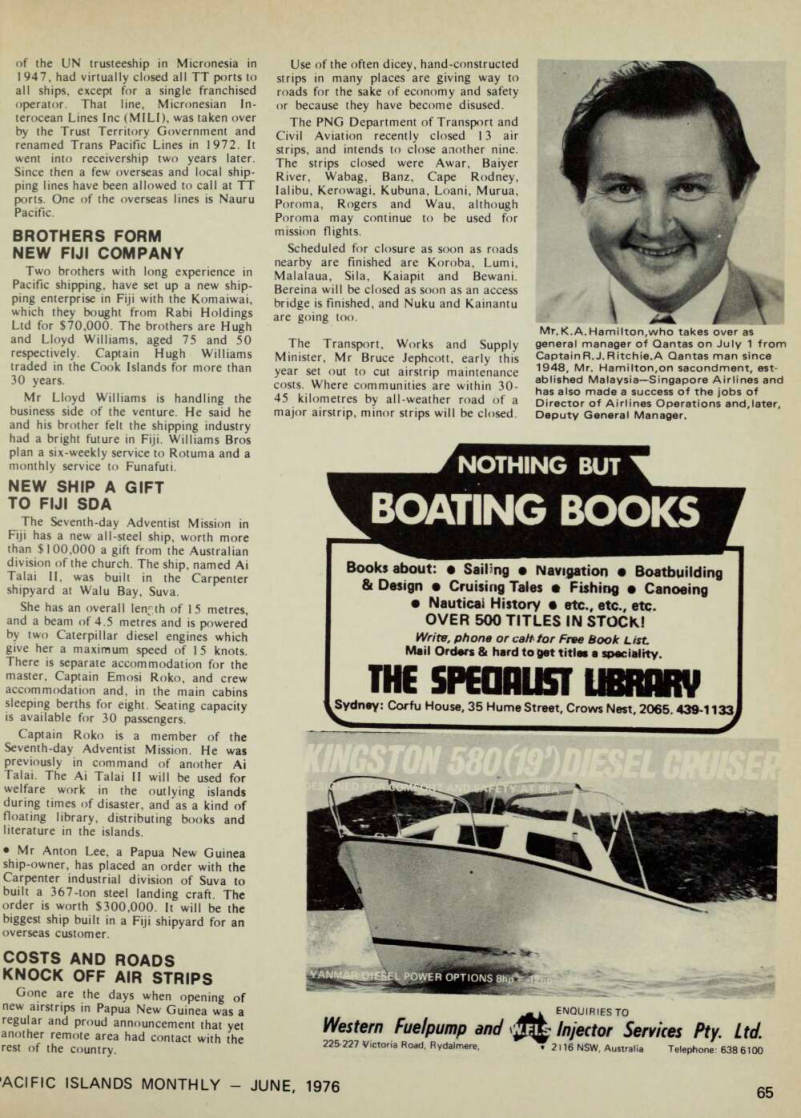
Mr. K. A. Hamilton,who takes over as general manager of Qantas on July 1 from CaptainR.J.Ritchie.A Qantas man since 1948, Mr. Hamilton,on sacondment, est ablished Malaysia—Singapore Airlines and has also made a success of the jobs of Director of Airlines Operations and,later, Deputy General Manager.