Business
pp. 59-60 · Read in the full issue
Palauans’ choicea living land or a big Cadillac
By Michael B. Brown
in Guam
The rapid and large social adjustment Palauans would have to make is not what is feared should the proposal for the world’s largest supertanker port for Palau in Micronesia become fact.
Having lived under the rule of foreign nations for centuries, Palauans are used to adapting to change.
But the environment is another matter.
A great many Palauans feel that too much of that which makes Palau a wonderful place in which to live, and unusual in the world, would be lost.
To a great extent, the people living in Palau subsist on what is provided for them by the sea. In fact, the Palau marine en vironment is internationally famous for its abundance and purity.
Conceivably, all this may drastically change, and Palau soon may find itself to be an advanced military-industrial com plex instead of a storybook cluster of tropical islands sleeping behind its living reef, with its people enjoying its clear waters, coral gardens, vest-pocket beaches and mushroom-like rock islands.
For, unlike developed countries in terested in the project, Palau has relatively few environmental protection laws, mak ing this already-geographically desirable port site even more desirable because of the minimal investment required for en vironmental protection.
The oil storage and distribution port to serve the Western Pacific was proposed in May 1975, in a report by New York Con sultant, Robert Panero, prepared for Japanese, US and Iranian government in terests, to store up to three months supply of oil at least 3.4 million tons and to cost around $4OO million.
It was intended to be at Kossol Reef,
Babelthuap, Palau’s largest island, a large
natural anchorage.
Ever since, Palauans have demanded that appropriate other studies be made, and their results given to the public, before they make an official stand on the issue.
Although the entire project has been in the making since October, 1974, when Panero, C.A. Zraket, and John Gasparotti
suggested that Palau be the site of the supertanker port, no information on en vironmental and/or cultural impact, produced by a non-biased party, has sur faced.
Because information concerning impor tant aspects of the proposal is scattered and vague, confusion among the Palauans has resulted. A great number of Palauans are still keeping quiet about the whole af fair because they need more information.
But there are many Palauans for the port, and the expected revenue it is supposed to bring these people, and many against, due to the probable damage to the environ ment.
For a people in need of an economic base, it is surprising to note that the Palauans have yet to accept officially what appears to be an answer to their economic problems. A great number of jobs would be created by the port facility, and it is predicted that some $6O to $BO million would be the Palauan people’s annual share.
“You Americans brought us into Civilization,’’ exclaimed Johnny Bekebekmad, a Palauan entertainer living on Saipan, “now let us get the means to
On its own with present prospects Micronesia was bankrupt. The brightest spot on the horizon for Micronesia’s economic development was the Palau
superport project.
This was the opinion expressed by Director of Territorial Affairs, Fred M.
Zeder, when he came from Washington and talked to the Guam Rotary Club and Chamber of Commerce about the
severe financial problems facing
Micronesia and Guam.
Looking to the problems of Micronesia in five years time “when the US presence won’t be what it is today”, Zeder said the 100,000 people of the Trust Territory were far from economic
self-sufficiency.
He praised the Port Pacific plan for Palau, and said, “With something of that magnitude we can have a very sound economy in Micronesia”.
He called the Palauans “probably the most business-oriented of all the islanders”, after he was presented on Saipan with a letter from six Palau legislators asking for the superport feasibility study to be expedited.
For the rest of Micronesia he held out the possibility of “some real oil finds in the area of the Marianas Trench” and said he was in touch with Shell, Texaco and Hunt oil companies about explora tion of the world’s greatest ocean depth at 36,198 ft.
Micronesian News Service
pay your prices.” Bekebekmad claimed he was neither for nor against the proposed port for his home islands, but he made one point clear: Palau, whether it likes it or not, is part of the twentieth century, and the proposed superport could make life very comfortable for a people who will have to make drastic lifestyle changes along with the ones the port will bring.
The Guam-based Pacific Daily News reported in April, that opposition to the
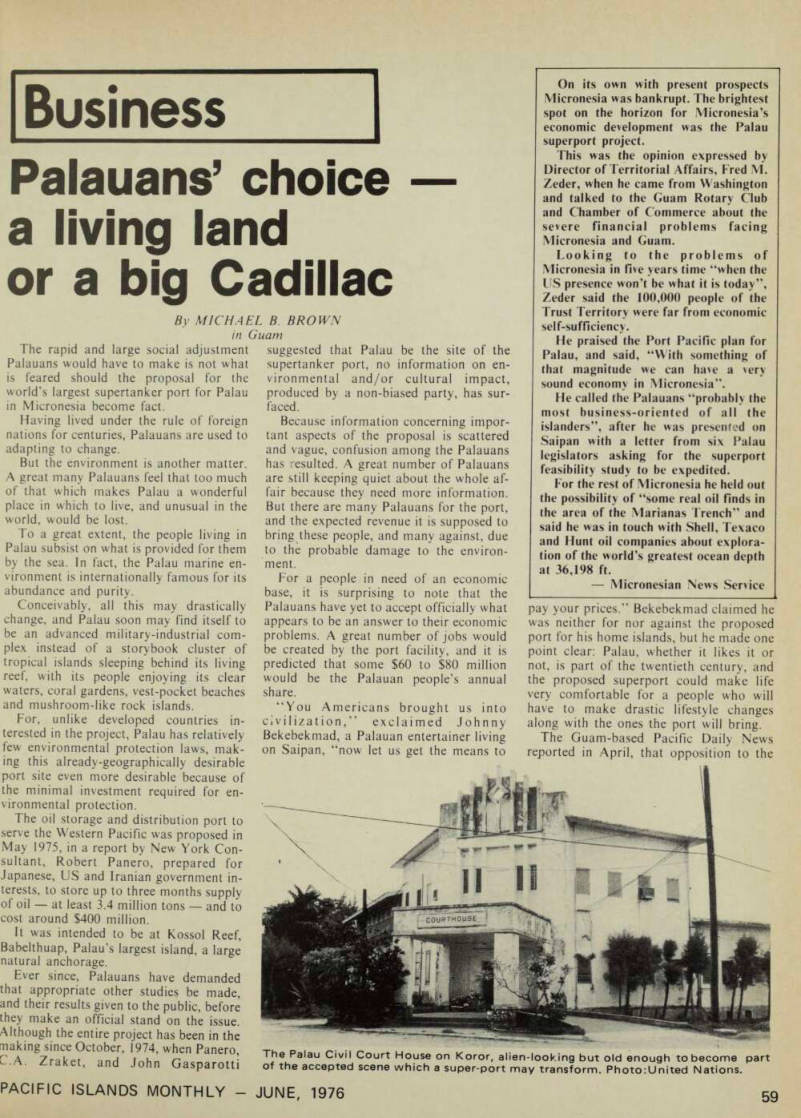
The Palau Civil Court House on Koror, alien-looking but old enough to become part of the accepted scene which a super-port may transform. Photo:United Nations.
port is growing in Palau. The young High Chief Ibedul of Palau, recently discharged with honour from the United States Army, claimed he “. . . can see the damage it (the proposed superport) is going to do to the water, marine life and the traditional way of life.”
The High Chief is the chairman of the Save Palau Organisation, a group formed primarily to stop the port’s construction, and he has asked that all the traditional chiefs of Palau “stand with him” in order that Palau may be saved from the port.
Iran, the country believed to be the na tion that will sell oil to consuming nations that will, in turn, ship the oil through Palau, has made no official stand on the issue. A Palauan delegation, though, has just returned from Iran where it held dis cussions, and a high government official working in Palau reported that “Iran and the United States are deadlocked” on the security end of Port Pacific at Palau.
This government source, who wishes to remain anonymous, reported, “Iran isn’t about to let her oil be stored in an un protected port facility in Palau”.
Among other demands, the Iranian Government wants the US Navy to provide round-the-clock patrols of Port Pacific at Palau.
The United States position on the super port is confusing. In fact, the US position is downright mysterious. For instance, while in Japan, Edward Johnston the High Commissioner for the Trust Territory of the Pacific Islands (Palau is one of the five districts in this trusteeship) told some Japanese officials that the final decision on the superport “must be made solely by the Palauans.” Yet he refused to let some visiting marine biologists from the Univer sity of Guam inspect the proposed port’s site. No reason was given for the refusal.
Reportedly, some American Intelligence
people appeared in Palau shortly after the proposal was made, for the purpose of recruiting “spies” for informational pur poses. As yet no official US stand on the proposal has been made, and it appears as though the United States wants more in formation, like many Palauans.
In general, most people don’t want supertankers or oil ports near where they live. Writing for The Far Eastern Economic Review recently, Roger Gale tells of how the fishermen and ecologists of Japan, a country that is dependent on im ported oil for 80 per cent of its energy needs, “. . . have virtually guaranteed that no large central terminal storage tank farms will ever be built in either mainland Japan or in Okinawa.”
While it is true the Japanese people have prevented the construction of ports similar to the one proposed for Palau, it is also true that they had the means to do so. Not so with Palau, as pointed out.
In a recent article published in the environment-oriented Audubon, Noel
Mostert writes, “There is scarcely a week that some tanker accident does not occur; sometimes there are several. Many of the worst pass completely unnoticed by the public.”
And the National Academy of Sciences, in Washington, DC, reported recently that, “. . . the quantity of oil entering the oceans from transportation-related sources has been increasing every year; given future in creases in production and transport, it is possible that transportation-related inputs will continue to increase despite the current interest and activity in control measures.” Thus, more oil will probably spill into the oceans than we can remove.
The present tankers used measure up to 250,000 tons (DWT). They transport oil from producing nations to consuming ones in ships with sometimes defective hulls 1-2 in thick. The tankers referred to by Panero in his port proposal for Palau measure out at a giant 1 MILLION (DWT), or four times larger than the tankers being used
today.
Noel Mostert warns that “. . .it is probable we are now entering the age of really giant spills.” It would seem, therefore, based on reports about super tankers and their frequent spills, that the chances of a major spill occurring in Palau
are overwhelming.
The proponents of ‘Port Pacific at Palau,’ whether they like it or not, are go ing to have to produce some valid en vironmental and cultural impact studies before they can proceed with their plans.
This much they owe the people of Palau.
But even after all information is available, don’t be surprised if the Palauans still op pose the port for their islands.
As Uchel Sechewas, a Palauan studying at the University of Guam, said, “I want to leave some land and some reef, something alive, to my children. I sure don’t want to leave behind just a one-acre lot and a Cadillac.”
Fiji hotels Big loss
The Naviti Resort Hotel, at Votualailai, on the south coast of Fiji’s Viti Levu, contributed $448,832 of a loss of $602,471 for Naviti Investments Ltd in 1974-1975. The luxury hotel is operated by Votualailai Ltd, a subsidiary of Naviti Investments. It opened its doors just as the Fiji tourist boom was tapering off and is now something of a white elephant.
The holding company, Naviti In vestments, incurred a loss of $49,079.
Other losses were, Makita Holdings Ltd, $83,450; Motels of Fiji Ltd, $5,856; Solomon Islands Investments Ltd, $1 5,254.
The directors said the year was the most difficult the company had faced since its formation about eight years ago. Liquidity problems had not been altogether solved.