romance through
pp. 54-55 · Read in the full issue
Queen Emmaromance through a novelist’s rose-coloured glasses
Books
In 1879, Emma Eliza Forsayth, nee Coe, aged 29, daughter of Jonas Mynderse Coe, US citizen, whose forebears had settl ed at New York in 1634, and Le’utu, a Sa moan lady of the Malietoa lineage, started a commercial enterprise in New Guinea which was worth over $1 million when she sold it 30 years later.
Queen Emma, as she became known throughout the Pacific, was educated in Sydney and San Francisco. From the late 1860 s until her departure for New Guinea, she assisted her father with his US com mercial agency and other interests.
In an age when very few women anywhere in the world took part in com merce, Emma displayed a business acumen unsurpassed by her male competitors. And she was her father’s confidante in the often violent political struggle which involved not only the Samoan lineages and the US, German and British governments and commercial interests but also the different Christian missions.
Her liaison with Colonel Albert Steinberger, who had come to Samoa as special envoy from President Grant, gave her an initial advantage in her efforts to further her father’s affairs, but even she could not prevent commercial rivals in the US and Samoa, supported by mis sionaries, triumphing over Steinberger and her father. The former was expelled from Samoa; Coe’s services as US commercial agent were terminated.
Throughout those years, her Fa’a Samoa life-style and her aggressive ap proach in business and politics caused Emma to be persona non grata with Apia’s white women who, in any case, considered themselves a cut above any part-Samoan.
In 1869, Emma married James For sayth, a Scot, who owned a hotel and other businesses in Apia. Nine years later, For sayth in the meantime having been reported lost at sea, she and her latest lover, Thomas Farrell, an Australian, sail ed for New Guinea.
They first settled in the Duke of York Islands, with Farrell recruiting and trading. In 1882, they moved to Ralum on the Gazelle Peninsula and Emma began to acquire vast tracts of land from the islanders. She had recognised that far more money could be made from plan-
tations than by buying copra from villagers. Her plantation enterprises and there were to be many were greatly helped by numerous Samoan relatives and friends whom she employed as overseers.
Emma’s greatest stroke of luck was hav ing the assistance of her sister Phebe and Phebe’s husband, Richard Parkinson.
Phebe became fluent in Kuanua, the language of the Tolai people, and she was to establish a relationship of mutual trust with New Guineans wherever she went. To quote Dr Margaret Mead, who recorded Phebe’s story in an interview with her in 1929, Phebe “remains the best excuse for European invasion of the graceful Polyne sian world, for she showed what a Polyne sian can do with European values when they are grafted on to a firm belief and pride in Polynesian blood’’.
Parkinson gained fame through his botanical and ethnological collections and observations. His book, Dreissig Jahre in der Sudsee, remains the best account of the Tolai and other people of his times. He was the first planter of any note to grow coconuts in New Guinea, and he in troduced cattle, horses, goals and other
livestock, and cacao, coffee and other cash crops on Emma’s plantations.
When the Marquis de Rays expedition to New Ireland, organised by a French rogue to settle some of his compatriots and other whites in New Guinea, failed, Emma and Farrell got hold of much of the sur vivors chattels and equipment, thereby laying the foundations of her great wealth.
This windfall enabled her to compete with the Deutsche Handels-und Plantagen- Gesellschaft, a large German concern which had begun to establish itself.
As R.W. Robson stressed in his book Queen Emma, a comprehensive biography first published in 1965 and now in its third revised edition, Emma’s enterprises were developed in a truly frontier situation.
There was much tribal fighting, can nibalism, and skirmishes, often bloody, between islanders and whites. On one oc casion, some villagers seized Emma near her residence at Gunantambu, trussed her to a pole and made off with her. Parkinson and several of her trusted Buka employees rescued her in the nick of time.
She would most likely have shared the fate of a village woman who was captured and eaten near Ralum, after first having been raped. Punitive expeditions, usually led by German officials or naval officers, were frequent, with loss of life on both sides.
Gunantambu was a show place, its bungalow the finest in the Pacific. Horse drawn carriages pulled up at a 20 ft wide cement staircase which led to an interior furnished with fin-de-siecle opulence, where the hostess proffered the best of im ported foods and beverages. Maids and footmen waited on Emma and her guests.
Not for nothing was she known as Queen Emma.
Her marriage, in 1893, to Paul Kolbe, a German cavalry officer who had come to New Guinea as plantation manager for the Imperial Administration, was contracted to provide her with the social status that had been denied her in Samoa.
With the arrival of more German of ficials, businessmen and settlers, Emma’s social pre-eminence became diminished.
After selling E.E. Forsayth & Co in 1903, she intended to settle in Sydney. She died 10 years later, while on a tour of Europe.
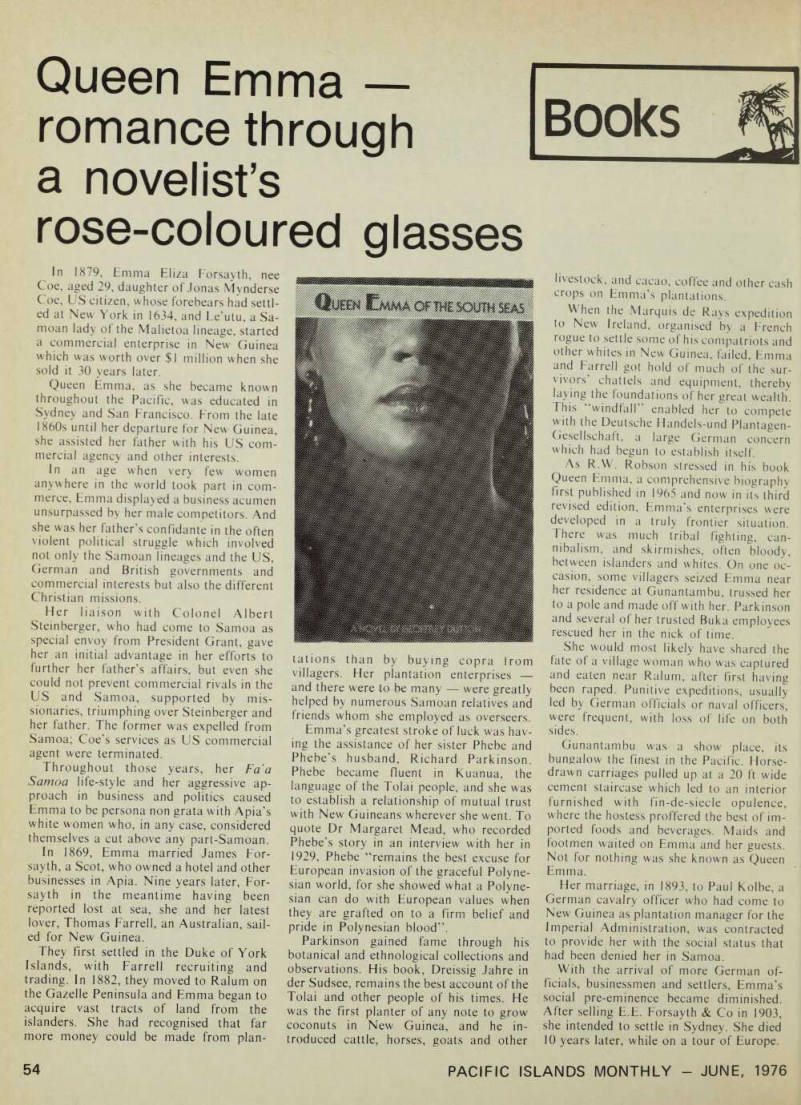
In his new book, Queen Emma of the South Seas, Geoffrey Dutton has Emma and some of her contemporaries reminisce or write, by “putting words in their mouths”. This does, of course, involve the author’s value judgment in selecting historical material. In addition, it demands a binding cement, manufactured by his im agination, for this is a novel.
After making several checks, eg what Dutton shows as a letter from Richard Parkinson to George Le Hunte against the “real” letter in the Mitchell Library, Sydney and of the observations with which Dutton credits Count Festetics de Tolna against Tolna’s book Vers L’Ecueil de Minicoy I believe that the research has been done with integrity.
Dutton acknowledges in the epilogue that Bob Schultze “had patiently helped in every aspect of research, especially to do with German documents, and the
knowledge accumulated during his long
residence in the New Ireland, New Britain area has been invaluable”. (I first met Bob Schultze in 1951, on a plantation started by his father in 1904. Adolf Schultze, Ger man vice-consul at Brisbane, had gone to New Guinea in 1901, become a planter, and married Caroline Rosminia Coe, one of Emma’s nieces.) More often than not, history books by academics are dry as dust, and it is left to the historical novel to bring before the or dinary reader the fascination" of the past.
Great historians such as Mommsen, Macaulay and Halevy bore most laymen and are rarely read today, and the same goes for many modern historians. But the novels of Dickens, Zola and Mann, by their present-day successors, and histories
by journalists Moorehead comes to mind enjoy a wide and enduring readership.
The sub-title of this book describes it as a novel. Nevertheless, like some of the author’s output listed as biographies, eg Founder of the City, the Life of William Light, or The Hero as Murderer, the Life of John Edward Eyre, it is a biographical novel, just as they are. And it is just as superbly done. Scholarship and erudition are matched by sensitivity and style. The text does justice to the quotes from Defoe, Baudelaire, Goethe, et al.
As for the author’s value judgments,
they are simply that judgments and
some readers may, for instance, prefer the interpretation of Emma’s world put forward in R.W. Robson’s Queen Emma, which is a straight biography, not a novelised version.
The view of Emma’s life as put fopward by Robson is, in my view, the more ac curate of the two books. Robson saw Emma as hard, ruthless to the point of be ing crooked in some of her dealings. She could be cruel and avaricious.
Dutton is too kind to Emma; she’s been romanticised. I believe that Dutton has come to accept this view because he is looking at her through the eyes of Phebe, who was indisputably a softer, more sym pathetic character. Phebe got on well with the islanders. Emma disliked the islanders, they were all kanakas to her. But in both books the islanders are mere shadows, a background to the setting.
Dutton’s Queen Emma of the South Seas is not an easy book to read. Because of its structure, it needs to be read through, and then re-read, if one wants to come to grips with it, and get full flavour from it. I cannot think of a better way to end this review than by quoting the first sentences of Chapter I, attributed to Phebe Parkin son: / wz// soothe with the sound of names.
Gunantambu. Gun-an-tambu. Emma’s house over the steps over the sea.
Volcanoes, clam shells, lemons.
Malapau, where we first lived.
Kuradui. The plantation she gave Richard and me. Ku-ra-dui. Gun-an tambu. Ma-la-pau. Soft native names.
Emma could never learn a language.
But she could speak the language of figures. And read them. And money would talk back to her. the wy it never did to Richard or me. Oh she was a great reader, my sister, she was the clever one, books as well as figures.
Politics, history, even medicine. Ganz bestimmt!
Yes, that was the real Emma, but in the following chapters Dutton comes close to losing that view of her. Harry Jackman. (QUEEN EMMA OF THE SOUTH SEAS. By Geoffrey Dutton. Published by MacMillan of Australia, Sydney, 1976. $7.95).
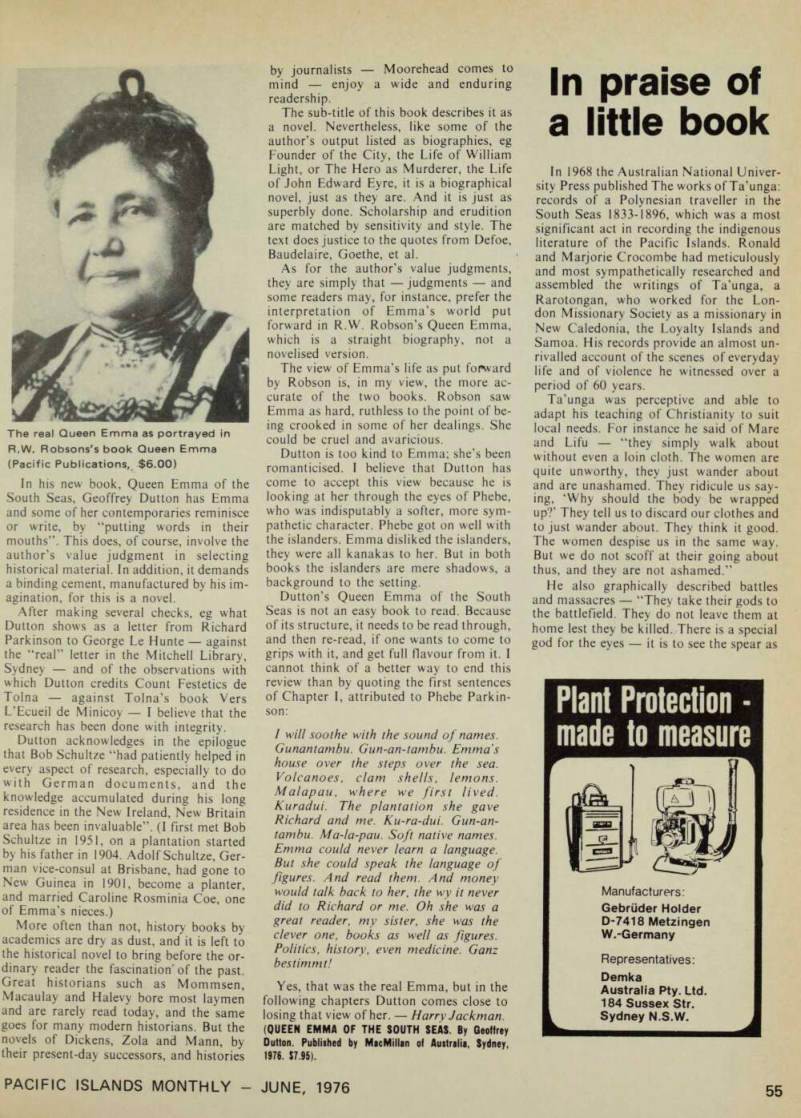
The real Queen Emma as portrayed in R.W. Robsons's book Queen Emma (Pacific Publications, $6.00)