Tropicalities
pp. 16-18 · Read in the full issue
Rebuilding
your island
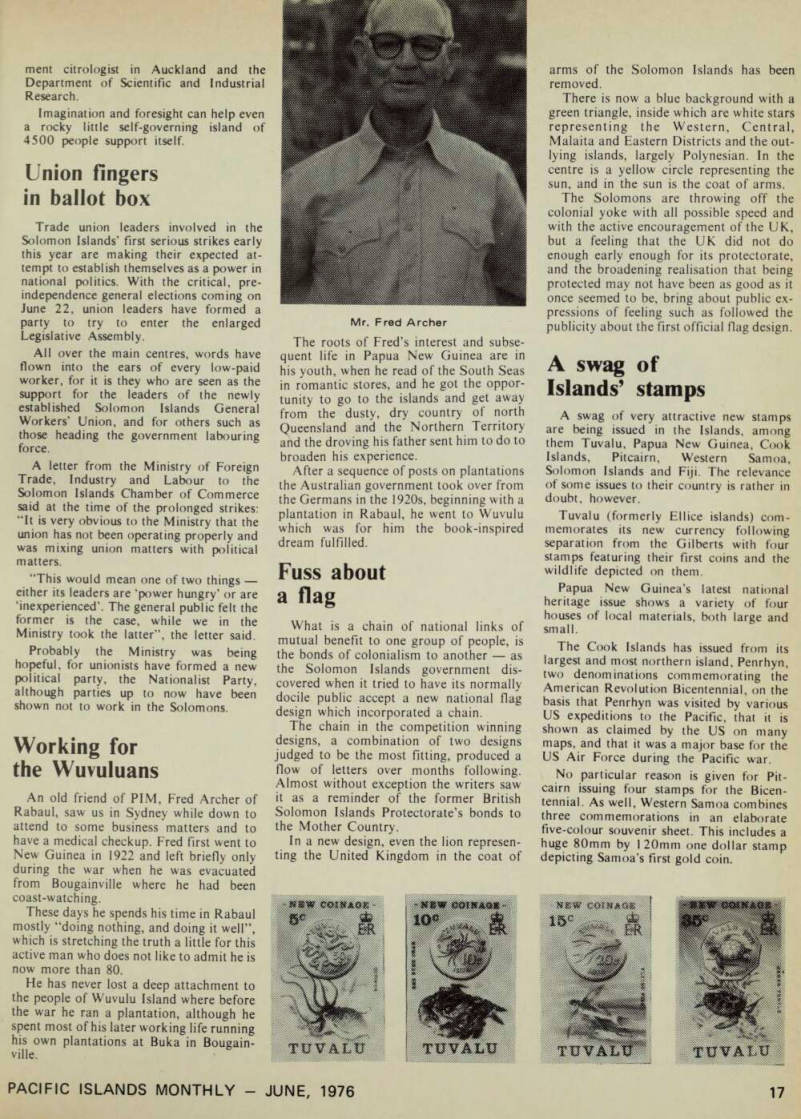
Rebuilding your island when it is washed away by big seas or demolished by cyclones is part of life for the occupants of the artificial islands of the Solomon Islands most of them in the glorious lagoons around the most populous island, Malaita.
The people of Ngongosila village in the Kwai area have set aside a day each week to work on restoring their little island, stone by stone, which was eroded by big seas. All the stones, or coral lumps, are collected by hand and carried by canoes to build the islands up so they are above the tides, and to erect walls where necessary.
As few as one family may live on these islands which are usually free of malaria mosquitoes and other pests because of their positions off-shore.
On others 200 or 300 people may live, and gardens and trees grow after generations have passed.
The welfare state has a part today in maintaining the islands, unlike the days past when it was a matter of the interested parties making all the effort. And a little modern technology as well.
Ngongosila villagers, for instance, believe that by starting the work themselves the Malaita local government council will help by organising some cabions (stones wrapped in wire netting) to be made and placed to stop sand being washed into the sea and individual stones being washed away. The council says it can help only if the damage to the island is serious.
Outlaw
adultery
Adultery has been regarded very seriously in many of Papua New Guinea’s local traditions even to carrying the death penalty in at least one part of the Sepik, as the Law Reform Commission of Inquiry discovered in Wewak.
These traditional values have not held so well, however, among many of the more westernised Papua New Guineans.
Which makes it fascinating to ponder the fate of approaches to the Commission to
recommend that traditional values should prevail, and laws be enacted to stamp out
adultery!
In Rabaul, a local magistrate asked the Commission to recommend severe punishment for adulterers, say a fine of K2OO plus 12 months’imprisonment. But he did not agree with submissions which suggested compensation for the husband or wife of an adulterer.
In Bougainville, the Commission was told that exploitation of women by expatriates and Papua New Guineans would not be tolerated any longer. People often ignored the adultery laws because they were too lenient. Local women had been used as playthings.
It was submitted that new adultery laws had to cover every section of the com-
munity, including one-day visitors
Cynics would be inclined to say that adultery cannot be legalised out of existence, even with a death penalty. Nor can murder, but adultery is undoubtedly more common. Would such laws be honoured, or be forced to become “dead letters” by the numbers of people breaking them at every level of society 7 Unlike stealing, for example, adultery might be said to happen more in high places than among simpler people, or certainly as much. PIM forecasts that adultery will be left largely for moralists to fight, rather than legislators.
Niue’s juicy
prospect
New Zealand has a reputation for organising the right kind of aid and the beginning of an export industry in lime juice by Niue is one example.
Tiny Niue’s entire lime crop is com mitted for at least the next three years to Innes Schweppes (NZ) Ltd, a soft drink manufacturer, beginning as 25,000 litres of juice this year and doubling by the third year.
Lime trees were planted six years ago with a grant from the NZ government.
Because Niue is rocky there are no large plantations. Each village has its trees in carefully cultivated plots of 10 to 30 trees, and each day a truck cir cumnavigates the island to pick up fruit
for processing.
Next step in developing the industry is to have Niue market fresh lime juice in NZ, and a soft drink bottling plant on the island is a possibility.
Innes Schweppes say the deal is good for NZ too. Niue is closer than the West Indies where the bulk of lime juice im ports have come from, so transport is cheaper, and Niue uses NZ currency, thus saving scarce foreign exchange.
The scheme is the result of co-operation between the company, the Niue Develop ment Board, the NZ government citrologist in Auckland, the NZ govern
An artificial island on Malaita
ment citrologist in Auckland and the Department of Scientific and Industrial Research.
Imagination and foresight can help even a rocky little self-governing island of 4500 people support itself.
Union fingers
in ballot box
Trade union leaders involved in the Solomon Islands’ first serious strikes early this year are making their expected at tempt to establish themselves as a power in national politics. With the critical, pre independence general elections coming on June 22, union leaders have formed a party to try to enter the enlarged Legislative Assembly.
All over the main centres, words have flown into the ears of every low-paid worker, for it is they who are seen as the support for the leaders of the newly established Solomon Islands General Workers’ Union, and for others such as those heading the government labouring force.
A letter from the Ministry of Foreign Trade, Industry and Labour to the Solomon Islands Chamber of Commerce said at the time of the prolonged strikes: “It is very obvious to the Ministry that the union has not been operating properly and was mixing union matters with political matters.
“This would mean one of two things either its leaders are ‘power hungry’ or are ‘inexperienced’. The general public felt the former is the case, while we in the Ministry took the latter”, the letter said.
Probably the Ministry was being hopeful, for unionists have formed a new political party, the Nationalist Party, although parties up to now have been shown not to work in the Solomons.
Working for
the Wuvuluans
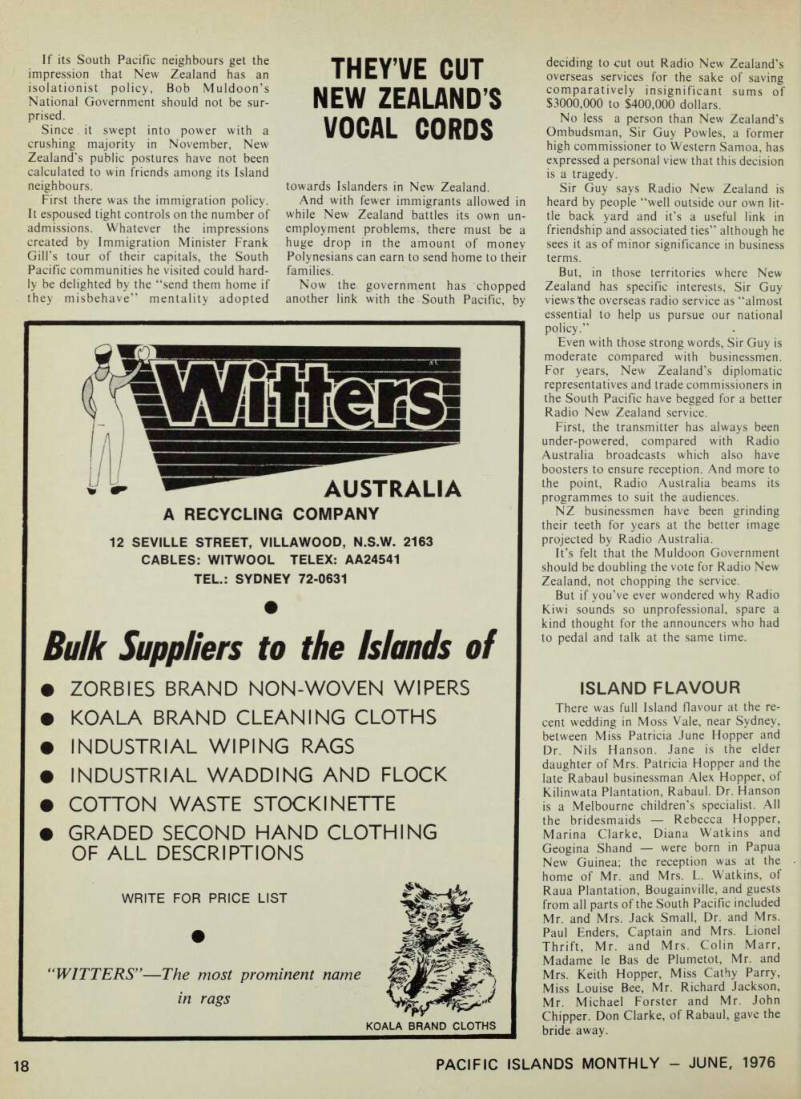
An old friend of PIM, Fred Archer of Rabaul, saw us in Sydney while down to attend to some business matters and to have a medical checkup. Fred first went to New Guinea in 1922 and left briefly only during the war when he was evacuated from Bougainville where he had been
coast-watching.
These days he spends his time in Rabaul mostly “doing nothing, and doing it well”, which is stretching the truth a little for this active man who does not like to admit he is now more than 80.
He has never lost a deep attachment to the people of Wuvulu Island where before the war he ran a plantation, although he spent most of his later working life running his own plantations at Buka in Bougain ville.
The roots of Fred’s interest and subse quent life in Papua New Guinea are in his youth, when he read of the South Seas in romantic stores, and he got the oppor tunity to go to the islands and get away from the dusty, dry country of north Queensland and the Northern Territory and the droving his father sent him to do to broaden his experience.
After a sequence of posts on plantations the Australian government took over from the Germans in the 19205, beginning with a plantation in Rabaul, he went to Wuvulu which was for him the book-inspired dream fulfilled.
Fuss about
a flag
What is a chain of national links of mutual benefit to one group of people, is the bonds of colonialism to another as the Solomon Islands government dis covered when it tried to have its normally docile public accept a new national flag design which incorporated a chain.
The chain in the competition winning designs, a combination of two designs judged to be the most fitting, produced a flow of letters over months following.
Almost without exception the writers saw it as a reminder of the former British Solomon Islands Protectorate’s bonds to the Mother Country.
In a new design, even the lion represen ting the United Kingdom in the coat of
arms of the Solomon Islands has been removed.
There is now a blue background with a green triangle, inside which are white stars representing the Western, Central, Malaita and Eastern Districts and the out lying islands, largely Polynesian. In the centre is a yellow circle representing the sun, and in the sun is the coat of arms.
The Solomons are throwing off the colonial yoke with all possible speed and with the active encouragement of the UK, but a feeling that the UK did not do enough early enough for its protectorate, and the broadening realisation that being protected may not have been as good as it once seemed to be, bring about public ex pressions of feeling such as followed the publicity about the first official flag design.
A swag of
Islands’ stamps
A swag of very attractive new stamps are being issued in the Islands, among them Tuvalu, Papua New Guinea, Cook Islands, Pitcairn, Western Samoa, Solomon Islands and Fiji. The relevance of some issues to their country is rather in doubt, however.
Tuvalu (formerly Ellice islands) com memorates its new currency following separation from the Gilberts with four stamps featuring their first coins and the wildlife depicted on them.
Papua New Guinea’s latest national heritage issue shows a variety of four houses of local materials, both large and small.
The Cook Islands has issued from its largest and most northern island, Penrhyn, two denominations commemorating the American Revolution Bicentennial, on the basis that Penrhyn was visited by various US expeditions to the Pacific, that it is shown as claimed by the US on many maps, and that it was a major base for the US Air Force during the Pacific war.
No particular reason is given for Pit cairn issuing four stamps for the Bicen tennial. As well, Western Samoa combines three commemorations in an elaborate five-colour souvenir sheet. This includes a huge 80mm by 120 mm one dollar stamp depicting Samoa’s first gold coin.
Mr. Fred Archer
If its South Pacific neighbours get the impression that New Zealand has an isolationist policy, Bob Muldoon’s National Government should not be sur prised.
Since it swept into power with a crushing majority in November, New Zealand’s public postures have not been calculated to win friends among its Island
neighbours.
First there was the immigration policy.
It espoused tight controls on the number of admissions. Whatever the impressions created by Immigration Minister Frank Gill’s tour of their capitals, the South Pacific communities he visited could hard ly be delighted by the “send them home if they misbehave” mentality adopted
They’Ve Cut
New Zealand’S
Vocal Cords
towards Islanders in New Zealand.
And with fewer immigrants allowed in while New Zealand battles its own un employment problems, there must be a huge drop in the amount of money Polynesians can earn to send home to their families.
Now the government has chopped another link with the South Pacific, by
deciding to cut out Radio New Zealand’s overseas services for the sake of saving comparatively insignificant sums of $3000,000 to $400,000 dollars.
No less a person than New Zealand’s Ombudsman, Sir Guy Powles, a former high commissioner to Western Samoa, has expressed a personal view that this decision is a tragedy.
Sir Guy says Radio New Zealand is heard by people “well outside our own lit tle back yard and it’s a useful link in friendship and associated ties” although he sees it as of minor significance in business terms.
But, in those territories where New Zealand has specific interests, Sir Guy views the overseas radio service as “almost essential to help us pursue our national policy.”
Even with those strong words, Sir Guy is moderate compared with businessmen.
For years, New Zealand’s diplomatic representatives and trade commissioners in the South Pacific have begged for a better Radio New Zealand service.
First, the transmitter has always been
under-powered, compared with Radio
Australia broadcasts which also have boosters to ensure reception. And more to the point, Radio Australia beams its programmes to suit the audiences.
NZ businessmen have been grinding their teeth for years at the better image
projected by Radio Australia.
It’s felt that the Muldoon Government should be doubling the vote for Radio New Zealand, not chopping the service.
But if you’ve ever wondered why Radio Kiwi sounds so unprofessional, spare a kind thought for the announcers who had to pedal and talk at the same time.
Island Flavour
There was full Island flavour at the re cent wedding in Moss Vale, near Sydney, between Miss Patricia June Hopper and Dr. Nils Hanson. Jane is the elder daughter of Mrs. Patricia Hopper and the late Rabaul businessman Alex Hopper, of Kilinwata Plantation, Rabaul. Dr. Hanson is a Melbourne children’s specialist. All the bridesmaids Rebecca Hopper, Marina Clarke, Diana Watkins and Geogina Shand were born in Papua New Guinea; the reception was at the home of Mr. and Mrs. L. Watkins, of Raua Plantation, Bougainville, and guests from all parts of the South Pacific included Mr. and Mrs. Jack Small, Dr. and Mrs.
Paul Enders, Captain and Mrs. Lionel Thrift, Mr. and Mrs. Colin Marr, Madame le Bas de Plumetot, Mr. and Mrs. Keith Hopper, Miss Cathy Parry, Miss Louise Bee, Mr. Richard Jackson, Mr. Michael Forster and Mr. John Chipper. Don Clarke, of Rabaul, gave the bride away.