Clues To
pp. 8-9 · Read in the full issue
Atoll May Reveal
Polynesia’S Past
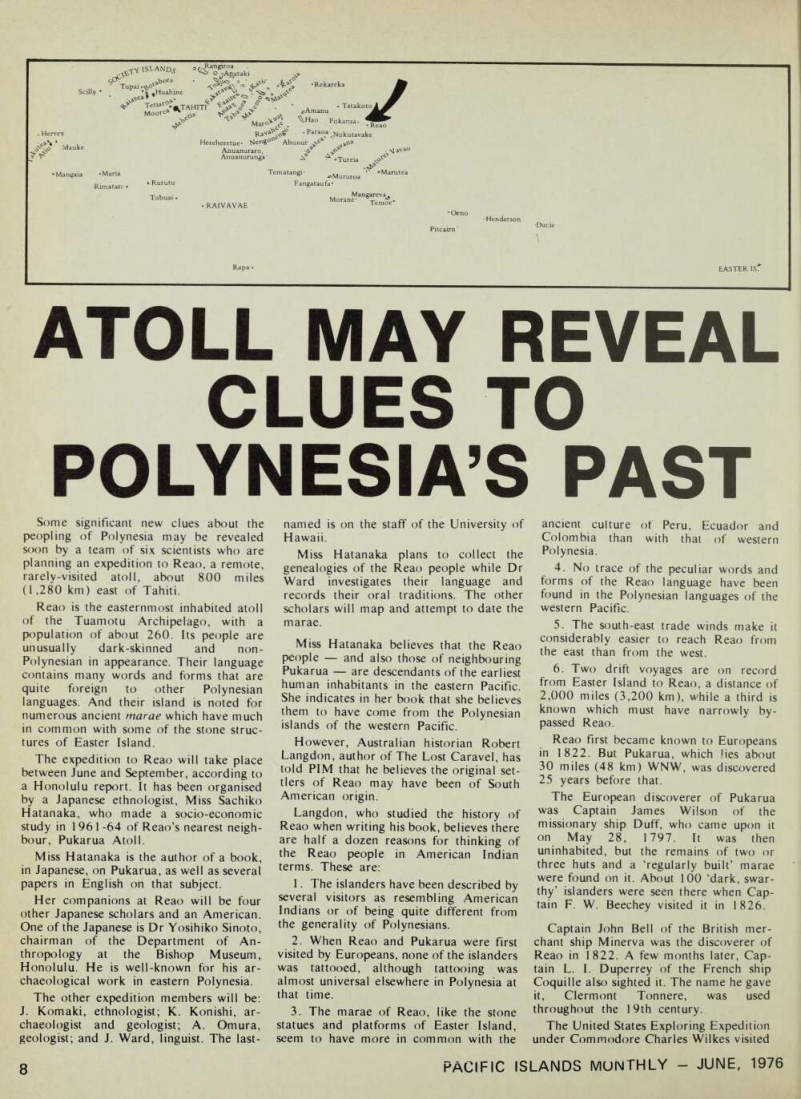
Some significant new clues about the peopling of Polynesia may be revealed soon by a team of six scientists who are planning an expedition to Reao, a remote, ato i’ T a rP. ut miles (1,200 km) east of Tahiti.
Reao is the easternmost inhabited atoll of the Tuamotu Archipelago, with a population of about 260, Its people are unusually dark-skinned and non- Polynesian in appearance. Their language contains many words and forms that are quite foreign to other Polynesian languages. And their island is noted for numerous ancient marae which have much in common with some of the stone structures of Easter Island.
The expedition to Reao will take place between June and September, according to a Honolulu report. It has been organised by a Japanese ethnologist, Miss Sachiko Hatanaka, who made a socio-economic study in 1961-64 of Reao’s nearest neighbour, Pukarua Atoll.
Miss Hatanaka is the author of a book, in Japanese, on Pukarua, as well as several papers in English on that subject.
Her companions a, Reao will be four other Japanese scholars and an American.
One of the Japanese is Dr Yosihiko Sinoto, chairman of the Department of Anthropology at the Bishop Museum, Honolulu. He is well-known for his archaeological work in eastern Polynesia.
The other expedition members will be: J. Komaki, ethnologist; K. Konishi, archaeologist and geologist; A. Omura, geologist; and J. Ward, linguist. The last-
named is on the staff of the University of Hawaii.
Miss Hatanaka plans to collect the genealogies of the Reao people while Dr Ward investigates their language and records their oral traditions. The other scholars will map and attempt to date the marae.
Hatanaka believes that the Reao , s Malar| aKa believes that the Reao and also those of neighbouring Pukarua are descendants of the earliest human inhabitants in the eastern Pacific. md,cates m her book that she believes f hem to ha ve come from the Polynesian elands of the western Pacific.
However, Australian historian Robert La "g do "; a l Uthor of The Lost Caravel ’ has told PIM that he believes the original settlers of Reao ma V have been of South American origin.
Langdon, who studied the history of Reao when writing his book, believes there are half a dozen reasons for thinking of the Reao people in American Indian terms - These are: 1. The islanders have been described by f-ral visitors as resembling American Indians or of being quite different from
the generality of Polynesians.
2. When Reao and Pukarua were first visited by Europeans, none of the islanders was tattooed, although tattooing was almost universal elsewhere in Polynesia at tbat time. 3. The marae of Reao, like the stone statues and platforms of Easter Island, seem to have more in common with the
ancient culture of Peru, Ecuador and Colombia than with that of western
Polynesia.
4. No trace of the peculiar words and forms of the Reao language have been found in the Polynesian languages of the western Pacific. 5, The south-east trade winds make it considerably easier to reach Reao from
th . f .
6 - I wo dr ' ' voyages are on record Ea « er ‘ S ‘ a^ n t ? R f ao ’ a . d,Bta u n “ of miles (3,200 km), while a third is know " which must have narrowly by passe eao.
Reao pirst became known to Europeans
? n a? J?** aboU j
miles (48 km) WNW, was discovered y ears betore that - The European discoverer of Pukarua was Captain James Wilson of the missionary ship Duff, who came upon it on . May 28, 1797. It was then uninhabited, but the remains of two or three huts and a regularly bu.lt marae ? ° n ll ‘ About 100 dark, swar f w m Captain John Bell of the British mer chant ship Minerva was the discoverer of Reao in 1 822. A few months later, Cap tain L. I. Duperrey of the French ship Coquille also sighted it. The name he gave it, Clermont Tonnere, was used throughout the 19th century, The United States Exploring Expedition under Commodore Charles Wilkes visited
both Keao and Pukarua in 1839. Thereaf ter, neither atoll seems to have had any contact with Europeans until 1 860 when a schooner owned by John Brander of Tahiti called at Pukarua and brought away seven islanders who had saved the life of a Mangarevan castaway several years earlier.
In 1865, the Catholic missionaries at Mangareva sent a schooner to both Reao and Pukarua and persuaded about 80 islanders to go to Mangareva, where they were indoctrinated in the Catholic faith.
They were repatriated about a year later.
The further evangelisation of Pukarua and Reao was then left to the Catholic mission at Anaa Atoll, 250 miles (400 km) east of Tahiti. But it was no easy task.
When Father Albert Montiton set out to reach Reao in the mission schooner Vatikana in 1869, contrary winds forced him back. Four years later, Father Ger main Fierens managed to reach the island, but a furious wind and sea prevented his landing on it. Finally, in 1874, a third priest, Father Vincent de Paul Terlyn, ef fected a landing. He stayed there for several months and built Reao’s first church.
Apart from Catholic missionaries, Reao and Pukarua have had little contact with Europeans over the past 100 years. Reao’s chief claim to fame in modern times is that in 1936 it was constituted the leprosarium for the Tuamotu Archipelago, following the discovery of several cases of leprosy on the island. The leprosarium has since been closed.
A former PIM correspondent in Tahiti, the late A. C. Rowland, was convinced that the Reao people were of American Indian descent. Writing in PIM in July, 1947, about the time the Kon-Tiki ex pedition set out from Peru, he said: The long-isolated, far-eastern island, Reao whose strange people have retained the physical characteristics of a non- Polynesian ancestry, whose massive stone platforms and arrangements of stone pillars correspond with those of Easter Island presents convincing evidence of migration from the east.’
Reao’s stone structures were examined by Dr. K. P. Emory during a 19-day stay on the atoll in 1929. The late J. Frank Stimson made a study of the local language on the same occasion.
No ethnological expedition has visited the atoll since then.