How to tender her with care
pp. 65-66 · Read in the full issue
When you buy a boat, big or small, it’s only the beginning of the adventure and of your love affair with the boat and the sea.
Power or sail, or both, your boat will become a living thing, and you’ll tender it with care. You’ll need to; boats have enemies. But, don’t worry. As there are many types of boats, so there are many ad visers, many experts. They’ll help to solve your problems which are compounded in
tropical waters.
Some of the problems have been solved with the advent of fibreglass, a revolution which has made mass-production of boats possible. But amateur builders, generally, haven’t been able to take advantage of fibreglass properties because of the high cost of the plug or mould.
The recent advent of closed cell pvc foam has made the production of one-off boats in fibreglass a more viable proposition not only for the amateur but also for the professional who is seeking lightweight with great strength.
Perhaps the most successful of the available foams is the Swiss product called “Airex” which has been used in the building of some of the world’s top ocean racers and cruising boats. This foam is supplied in sheets die cut into 1 >/2 in in terconnected squares which allows it to be easily shaped into compound squares.
Airex will not absorb water, crumble or deteriorate. It has good resistance to aging and will not rot.
A good, tough finish is essential. Fillers, glues, preservatives, varnishes, all are needed and if a vessel is left at a mooring, a good anti-fouling at regular intervals is
important.
A New Zealand company, Consolidated Chemicals Ltd, markets a full range of marine protective coatings, finishes and adhesives throughout the Pacific and offers a “man-on-the-spot” for advice and ser vice.
Not for nothing have boats, and ships, been endowed with feminine qualities as part of the love affair.
“She’s this and she’s that”, say the boatees and yachtees whenever they get together. And, like women, boats come in many shapes and sizes. Design is everything, and today the computer, the testing tank and man’s ingenuity have put together some excellent craft.
Like for instance, the three types touched upon here.
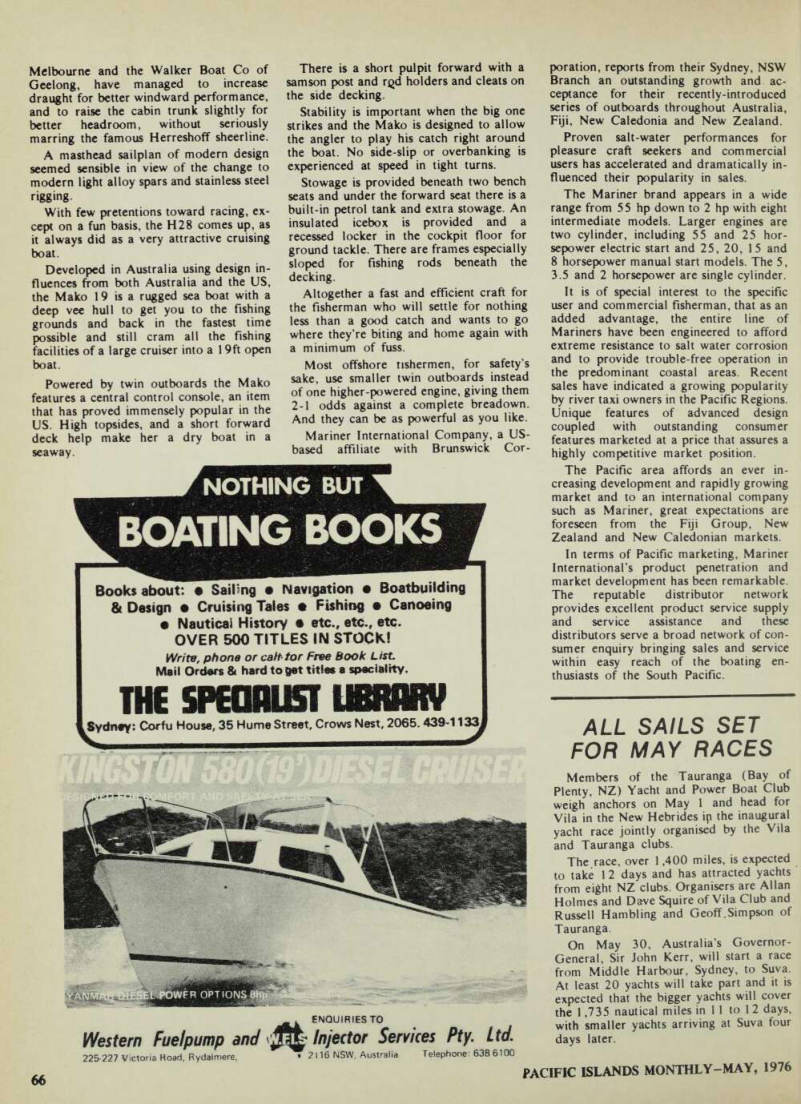
There’s the Kingston 580 diesel cruiser, the harbinger of a completely new breed of workboat-based pleasure craft, and one of the very few displacement pleasure boats being built in the Pacific area.
Distributed by Western Fuelpump and
Injector Services, of Sydney, the Kingston is powered by a proven Yanmar diesel engine, features a small cabin with two bunks, marine toilet and storage space all under a traditional-style cain trunk which provides comfortable sitting headroom.
The cabin has lockable doors and steering is with a traditional “ship’s wheel” Three engines are listed, 8, 1 2, or 24 hp and offer economy of around a gallon per hour or less depending on
which unit you choose. Overalf dimensions are: 5.80 m (19ft) long, 2.32 m beam, draft 530 mm (21 in) and displacement 770 kg.
Along with the Tahiti Ketch and the Seabird the H2B of L. Francis Herreshoflf is among the world’s most popular and well-known cruising designs and it was only a matter of time before this classic was to see its image in glass, fibreglass.
Herreshoff designed the H2B for the man with limited time to sail but requiring a boat that would take him as far afield as limited time would allow. It tfhd to be a boat that could be quickly away for an evening’s sail, one that could ghost along well in light airs and Just as well stand up to her canvas in a blow.
The manufacturers, Sailmaster of
Melbourne and the Walker Boat Co of Geelong, have managed to increase draught for better windward performance, and to raise the cabin trunk slightly for better headroom, without seriously marring the famous Herreshoff sheerline.
A masthead sailplan of modern design seemed sensible in view of the change to modern light alloy spars and stainless steel rigging.
With few pretentions toward racing, ex cept on a fun basis, the H2B comes up, as it always did as a very attractive cruising boat.
Developed in Australia using design in fluences from both Australia and the US, the Mako 19 is a rugged sea boat with a deep vee hull to get you to the fishing grounds and back in the fastest time possible and still cram all the fishing facilities of a large cruiser into a 19ft open boat.
Powered by twin outboards the Mako features a central control console, an item that has proved immensely popular in the US. High topsides, and a short forward deck help make her a dry boat in a seaway.
There is a short pulpit forward with a samson post and rsd holders and cleats on the side decking.
Stability is important when the big one strikes and the Mako is designed to allow the angler to play his catch right around the boat. No side-slip or overbanking is experienced at speed in tight turns, Stowage is provided beneath two bench seats and under the forward seat there is a built-in petrol tank and extra stowage. An insulated icebox is provided and a recessed locker in the cockpit floor for ground tackle. There are frames especially sloped for fishing rods beneath the decking.
Altogether a fast and efficient craft for the fisherman who will settle for nothing less than a good catch and wants to go where they’re biting and home again with a minimum of fuss, Most offshore nshermen, for safety’s ““ k smaller <*“> outboards instead of one h.gher-powered engine giymg them odds a B a '"« a complete breadown.
And they can be as powerful as you like, Mariner International Company, a US based affiliate with Brunswick Cor
poration, reports from their Sydney, NSW Branch an outstanding growth and ac ceptance for their recently-introduced series of outboards throughout Australia, Fiji, New Caledonia and New Zealand.
Proven salt-water performances for pleasure craft seekers and commercial users has accelerated and dramatically in fluenced their popularity in sales.
The Mariner brand appears in a wide range from 55 hp down to 2 hp with eight intermediate models. Larger engines are two cylinder, including 55 and 25 hor sepower electric start and 25, 20, 15 and 8 horsepower manual start models. The 5, 3.5 and 2 horsepower are single cylinder.
It is of special interest to the specific user and commercial fisherman, that as an added advantage, the entire line of Mariners have been engineered to afford extreme resistance to salt water corrosion and to provide trouble-free operation in the predominant coastal areas. Recent sales have indicated a growing popularity by river taxi owners in the Pacific Regions.
Unique features of advanced design
coupled with outstanding consumer
features marketed at a price that assures a
highly competitive market position.
The Pacific area affords an ever in
creasing development and rapidly growing
market and to an international company such as Mariner, great expectations are foreseen from the Fiji Group, New Zealand and New Caledonian markets.
In terms of Pacific marketing, Mariner
International’s product penetration and
market development has been remarkable.
The reputable distributor network
provides excellent product service supply
and service assistance and these distributors serve a broad network of con sumer enquiry bringing sales and service within easy reach of the boating en thusiasts of the South Pacific.