Rotorua!
pp. 19-21 · Read in the full issue
The Islanders’ image in New Zealand a little tarnished of late got a terrific polishing at Rotorua, the North Island’s thermal resort, when 1,200 Islanders from 22 territories rolled back the centuries with an eight-day display of traditional dances, arts and crafts early in March.
It was the Second South Pacific Festival of the Arts and it could be the last, that’s if somebody doesn’t do some streamlining and cut costs. The first festival, in May, 1972, cost the host country, Fiji, around $200,000. The Rotorua festival cost New Zealand $650,000, a total bill of a million dollars if you count the visiting groups’ own expenses.
Not that it wasn’t worth the money. It was; every cent, with the possible exception of that which disappeared in ad ministration costs and payment to house managers and tradesmen —*which is why the festival should be confined to the Islands where so much is done for nothing.
It was a glorious festival for the Islanders, who were cosseted, wined (non-alcoholic) and dined by their Maori hosts at the traditional maraes, and a glorious festival for those fortunate to gain admission. For others, it wasn’t so good. Many who had bought season tickets, and should have had seats reserved, couldn’t get in to the performances. There were 30,000 visitors in the city. With the exception of the stadium, none of the venues was big enough for the crowds which queued outside the doors, some for a couple of hours. Season tickets bought at the outset mean money in the kitty from the first. They should have been catered for, especially when most had come miles to enjoy genuine Island culture.
Reporters, wanting to write about the various performances for several million people, had to queue for entry. At such func tions, where the behind-the-scenes story is important and takes time to get, pressmen haven’t time to queue. So many missed out and the organisers missed out on much publicity and future goodwill!
Now with regard to the cost which will frighten off future host countries. The first festival cost Fiji $200,000, a third of the cost to New Zealand. The Suva festival was for 15 days and 4,000 performers took part. There were 1 200 performers at Rotorua for eight days.
Maybe the generous subsistence allowance of $l2 a head per day paid to the Maori hosts was too much. But good on the Maoris if they made a profit.
Dr Macu Salato, Secretary-General of the South Pacific Commission, the festival’s parent, said in the middle of the week that no one had volunteered to host the next festival. It cost too much, he said.
Later, Papua New Guinea volunteered to stage the third festival four years from now if Australia will help and Australia had already offered help to whoever would take on the job.
Victor Carell, executive director of the first festival, told me: “Even at today’s in flated prices, I don’t think there is any need for the cost to be much more than the Suva festival if it’s held in an Island
country”.
It’s likely the SP Festival Committee,
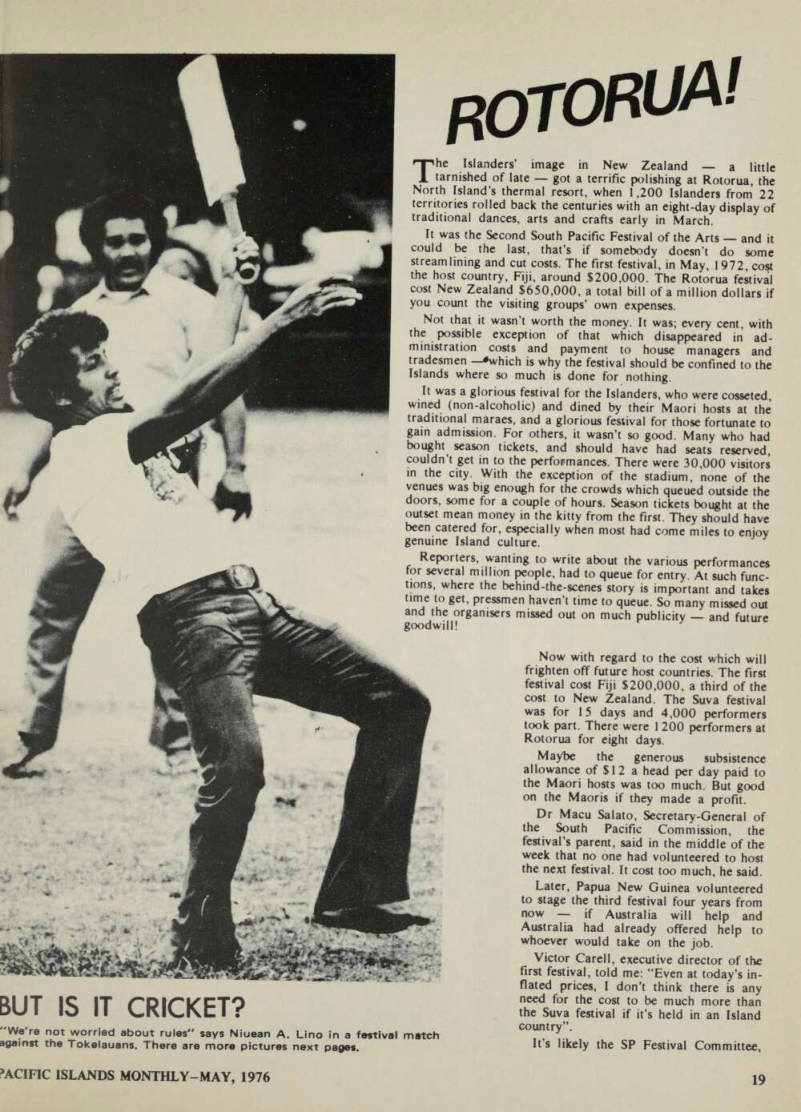
But Is It Cricket?
"We're not worried about rules" says Niuean A. Lino in a festival match against the Tokelauans. There are more pictures next pages.
which will meet around November’s end, will propose the formation of an Arts Council. That’s all to the good, provided it’s an Islander’s Council which should keep the festival- in the Islands.
Rotorua was kind to the performers, but it’s first aim was to provide a tourist at traction and that’s not the Islanders’
idea. They want to restore their cultures and traditions.
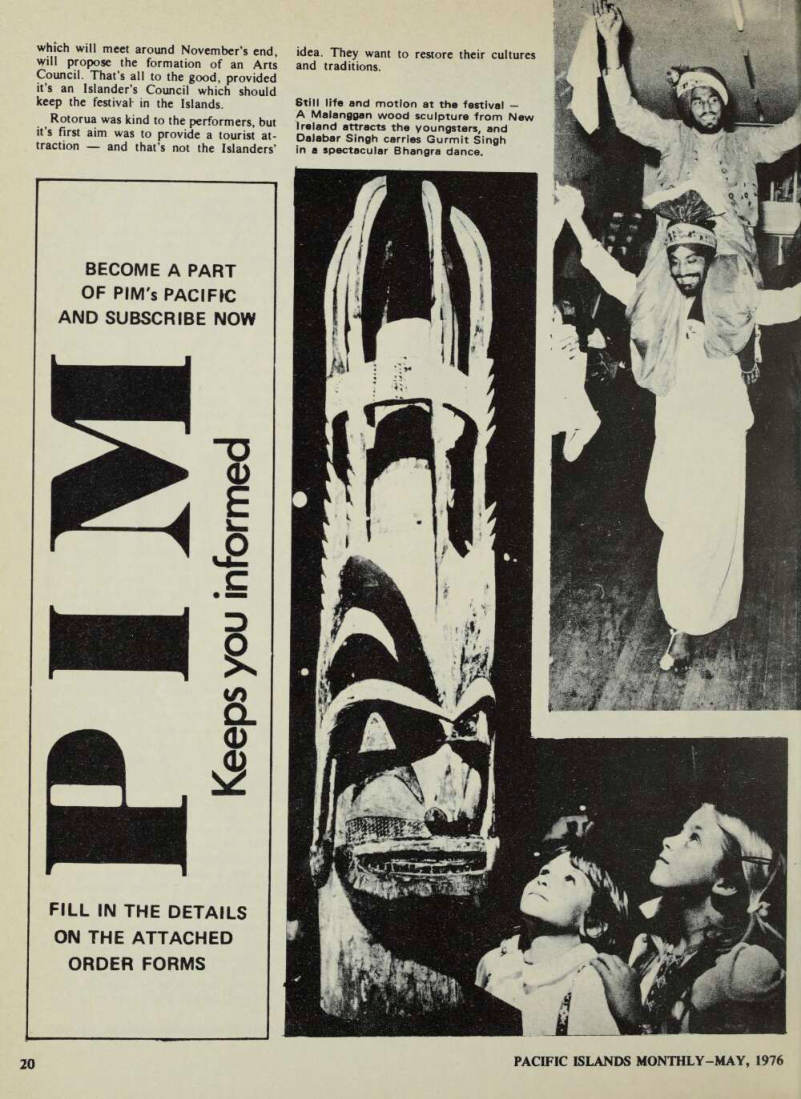
Still life and motion at the festival A Maianggan wood sculpture from New Ireland attracts the youngsters, and Dalabar Singh carries Gurmit Singh in a spectacular Bhangra dance.
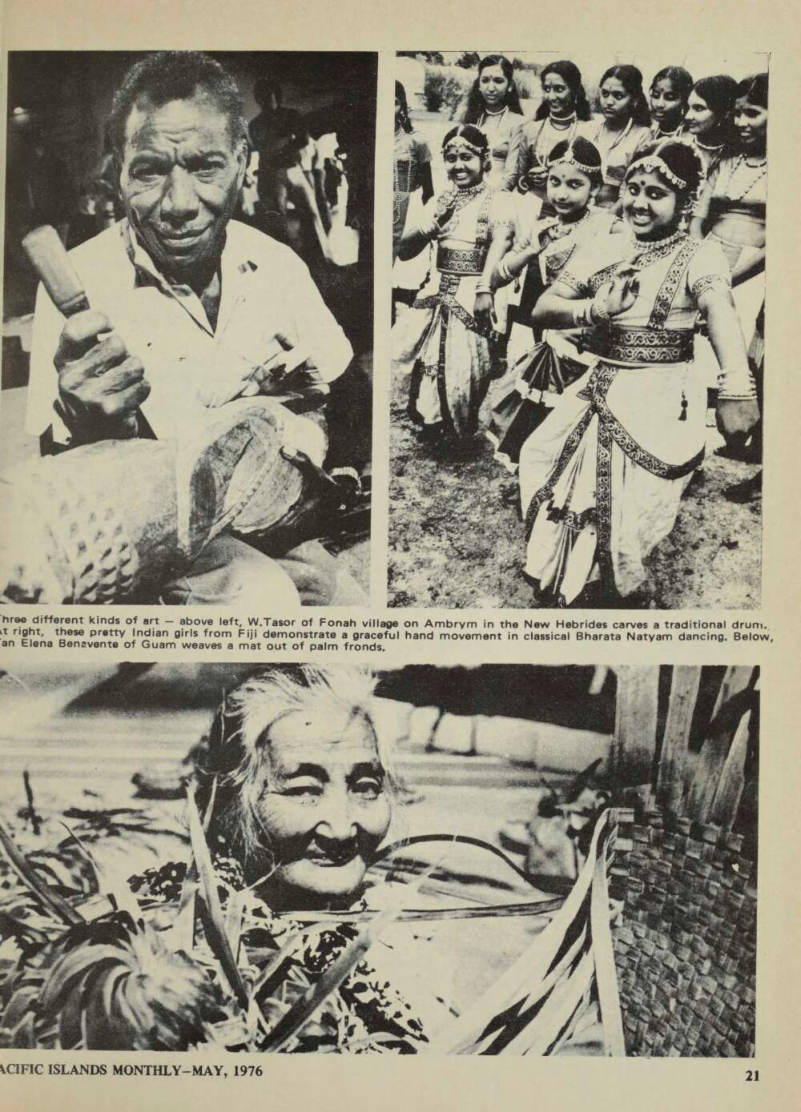
hrec different kinds of art — above left, W.Tasor of Fonah village on Ambrym in the New Hebrides carves a traditional drum. . right, these pretty Indian girls from Fiji demonstrate a graceful hand movement in classical Bharata Natyam dancing. Below an Elena Bensvente of Guam weaves a mat out of palm fronds.