Fighters’
pp. 9-10 · Read in the full issue
Freedom Fighters’ long arm
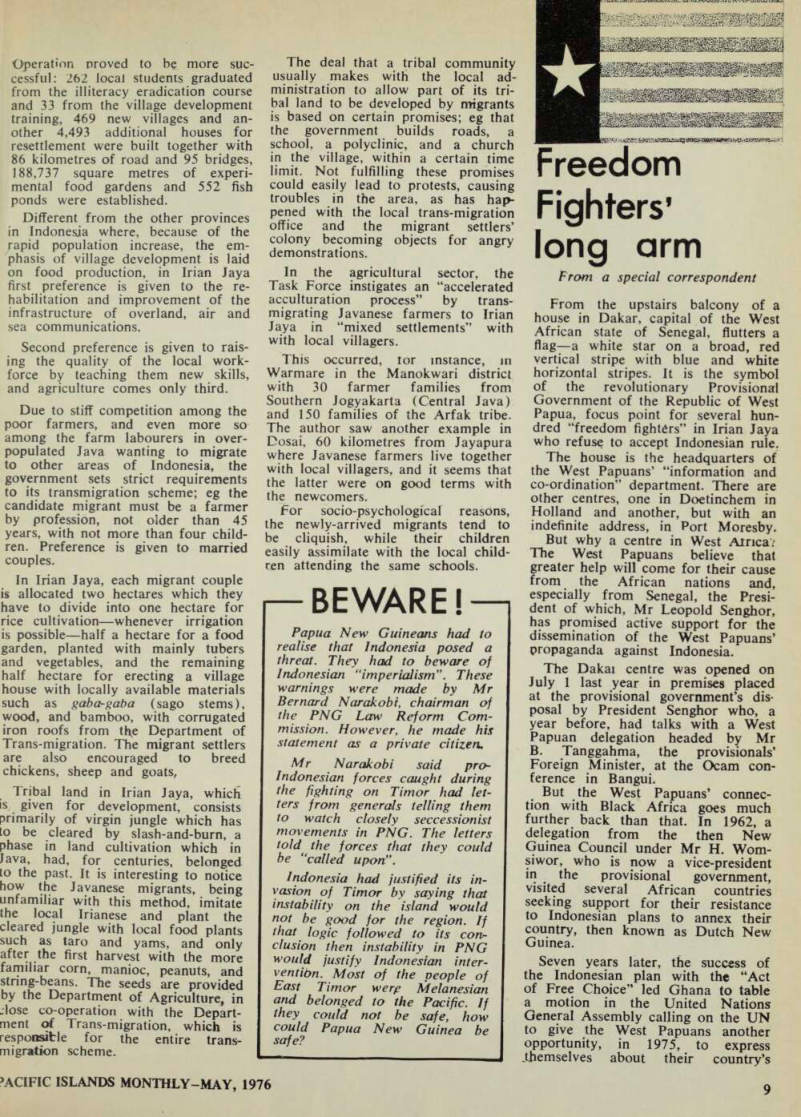
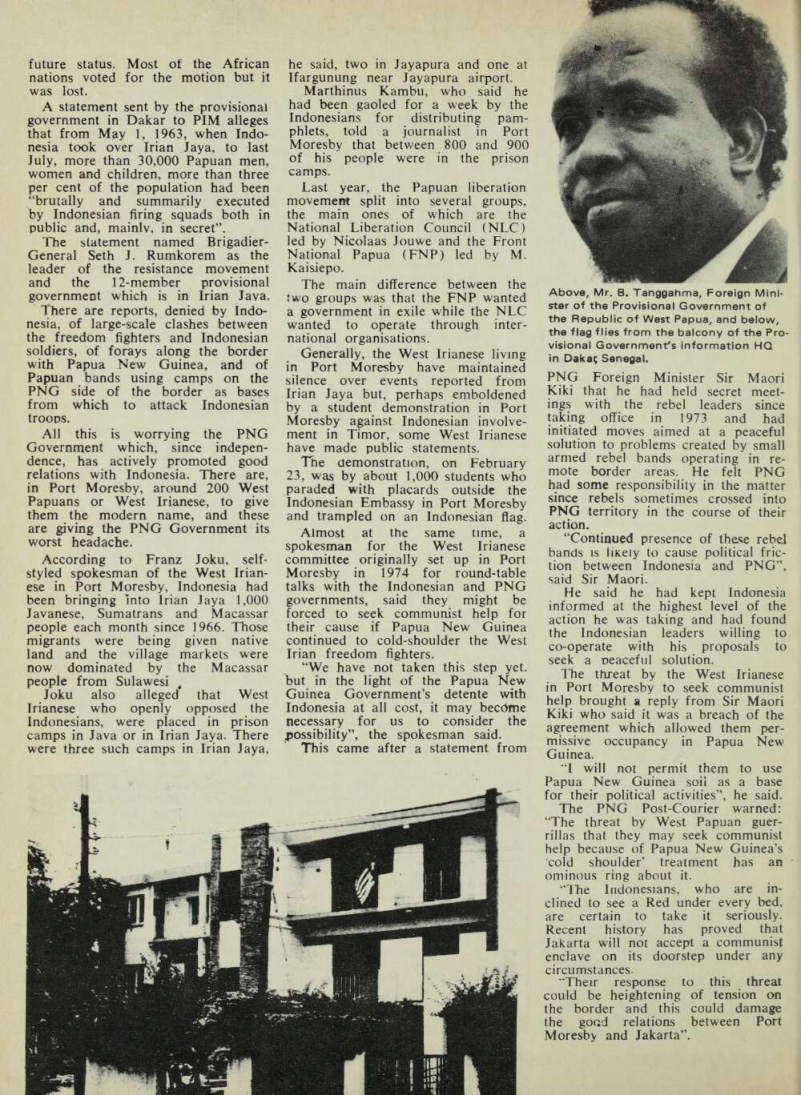
From a special correspondent From the upstairs balcony of a house in Dakar, capital of the West African state of Senegal, flutters a flag—a white star on a broad, red vertical stripe with blue and white horizontal stripes. It is the symbol of the revolutionary Provisional Government of the Republic of West Papua, focus point for several hun dred “freedom fighters” in Irian Jay a who refuse to accept Indonesian rule.
The house is the headquarters of the West Papuans’ “information and co-ordination” department. There are other centres, one in Doetinchem in Holland and another, but with an indefinite address, in Port Moresby.
But why a centre in West Atncav The West Papuans believe that greater help will come for their cause from the African nations and, especially from Senegal, the Presi dent of which, Mr Leopold Senghor, has promised active support for the dissemination of the West Papuans’ propaganda against Indonesia.
The Dakai centre was opened on July 1 last year in premises placed at the provisional government’s dis posal by President Senghor who, a year before, had talks with a West Papuan delegation headed by Mr B. Tanggahma, the provisionals’
Foreign Minister, at the Ocam con ference in Bangui.
But the West Papuans’ connec tion with Black Africa goes much further back than that. In 1962, a delegation from the then New Guinea Council under Mr H. Wom siwor, who is now a vice-president in the provisional government, visited several African countries seeking support for their resistance to Indonesian plans to annex their country, then known as Dutch New Guinea.
Seven years later, the success of the Indonesian plan with the “Act of Free Choice” led Ghana to table a motion in the United Nations General Assembly calling on the UN to give the West Papuans another opportunity, in 1975, to express .themselves about their country’s
future status. Most of the African nations voted for the motion but it was lost.
A statement sent by the provisional government in Dakar to PIM alleges that from May 1, 1963, when Indo nesia took over Irian Jaya, to last July, more than 30,000 Papuan men, women and children, more than three per cent of the population had been “brutally and summarily executed by Indonesian firing squads both in public and, mainly, in secret”.
The statement named Brigadier- General Seth J. Rumkorem as the leader of the resistance movement and the 12-member provisional government which is in Irian Java.
There are reports, denied by Indo nesia, of large-scale clashes between the freedom fighters and Indonesian soldiers, of forays along the border with Papua New Guinea, and of Papuan bands using camps on the PNG side of the border as bases from which to attack Indonesian troops.
All this is worrying the PNG Government which, since indepen dence, has actively promoted good relations with Indonesia. There are, in Port Moresby, around 200 West Papuans or West Irianese, to give them the modern name, and these are giving the PNG Government its worst headache.
According to Franz Joku, self styled spokesman of the West Irian ese in Port Moresby, Indonesia had been bringing into Irian Jaya 1,000 Javanese, Sumatrans and Macassar people each month since 1966. Those migrants were being given native land and the village markets were now dominated by the Macassar people from Sulawesi , Joku also alleged that West Irianese who openly opposed the Indonesians, were placed in prison camps in Java or in Irian Jaya. There were three such camps in Irian Jaya,
he said, two in Jayapura and one at Ifargunung near Jayapura airport.
Marthinus Kambu, who said he had been gaoled for a week by the Indonesians for distributing pam phlets, told a journalist in Port Moresby that between 800 and 900 of his people were in the prison camps.
Last year, the Papuan liberation movement split into several groups, the main ones of which are the National Liberation Council (NLC) led by Nicolaas Jouwe and the Front National Papua (FNP) led by M.
Kaisiepo.
The main difference between the two groups was that the FNP wanted a government in exile while the NLC wanted to operate through inter national organisations.
Generally, the West Irianese living in Port Moresby have maintained silence over events reported from Irian Jaya but, perhaps emboldened by a student demonstration in Port Moresby against Indonesian involve ment in Timor, some West Irianese have made public statements.
The demonstration, on February 23, was by about 1,000 students who paraded with placards outside the Indonesian Embassy in Port Moresby and trampled on an Indonesian flag.
Almost at the same time, a spokesman for the West Irianese committee originally set up in Port Moresby in 1974 for round-table talks with the Indonesian and PNG governments, said they might be forced to seek communist help for their cause if Papua New Guinea continued to cold-shoulder the West Irian freedom fighters.
“We have not taken this step yet. but in the light of the Papua New Guinea Government’s detente with Indonesia at all cost, it may become necessary for us to consider the possibility”, the spokesman said.
This came after a statement from
PNG Foreign Minister Sir Maori Kiki that he had held secret meet ings with the rebel leaders since taking office in 1973 and had initiated moves aimed at a peaceful solution to problems created by small armed rebel bands operating in re mote border areas. He felt PNG had some responsibility in the matter since rebels sometimes crossed into PNG territory in the course of their action.
“Continued presence of these rebel bands is likely to cause political fric tion between Indonesia and PNG”, said Sir Maori.
He said he had kept Indonesia informed at the highest level of the action he was taking and had found the Indonesian leaders willing to co-operate with his proposals to seek a neaceful solution.
The threat by the West Irianese in Port Moresby to seek communist help brought a reply from Sir Maori Kiki who said it was a breach of the agreement which allowed them per missive occupancy in Papua New Guinea.
"I will not permit them to use Papua New Guinea soil as a base for their political activities”, he said.
The PNG Post-Courier warned: “The threat by West Papuan guer rillas that they may seek communist help because of Papua New Guinea’s cold shoulder’ treatment has an ominous ring about it.
“The Indonesians, who are in clined to see a Red under every bed, are certain to take it seriously.
Recent history has proved that Jakarta will not accept a communist enclave on its doorstep under any circumstances.
“Their response to this threat could be heightening of tension on the border and this could damage the goad relations between Port Moresby and Jakarta”,
Above, Mr. B. Tanggahma, Foreign Mini ster of the Provisional Government of the Republic of West Papua, and below, the flag flies from the balcony of the Pro visional Government's information HQ in Dakar Senegal.