Islands move into Electronic Age
pp. 55-56 · Read in the full issue
From ROBERT KEITH-REID in Suva
Electronic data processing is one of the up and coming industries of Fiji. Five computer centres, three installed within the last 12 months, have created around 250 jobs in a community which counts an under taking employing 100 people as a major one.
For seven years an International Computers Ltd model 1902-A in the Electronic Data Processing branch of the Fiji Ministry of Finance had the field to itself. Then the state controlled Fiji Sugar Corporation got two small Burroughs computers in 1975.
Last year, the Suva branch of the Bank of New Zealand invested $250,000 in two ICL model 29035, the Native Land Trust Board bought one of the same type, and the Fiji National Provident Fund paid around $260,000 for an NCR Century model.
IBM opened a centre in Suva in 1967 at the government’s request, but its capacity quickly became in adequate.
The government accepted a pro position from UCL that has kept a 32K capacity computer busy in Suva ever since. This runs 16 hours a day in two eight-hour shifts, plus 16 more hours at weekends.
ICL has a resident engineer in Suva. Apart from one overseas analyst the staff of the government unit, about 40, is local.
Hiring the computer costs the government about $150,000 a year
and salaries and other costs took the total bill for the service to about $349,000 last year.
Revenue, about $94,000 last year, comes from a commercial user who hires time on the government in stallation.
The ICL computer handles the government’s entire pay roll, trade figures, tax figures, migration and employment figures and processes foreign exchange transactions.
It keeps checks on stock move ments in the Government Supplies Department, and does work for the
Town Planning Department, Lands Department, Electoral Office, school examination result analysis and a host of other duties.
About 20 hours a year is spent working for the University of the South Pacific and other users are the Solomon Islands Government, vari ous Fiji statutory organisations, and the Suva City Council.
Mr C. Lee Joe, the unit’s acting manager, says it is impossible to estimate what the computer saves in terms of paper work and repetitive figure-checking exercises.
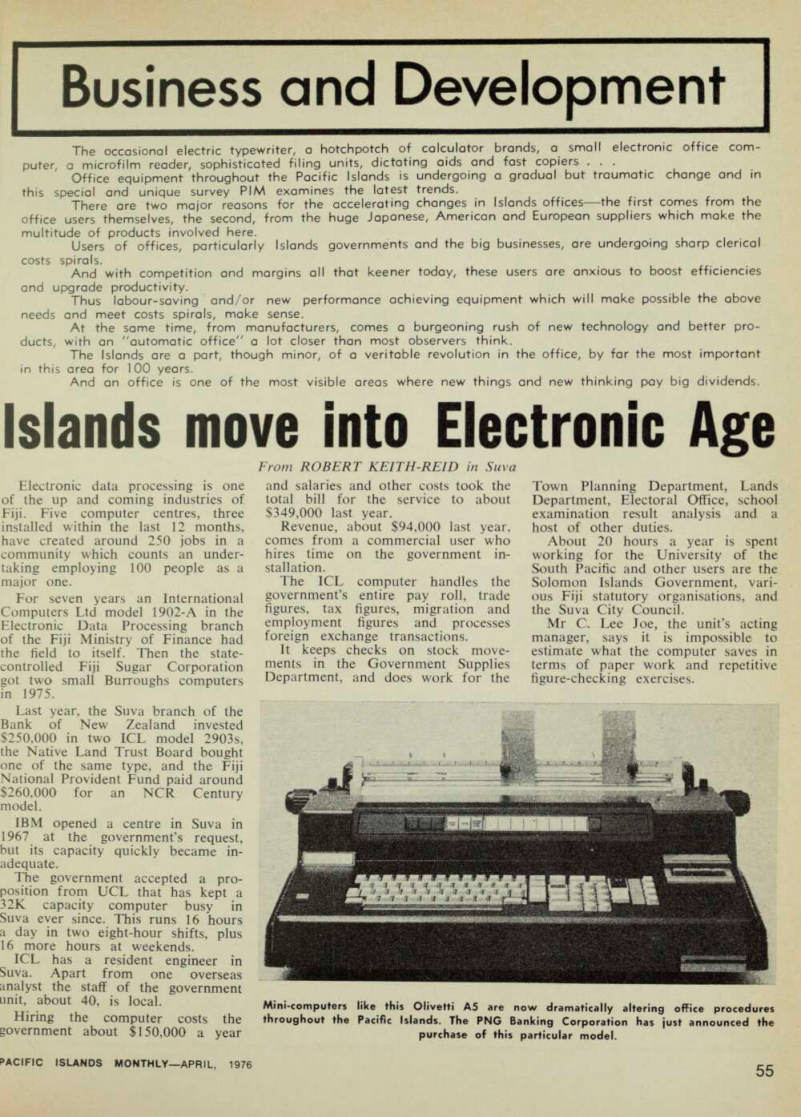
Mini-computers like this Olivetti A5 are now dramatically altering office procedures throughout the Pacific Islands. The PNG Banking Corporation has just announced the purchase of this particular model.
“It’s not so much cost saved as time saved”, he says. “With access to instant information, government officials have more time for creative work”.
About one-third of the business handled by the government com puter is for International Data (South Pacific) Ltd, a New Zealand owned company which started busi ness in Suva in 1970.
Beginning with a staff of three and eight clients, manager Cam Goodir recalls, it now employs 25 people and has custom for 50 differ ent services.
The company devises a pro gramme to suit a client’s needs, punches out the information and sends the cards along to the govern ment centre for processing. Most of its work deals with company ac counts and pay rolls, but the range runs from quality control matters to updating company share registers.
At one time International Data was employing 60 key punch oper ators in two shifts handling business for clients in Australia. But this business collapsed when the Austra lian economy began tottering and hasn’t recovered yet.
Another New Zealand-backed operator, Pacific Computer System (Fiji) Ltd, recently entered the field but apparently intends to have its
data processing carried out in New Zealand.
The new ICL and NCR computers, which arrived in Suva last year, went to buyers with a big volume of work and some special problems to handle.
The Bank of New Zealand has been trading in Fiji for more than a century; as the first bank in the country it’s also the first to have its accounting system computerised.
The Native Land Trust Board, as Fiji’s biggest landlord, has already found its ICL computer an invalu able aid in sorting out thousands of complex land transaction matters, but it is still having some work done for it by the government unit.
With 100,000 accounts to look after, the Fiji National Provident Fund bought its computer to over come the sheer physical problems posed by sorting through strip ledger cards.
Although the three new computer operators have plenty of capacity to spare, they do not envisage taking on any outside work.
During 1974-75, Fiji firms and organisations invested about $940,000 in computers and related equipment.
Sales of “mini computers”, highly sophisticated electronic accounting machines in the $20,000 to $30,000 class, are going well.