With Riches In The Ground
pp. 11-15 · Read in the full issue
The Solomons At The Cross Roads
The Solomon Islands are going through the most convulsed period in their history , facing, after more than 70 years of somnolent colonialism, the harsh realities of emerging into the world around them .
Swift withdrawal is underway by the UK from its former protectorate; foreigners are discovering some of the prizes of these quite large, fertile and mineral-rich islands and their seas; improved health—prob ably the most significant change brought by colonialism—has resulted in a galloping birthrate; the politics of a legislature only a jew years dominated by local people is confused and still lacking in firm purpose.
By Denis Fisk
Many would say today the Solo mon Islands are a fortunate country because the British administrators hardly developed the Solomon Islanders’ own economy in the 79 years it has been a protectorate.
For most of this century there was hardly an argument raised against the “development” of such countries’ resources—these days more properly, and neutrally, called exploitation.
But how many of the developing countries today could, if there was reason, chop off all overseas trade and aid and return to self-sufficiency?
That’s an extreme way of putting it, but the Solomons, in this year of self-government and only a year or so away from independence, still could.
No doubt in the next decade or two many of its people will wish it was doing just that. And they could be sorry they and foreign partners are increasingly exploiting their natural and human resources, and irretrievably becoming part of “the mixed-up community of nations” with all the hoped-for benefits and the problems that brings, as Chief Minister Solomon Mamaloni pointed out in January.
He was making the point that deep involvement with the outside world was essential to finding jobs for the large numbers of young people who will double the popu lation well before the year 2000.
At the same time he commented: “Actually, I think the world is full of hungry sharks swimming around looking for nice little developing countries to swallow up”.
It’s the dangers I’d like to discuss, since they are less-often debated publicly. • How much of the Solomons’ self-sufficiency in food and way of life will be left in 1966: • When the population will be about 400,000 instead of the 200,000 of today; • When the much-promoted and Australian-subsidised export cattle industry will have taken over most of the coastal land which has always
been available for rotating root crops and other crops; • When at least two and pro bably more big mining projects could be operating, distorting for ever the economy and the expecta tions by Solomon Islanders of con sumer goods; • When rice, grown commercially by (at present) an American com pany, will have taken over as the staple food of all town dwellers and as the desired food of villagers, in place of the independently-produced garden vegetables which today give order and meaning to village life; • When it is a way of life to pander to foreign visitors because they bring money and make jobs; • When more Solomon Islanders aged between 15 and 50 will be working for a wage rather than sup porting themselves because they will be too proud to garden or even to raise commercial crops.
Does all that sound too harsh, too far-fetched, when the present govern ment is planning how the new coun try will find interesting and useful ways of life for thousands of young people every year, new jobs, train ing and rural development and land reforms to give some of the growing army of landless their chance, and how it can join the world of the sharks.
It remains to be seen whether the increasing hunger of the sharks and their weakening bargaining position will eventually favour little develop ing countries like the Solomons with their tasty but limited resources of land, sea-life and minerals.
Will the Solomons develop enough of its own wisdom and get enough help to be able to feed the man eaters enough to keep them happy but not so much that the feeding ground is destroyed and the occu pants left dependent?
Already, the Chief Minister has had a chastening experience with the
Letcher Mint of the USA, where he appears to have acted without sufficient forethought, perhaps dis tracted by the problems of putting together a workable and able com bination of ministers to govern.
Already, the Solomons are ex periencing imported political and social problems, partly inspired by self-interest among their own peoples.
Self-government in January came in the midst of the country’s first general strike. It was partially effec tive in advancing claims for the General Workers’ Union and the Government Non-established Workers Union (mostly labourers) which joined in striking for a week, in some cases for longer. It brought about the first confrontation by riot police who, fortunately, readily dis persed a mob of a few dozen young men with tear gas, but a number of stores were damaged by stones during the retreat.
One of the more radical thinkers
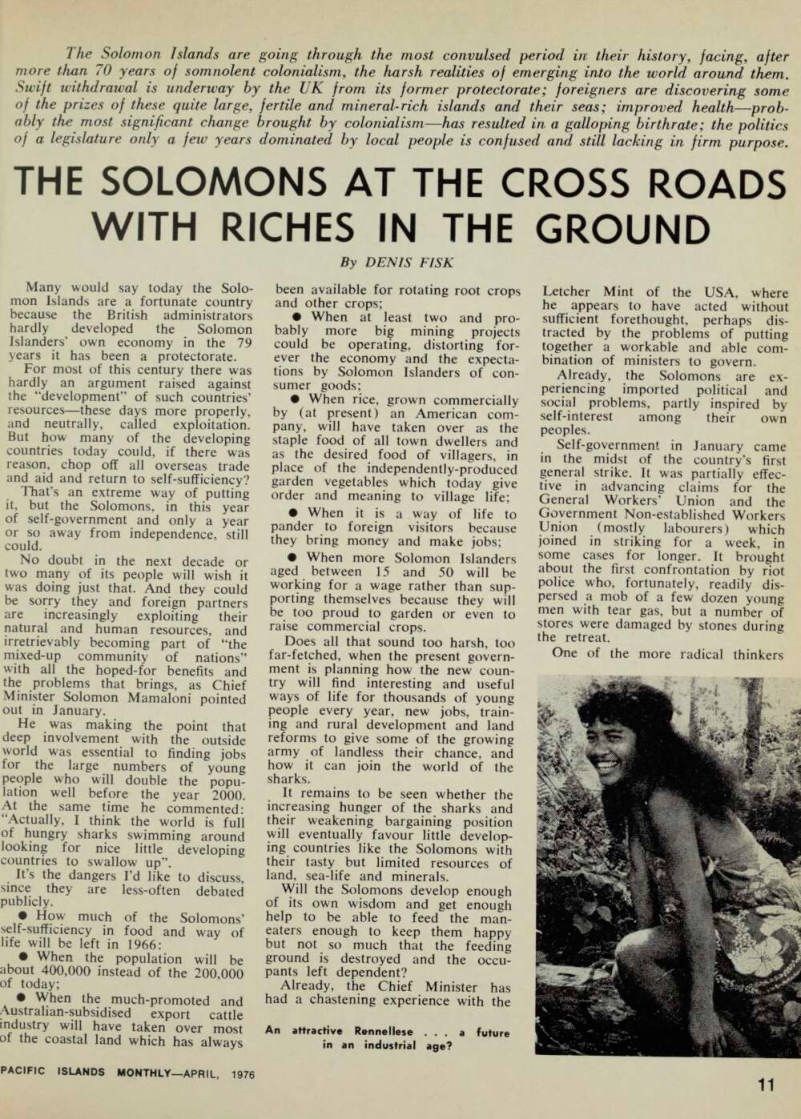
An attractive Rennellese ... a future in an industrial age?
in both union and government affairs (now the new Minister for Works and Public Utilities), the Member for Honiara, Ashley Wickham, called the clash with the riot police and the damage afterwards a shameful display of irresponsibility.
The current General Workers’
Union president, Bartholomew Ulufa’alu, has brought tactics with him from the much more sophisti cated union scene of Papua New Guinea, including opting to serve jail sentences in place of paying fines for his participation in civil dis turbances.
Both he and the union’s secretary, Paul Belande, appear to be using their positions to build a power base in national politics.
Mining is a virtual certainty in the Solomon Islands, sooner or later.
The government does not like talk ing about it publicly, and almost all the information made public has come in response to questions from the opposition in the Legislative Assembly.
A written request I made last year to have confirmed and expanded some published information about the likely mining of bauxite on Ren nell and Wagina (also called Vaghena) Islands was refused.
The Rennell/Wagina proposal has reached the stage of an exchange of letters of intent between the Mitsui Mining and Smelting Co of Japan, which has the Rennell deposit, Conzinc Riotinto of Australia, which has the Wagina deposit, and the government, dependent upon a feasi bility study carried out last year and supposedly finished about now.
The government has been doing its utmost to reach agreement with the companies to create the jobs and income it wants. It has already said it would like to see not only mining involving maximum participation by local people but an alumina plant— the first stage of bauxite processing for aluminium—to be built on Ren nell. Despite the good deal the government seeks—so per cent of the total proceeds through taxation, dividends and royalties—it has not been anxious to promote a public debate about mining, apparently because of what it could mean to life in the Solomons.
The thoughtful Finance Minister, Willie Betu’s modest estimate that at least S2OO million would be needed in capital investment, and thousands of expatriate workers to establish mining and the alumina plant, are indications enough.
The S4OO million copper mine on Bougainville has changed the life style, the topography, even the rain fall, it is said, on a large island of
90.000 people. It is by far the domi nant economic influence in Papua New Guinea with 2i million people.
It has greatly influenced the poli ticisation of Bougainville into pro and anti-secession camps, and threatens the existence of the Somare government. It also brought to a head the first international political problem for the still loosely-united Solomon Islands.
What can be foreseen as the result of a similar investment in a simi larly new nation of less than one tenth the population?
What will happen to the people of Rennell on which, Mitsui in Tokyo confirmed for me, there are about 2,600 acres of land to be mined for 30 million tonnes of ore. with an alumina plant to produce 600.000 tonnes a year, rising perhaps to 1.3 million tonnes? Roughly half of this alumina would result from the mining also of the Wagina de posit of about 28 million tonnes, by CRA which would ship it to Rennell.
Rennell has about 1,000 people, Polynesians, who with about another 500 Bellona Islanders on a much tinier atoll 15 km away, make a distinct remote community, different from the bulk of Solomon Islanders, For years the government has been trying to persuade the Rennel lese to agree to compensation per head for land and for each coconut tree and other useful tree which would be lost to mining, and to agree to being resettled at the other end of the Solomons some 600 km away. Government would prefer the island deserted for Mitsui, who have carried out extensive trial mining at one end.
Agreements have been made, and then upset, causing concern to government and Mitsui. The last I heard, the Rennellese were busy with unusual industry, both planting coconut trees in any available space
and making babies, to increase com pensation should it come.
It would be ironical if Rennell’s coconut industry disappeared, since it was this remote atoll which pro duced by its own natural selection the prolific coconut variety which has been exported as seed coconut to so many tropical countries.
The situation is ripe for another cause celebre like phosphate-rich Ocean Island which has involved the UK, Fiji and the Gilberts ad ministrations in international litiga tion many years after its original inhabitants were transplanted to a Fiji island.
Even if the Rennellese agree to being resettled, for how long will they be happy away from their home land? Their gods were wiped out just before World War II by the dramatic arrival of Christianity, but the pull of the land is more subtle than that, especially for a people with their own miniature environment.
Will they return? The government has talked of filling in the holes with imported soil when the 40-odd years of mining is up. What will be the state of the Rennellese after that long? The Western Solomons, where they could be resettled, doesn’t want them as a unit, but fragmented.
If they stayed, it would be no time before the invading mining technology and a huge camp of foreign men, not to mention a pol luting alumina plant, would wreck remaining traditions, social order and environment.
Government has an unenviable decision to make, and it is more on the shoulders of Solomon Islanders than the decision to mine Bougain ville ever was for Papua New Guineans or Bougainvilleans.
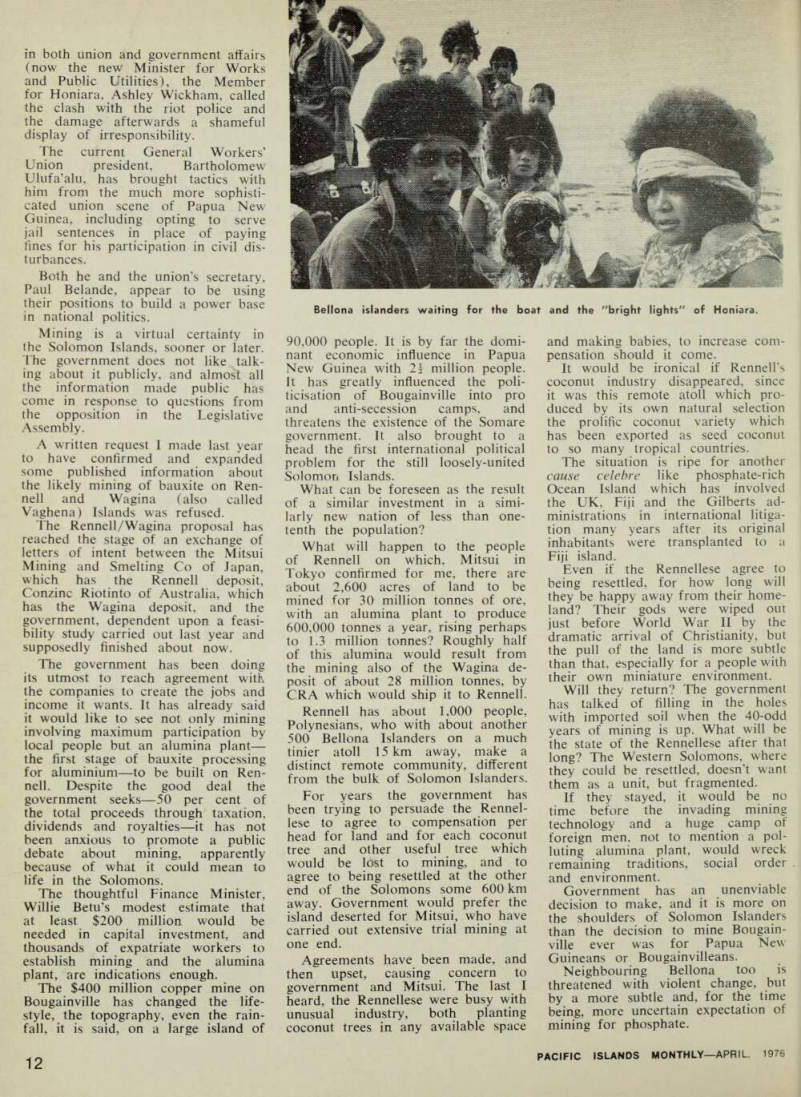
Neighbouring Bellona too is threatened with violent change, but by a more subtle and, for the time being, more uncertain expectation of mining for phosphate.
Bellona islanders waiting for the boat and the "bright lights" of Honiara.
I am told there is estimated to be some 10 million tonnes of phosphate bearing material spread over about 115 hectares of this atoll which measures only 11.5 km by 3 km at its widest.
The Bellonese were told the interested miner was the British Phosphate Commission, through a hired Englishman who has spent many years in the Pacific. Last year he offered the Bellonese participation in a venture tentatively called the South Pacific Development Com pany, The man is Fred Dixon, a small, balding character well known in Bougainville where he worked for Bougainville Copper in community relations. In the Solomons he was equally well known for the stormy period he spent as manager of the Honiara Hotel for local businessman, Jimmy Chan, before walking out and onto a visiting cruise ship, and again when he returned until about the end of 1974 for the time he spent living with the closely-knit Gilbertese com munity whom he helped establish and promote outside Honiara as an entertainment unit for local and overseas visitors. (The Gilbertese came to the Solomons during a famine in the Line Islands in the 19505).
Their emphasis on retaining cus toms is a good indicator to the feel ings that might be within the Poly nesian Rennellese and Bellonese who have no ties other than political with the rest of the Solomons.
Mr Dixon’s proposals, first made during a visit on May 6 last year, followed visits he made in 1974 when he was talking to the Rennel lese and Bellonese about “settling” there. No Europeans live on the atolls.
He depicted for them a multi million dollar industry which would result in “all means of comfort and luxury and an undreamed Utopia”, as one Bellona man put it, if the island was given up to mining.
The proposal has divided the island into two hostile camps, turn ing father against son, brother against brother, in-laws against each other, and so on. In general the division is between the older gener ations who are sold on the idea, and a minority group of younger people who are mostly educated and believe they see the implications better. They see their people being divorced from their culture and lands, and the end of them as an ethnic group.
Opponents formed an organisation to fight against mining, fittingly nam ing themselves the Mau Tiki Tiki Movement after a culture hero.
The government has heard many representations from both sides.
Opponents were frightened by the early agreement of supporters who told the Permanent Secretary for Trade, Industry and Labour, Dr Dick Thompson, they were happy to see mining go ahead even before nego tiations for compensation, equity, resettlement and other matters had been settled. The future of the phos phate appears suspended for the time being with government uncommitted either way.
It is not long since the Solomon Islands Government was committed to development based on widespread rural industry, multiple trading posts which could, in time, provide some urban amenities, and to restricting as much as possible the growth of the capital, Honiara.
Committal instead to an economy based for the next 50-odd years on mining would be the end of this answer to the electorate’s demands in the early 19705. Like people else where, Solomon Islanders are sensi tive to what earns them the most mqney the easiest way. When copra prices are low they turn to logging or fishing or spices or cattle or what ever is going.
Mining would pull thousands of farmers and self-sufficient villagers into actual mine work and the other industries that would grow with the import and export boom accom panying it, in addition to mopping up the growing numbers of school leavers who often want to hang around Honiara.
At this stage, there is hardly one generation which can really be said to know only urban living and work ing. Honiara has grown from nothing since the war, and half its population still gardens for much of their living.
'Hie educated elite, with hopes of living in the European way, is very small, a few thousand.
But it is they who will be making the decisions for the rest on what their future lives will be like: the elected politicians, some of whom have grown to depend too much on their privileges; the rather new public servants living in spacious brick and timber houses provided originally by British aid to house European public servants, and who, in some cases, have risen too quickly to desks at which they mainly spend time find ing someone else to do their work; the small cohort of remaining British, Australian and New Zealand public servants on contract now with few exceptions, who try to find ways of making the Solomons pay its way; the earnest high school and university graduates infiltrating the community and impatient to lead; and the busi ness community acting like business men anywhere.
But most of all, making the de
cisions will probably rest with the somewhat unpredictable, supreme political tactician. Chief Minister Solomon Mamaloni—if he survives the general election in the middle of this year and can put together yet another ministry from the survivors of the present 24 member parlia ment, together with some new mem bers one expects to be elected mostly from the ranks of the present public service.
For the remaining few months of this parliament he has a team which, for the first time, makes just about the most practical use of the executive talent available in the Legislative Assembly.
There are arguments that someone like David Kausimae with his long experience should not have been dropped. But Mr Kausimae is vehemently opposed by some of the new office-holders.
The rout of the standing members in 1973 may be repeated, leaving the Solomons again with a largely in experienced parliament at an even more critical time.
Among the new ministers are several I would expect to have good chances of retaining their seats be cause they have consolidated then positions since their election: David Thuguvoda (Agriculture and Lands), a tireless worker at building influence in his electorate through a political instinct; Benedict Kinika (Education and Cultural Affairs) who avoided ferociously opposing Mr Mamaloni of his own island Makira in earlier days to maintain support of electors who could not understand his opposition to Mamaloni; Pulepada Ghemu (Foreign Trade, Industry and Labour), who came in through a by-election with a potent support base at home; probably Ashley Wickham, who faces the difficult electorate of Honiara (likely to be divided since it is twice the size of of most others), but who has been the most persistent questioner and debater in the legislature on local and national issues; and Jona than Fifi’i because of traditional respect for his role in the Marching Rule movement of 25 years ago and his more prominent role now.
Whoever is governing will have a classic decision to make as to whether having fairly rich resources to exploit is more of a problem than the resources are worth.
In some colonies and developing countries almost any change like this would be an improvement. But the Solomon Islanders are not hungry, not lacking in shelter, not very un healthy, and many more are being educated. The only question is whether “development” will really benefit these particular islands?