Pacific Islands Monthly
pp. 8-9 · Read in the full issue
Islands Learn To Live With The
Bomb And Keep The Forum Intact
By JOHN CARTER who was at Rotorua
The seventh meeting of the South Pacific Forum, held over two days at Rotorua in March and co-inciding with the second South Pacific Festival of the Arts, was an exercise in the Island art of avoiding the reefs of controversy. Taking no longer than 4i hours it was conducted in a spirit of sweet reason and light— to the disappointment of Australian and New Zealand metropolitan news papermen.
They had created headlines about a coming split over the Islands’ cam paign for a nuclear-free South Paci fic. They based their hopes—and they were hopes because the Forum hasn’t produced a world-shattering story yet—on an apparent change by the newly-elected Australian and New Zealand governments of the previous Socialist governments’ policy of sup port for a nuclear-free zone. Both NZ’s Prime Minister Robert Muldoon and Malcolm Fraser, his Australian counterpart, who were meeting Island leaders for the first time as prime ministers, had said only weeks before that a nuclear-free zone was impractical.
'‘That means a row at the Forum”, reckoned the metropolitan newsbut they also reckoned with out the Islanders’ Pacific Way, reach ing a consensus and avoiding a row.
I told them there would be no row, no split. I reasoned that the Islands would be satisfied with continuing support fpr a campaign against nuclear testing like the French tests at Mururoa and for a denial of nuclear bases in the South Pacific to any power.
Australia and New Zealand had had second thoughts about the word ing of the resolution which New Zealand, Fiji and others had man aged to steer through the United Nations’ General Assembly. It was too loosely worded and its scope could refer to the passage of nuclear powered ships carrying nuclear wea pons though the Islands—United States nuclear submarines, for in stance.
That would be against the ANZUS
Pact and was bound to upset Ame rica, which has been having second, or third, thoughts about its foreign policy of bearing the burden of overseas defence. Upsetting the Americans could perhaps mean a return to the old isolationism. In which case the lesser of the two evils would be a watering down of the resolution for a nuclear-free zone.
When the nine Forum member countries got down to business for a 90-minute session on the first day, the nuclear-free zone loomed large on the small agenda and consider ation of it was adjourned until the following day.
The press concluded that was be cause there was a risk of a row. I think it was because Mr Fraser wasn’t due at the meeting until the
following day. Foreign Minister
Andrew Peacock was there, but the earlier comment on the impracticality of a nuclear-free zone had been made by Mr Fraser, so, obviously, he would like to handle it. Anyway, the Forum is regarded as a summit meeting of prime, or chief ministers.
It took them half the following morning to settle the matter. But there was no row. There was a reso
lution with intriguing wording—a
face-saver for somebody? An attempt to avoid the ambiguity of the UN resolution? A compromise? Mr Muldoon, in off-the-cuff comments afterwards—he wasn't the Forum’s chosen spokesman—called it a clari fication. And it was. It certainly won’t upset the ANZUS Pact.
It was plain then that the imprac ticality was in assuming that the UN resolution was meant to ban the free passage of ships on the high seas.
The former Australian and NZ governments had probably not given that aspect a thought. The Islands would sooner have nuclear weapon carrying ships at the other side of the world but they weren’t going to insist on .it at the expense of the loss of American defence.
Mr Muldoon, probably playing politics, talked about the “duplicity”
of the old NZ government and said the new resolution tidied up a lack of understanding that had been com pounded by the previous government.
Well, that lack of understanding was repaired and the Islands have the assurance of their more powerful partners that they’ll continue to back them in opposing nuclear tests in the South Pacific.
Fiji’s Prime Minister, Ratu Sir Kamisese Mara, had the job of ex plaining, as official spokesman, the resolution to the press. They gave him a hot time, mainly because they believed there had been a row be hind closed doors and there were headlines to justify. Ratu Mara, however, wouldn’t concede that at all. There was no row, he insisted.
The resolution showed the true posi tion. There had been no alteration.
He didn’t say there had been clari fication but that’s what he meant.
He made it plain that he wouldn’t object to nuclear-powered ships sail ing into Suva. In fact, he said he wished he had the services of such vessels to save Fiji’s dearly-bought oil. As for ships carrying nuclear weapons, he also made it plain that he wouldn’t welcome them, but if they were ships belonging to the Western powers (he didn’t use that term but that’s what he meant) and they insisted in tying up at Suva, he would tell them that he would also have to allow Russian ships to do the same.
Here is the resolution: “The members of the Forum agreed that in carrying forward their con sultations under the resolution adopted by the General Assembly of the United Nations on December 11,- 1975, endorsing the idea of a nuclear weapons-free zone in the South Paci fic, their objectives would be to ad vance the cause of general disarma ment and to seek the cessation of nuclear weapons testing in the South Pacific. In taking such action they would respect the principle of the freedom of navigation of the high seas. They agreed that in developing the concept embodied in the General
Assembly Resolution along these lines there would be no incompati bility with existing security arrange ments”.
The previous day, Australia’s Mr Peacock expertly fielded questions from the press about the nuclear-free zone and gave an assurance that Australia would continue to be totally opposed to any atmospheric testing. That was what has really bugged the Islands.
Any other business didn’t matter a cracker. As Ratu Sir Kamisese told me: “It was a good idea to have an informal meeting. It keeps the mill grinding. We had a check list of The resolutions or decisions made in Tonga and one or two of them needed interim decisions which we made”.
Regional shipping was on the agenda and the Forum considered a report of SPEC’s work on this pro ject which was said to be in its final stages of completion. It expressed satisfaction and decided on further consideration at the Forum meeting which, the leaders later agreed, would be at Nauru for three days beginning on July 26.
Whatever anyone might think about the Forum meeting and the idea some have that the Islands lost out so far as the nuclear-free zone was concerned, Fiji’s Prime Minister was more than satisfied that it had been held. He was able to kill two birds with one stone, the other bird, and maybe a more important one, being Fiji’s future relations with Australia and New Zealand.
Ratu Mara had private talks with Mr Fraser and Mr Muldoon. Both satisfied him that they would con tinue in the same vein as their pre vious governments.
Mr Fraser went further. He agreed that machinery should be set up for meetings between Fiji and Australia to discuss problems arising in poli tical and industrial relations. Using that machinery, Fiji might be able to get more satisfaction over such intricate matters as immigration which didn’t get on to the Forum agenda.
Ratu Mara also tackled Mr Mul doon over the loss to Fiji’s sugar industry of NZ dollars caused by New Zealand's devaluation last year, and airline landing rights. He failed to get an assurance from Mr Mul doon that New Zealand will make up the difference in the price Fiji would have got for the sugar she has sold under a two-year agreement to New Zealand if the latter had not devalued its currency. But he’s still hoping.
With regard to airline rights, Fiji is at a disadvantage in having Austra lian and New Zealand partners in
Air Pacific, having to exchange her national rights for airline co ordination. Ratu Mara said Fiji had tied up her civil air rights for the sake of a regional airline associated with Air New Zealand and Qantas.
Fiji wants to be free to negotiate with airlines like Singapore Air Lines, Japan Airlines and others. And Ratu Mara is hoping he’ll get some change out of New Zealand—and some liquified gas if and when that coun try produces any. He told me he has put Fiji’s name down as a customer.
At present, Fiji has to buy from Australia and, because of difficulties with the Australian Seamen's Union, she has to import it in Australian ships.
Attending the Forum were Presi dent Hammer Deßoburt (Nauru), Ratu Sir Kamisese Mara (Prime Minister, Fiji), Mr Malcolm Fraser (Prime Minister. Australia) and Mr Andrew Peacock (Foreign Affairs Minister, Australia), Mr R. D. Mul doon (Prime Minister, New Zea land), Mr Michael Somare (Prime Minister, Papua New Guinea), Prince Tu’ipelehake (Prime Minister, Tonga). Sir Albert Henry (Premier, Cook Islands), Mr Robert Rex (Premier, Niue). Mr Aumua loane (Finance Minister, Western Samoa) and, as observers, Mr Naboua Ratieta (Chief Minister, Gilberts) Mr Toalipi Lauti (Chief Minister, Tuvalu) and Mr Benedict Kinika (Education Minister, Solomon Islands). Mr Mahe Tupouniua, Director of SPEC, which acts as the Forum secretariat, was also present.
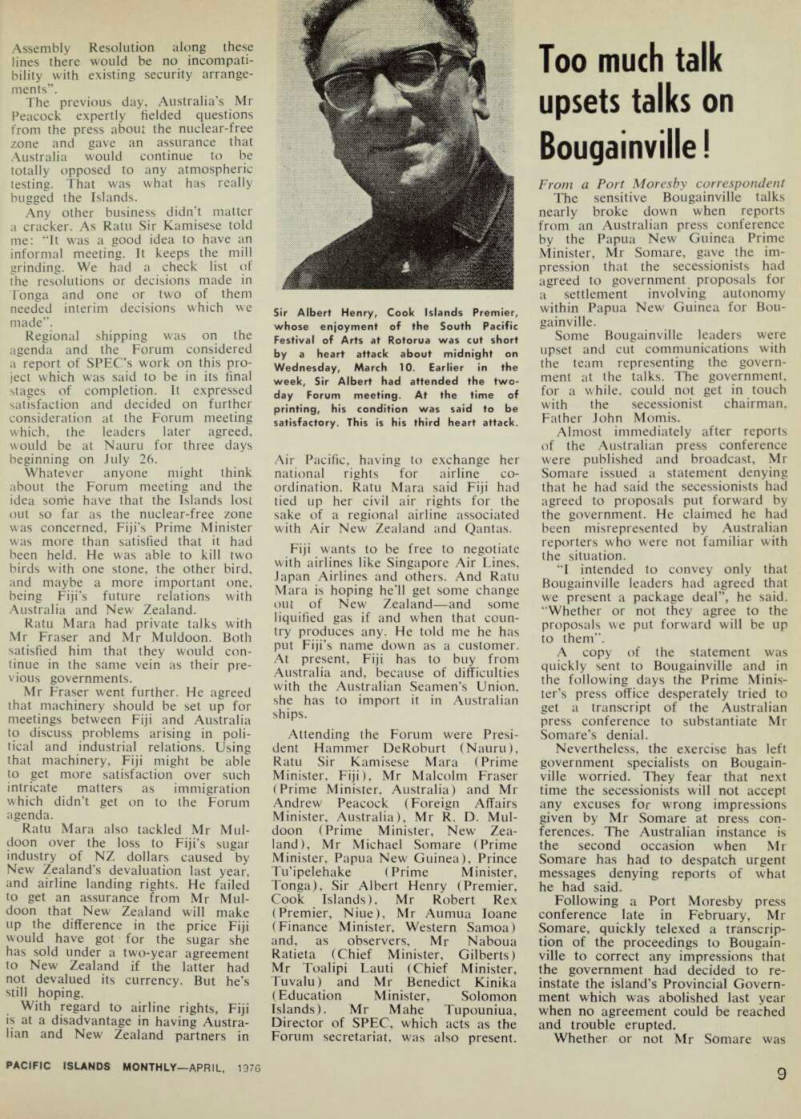
Sir Albert Henry, Cook Islands Premier, whose enjoyment of the South Pacific Festival of Arts at Rotorua was cut short by a heart attack about midnight on Wednesday, March 10. Earlier in the week, Sir Albert had attended the two day Forum meeting. At the time of printing, his condition was said to be satisfactory. This is his third heart attack.