Pacific
p. 67 · Read in the full issue
Women
Speak Up
From VANESSA G RIF FEN in Suva
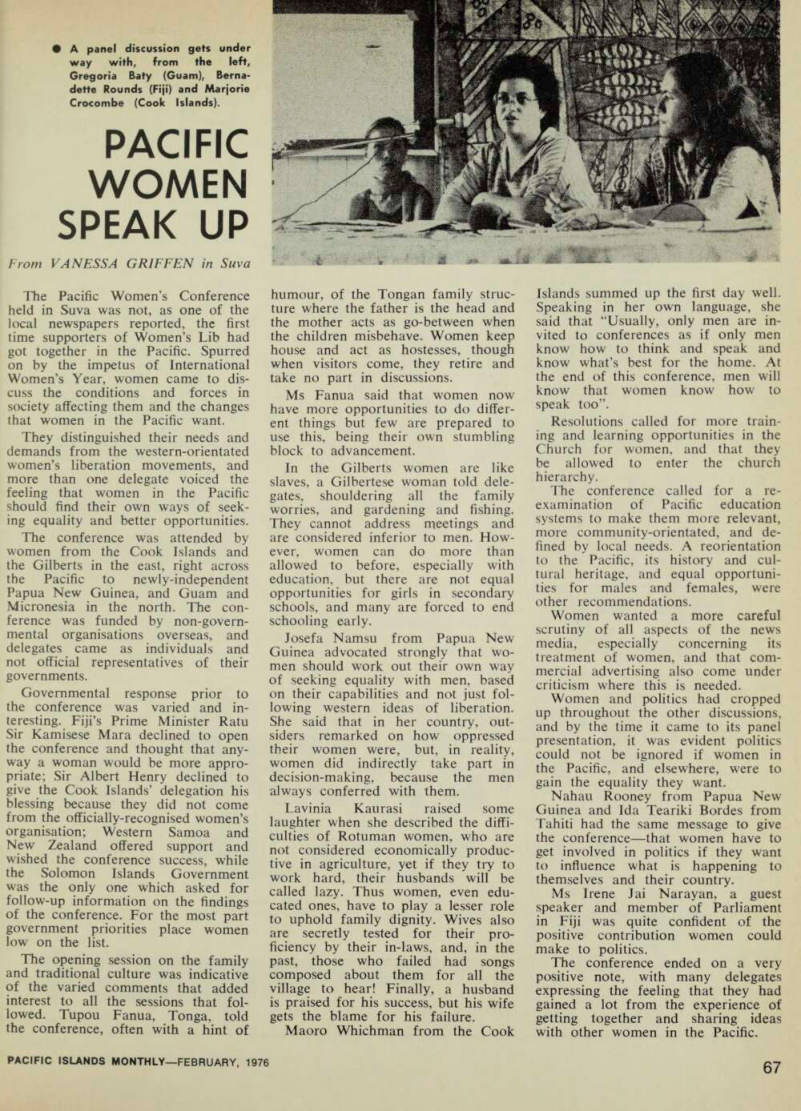
The Pacific Women’s Conference held in Suva was not, as one of the local newspapers reported, the first time supporters of Women’s Lib had got together in the Pacific. Spurred on by the impetus of International Women’s Year, women came to dis cuss the conditions and forces in society affecting them and the changes that women in the Pacific want.
They distinguished their needs and demands from the western-orientated women’s liberation movements, and more than one delegate voiced the feeling that women in the Pacific should find their own ways of seek ing equality and better opportunities.
The conference was attended by women from the Cook Islands and the Gilberts in the east, right across the Pacific to newly-independent Papua New Guinea, and Guam and Micronesia in the north. The con ference was funded by non-govern mental organisations overseas, and delegates came as individuals and not official representatives of their governments.
Governmental response prior to the conference was varied and in teresting. Fiji’s Prime Minister Ratu Sir Kamisese Mara declined to open the conference and thought that any way a woman would be more appro priate; Sir Albert Henry declined to give the Cook Islands’ delegation his blessing because they did not come from the officially-recognised women’s organisation; Western Samoa and New Zealand offered support and wished the conference success, while the Solomon Islands Government was the only one which asked for follow-up information on the findings of the conference. For the most part government priorities place women low on the list.
The opening session on the family and traditional culture was indicative of the varied comments that added interest to all the sessions that fol lowed. Tupou Fanua, Tonga, told the conference, often with a hint of
humour, of the Tongan family struc ture where the father is the head and the mother acts as go-between when the children misbehave. Women keep house and act as hostesses, though when visitors come, they retire and take no part in discussions.
Ms Fanua said that women now have more opportunities to do differ ent things but few are prepared to use this, being their own stumbling block to advancement.
In the Gilberts women are like slaves, a Gilbertese woman told dele gates, shouldering all the family worries, and gardening and fishing.
They cannot address meetings and are considered inferior to men. How ever, women can do more than allowed to before, especially with education, but there are not equal opportunities for girls in secondary schools, and many are forced to end schooling early.
Josefa Namsu from Papua New Guinea advocated strongly that wo men should work out their own way of seeking equality with men, based on their capabilities and not just fol lowing western ideas of liberation.
She said that in her country, out siders remarked on how oppressed their women were, but, in reality, women did indirectly take part in decision-making, because the men always conferred with them.
Lavinia Kaurasi raised some laughter when she described the diffi culties of Rotuman women, who are not considered economically produc tive in agriculture, yet if they try to work hard, their husbands will be called lazy. Thus women, even edu cated ones, have to play a lesser role to uphold family dignity. Wives also are secretly tested for their pro ficiency by their in-laws, and, in the past, those who failed had songs composed about them for all the village to hear! Finally, a husband is praised for his success, but his wife gets the blame for his failure.
Maoro Whichman from the Cook
Islands summed up the first day well.
Speaking in her own language, she said that “Usually, only men are in vited to conferences as if only men know how to think and speak and know what’s best for the home. At the end of this conference, men will know that women know how to speak too”.
Resolutions called for more train ing and learning opportunities in the Church for women, and that they be allowed to enter the church hierarchy.
The conference called for a re examination of Pacific education systems to make them more relevant, more community-orientated, and de fined by local needs. A reorientation to the Pacific, its history and cul tural heritage, and equal opportuni ties for males and females, were other recommendations.
Women wanted a more careful scrutiny of all aspects of the news media, especially concerning its treatment of women, and that com mercial advertising also come under criticism where this is needed.
Women and politics had cropped up throughout the other discussions, and by the time it came to its panel presentation, it was evident politics could not be ignored if women in the Pacific, and elsewhere, were to gain the equality they want.
Nahau Rooney from Papua New Guinea and Ida Teariki Hordes from Tahiti had the same message to give the conference—that women have to get involved in politics if they want to influence what is happening to themselves and their country.
Ms Irene Jai Narayan, a guest speaker and member of Parliament in Fiji was quite confident of the positive contribution women could make to politics.
The conference ended on a very positive note, with many delegates expressing the feeling that they had gained a lot from the experience of getting together and sharing ideas with other women in the Pacific.
• A panel discussion gets under way with, from the left, Gregoria Baty (Guam), Berna dette Rounds (Fiji) and Marjorie Crocombe (Cook Islands).