Business and Development
pp. 63-65 · Read in the full issue
While The Experts Plan, Tonga
Gets On With Her Fishing
From W. A. WILKINSON, Tonga's Fisheries Officer
For more than 20 years, the South Pacific Commission and other agen cies have schemed, planned and experimented to create viable fishing industries for the Islands. But, with the exception of Tonga, none of the Island territories yet has a fishing industry other than those run by outsiders, Tonga has shown courageous initiative in attempting to develop its pelagic fishery resources and, with some help from the Japanese experts, has become the first Island territory to own and operate success fully a deep-sea long-line fish catcher.
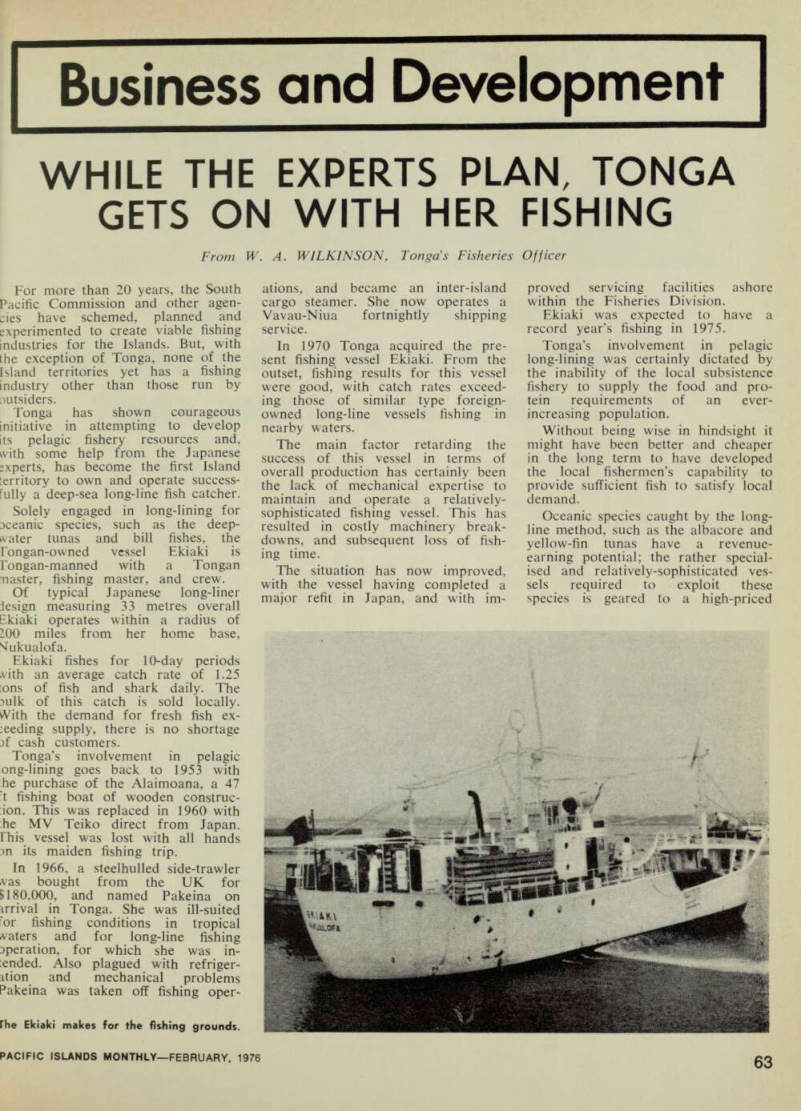
Solely engaged in long-lining for oceanic species, such as the deep water tunas and bill fishes, the Eongan-owned vessel Ekiaki is Eongan-manned with a Tongan naster, fishing master, and crew.
Of typical Japanese long-liner Jesign measuring 33 metres overall Ekiaki operates within a radius of ZOO miles from her home base, Nukualofa.
Ekiaki fishes for 10-day periods with an average catch rate of 1.25 tons of fish and shark daily. The oulk of this catch is sold locally.
With the demand for fresh fish ex :eeding supply, there is no shortage af cash customers.
Tonga’s involvement in pelagic ong-lining goes back to 1953 with .he purchase of the Alaimoana, a 47 r t fishing boat of wooden construc tion. This was replaced in 1960 with the MV Teiko direct from Japan.
Ehis vessel was lost with all hands tin its maiden fishing trip.
In 1966, a steelhulled side-trawler was bought from the UK for 5180,000, and named Pakeina on arrival in Tonga. She was ill-suited : or fishing conditions in tropical waters and for long-line fishing operation, for which she was in tended. Also plagued with refriger ation and mechanical problems Pakeina was taken off fishing oper
ations, and became an inter-island cargo steamer. She now operates a Vavau-Niua fortnightly shipping service.
In 1970 Tonga acquired the pre sent fishing vessel Ekiaki. From the outset, fishing results for this vessel were good, with catch rates exceed ing those of similar type foreign owned long-line vessels fishing in nearby waters.
The main factor retarding the success of this vessel in terms of overall production has certainly been the lack of mechanical expertise to maintain and operate a relatively sophisticated fishing vessel. This has resulted in costly machinery break downs, and subsequent loss of fish ing time.
The situation has now improved, with the vessel having completed a major refit in Japan, and with im
proved servicing facilities ashore within the Fisheries Division.
Ekiaki was expected to have a record year’s fishing in 1975, Tonga’s involvement in pelagic long-lining was certainly dictated by the inability of the local subsistence fishery to supply the food and pro tein requirements of an ever increasing population.
Without being wise in hindsight it might have been better and cheaper in the long term to have developed the local fishermen’s capability to provide sufficient fish to satisfy local demand.
Oceanic species caught by the long line method, such as the albacore and yellow-fin tunas have a revenue earning potential; the rather special ised and relatively-sophisticated ves sels required to exploit these species is geared to a high-priced
the Ekiaki makes for the fishing grounds.
nd product such as canned tuna, ather than for local domestic con amption in fresh fish form.
Nevertheless, Tonga is now pro ressing towards the development of s local fisheries. A Loans to 'ishermen’s Scheme has been estab shed which provides low-interest >ans to fishermen for the purchase f engines, boats and fishing equip lent, The use of ice is now being icouraged by the Fisheries Division; 2W diesel-powered fishing boats are ;ing constructed, and used by the ical fishermen.
Bilateral assistance from the more weloped Pacific neighbours has ;en requested. Australia has com eted a fisheries programme report ir Tonga, and will assist with the ovision of fishing boats, extension id training centres, cold storage id transport facilities.
New Zealand is providing scientific, id material help in assessing the issibilities of establishing an oyster id mussel cultivation programme, le UNDP has now an ongoing hery resource survey project, which looking at both the potential for e demersal and the pelagic migrat g species, particularly the skipjack na.
During 1973, a survey carried out the Japan Marine Fishery Re urce Centre Organisation indicated potential commercial resource of ipjack exists, sufficient to support live-bait pole and line fishery based Vavau. The UNDP team is also instigating the availability of a itable live bait to support this hery.
The prospects for fisheries develop mt in Tonga looks promising, istakes made in the past, hopefully, 11 not be repeated. What is en uraging is that Tongans have own that they can master modern hing techniques. Their long liner manned entirely by Tongans, in lat is accepted as one of the trld’s most arduous jobs.
Future development of the fishing Justry will ensure employment in mga for Tongans who certainly ust otherwise look overseas, with 2 social and community damage lich enforced family separations uses.
It will provide revenue and much eded protein: it should lessen the iportation of nutritionally-suspect ined food from overseas.
Tonga imported $365.000-worth of ined fish alone in 1974. These may 4 be over-prestigious objectives; ey are certainly fundamental ones, lich no Pacific Island territory can : ord to neglect.