Pacific Transport
pp. 55-59 · Read in the full issue
Setback For Continental Over
Saipan-Japan Route Rights
From a Saipan correspondent
The battle for the lucrative air route between Saipan and Japan is on again with Pan American World Airways and Continental/Air Micro nesia still the main contestants.
President Gerald Ford of the US, who has the final say, after several preliminary stages, directed the Civil Aeronautics Board to reconsider its award of the route to Continental/ Air Micronesia.
A new point emerged—the Japan ese Government has told the CAB that it would not allow Continental/ Air Micronesia, which does not serve Japan, to establish the service.
It seems odd that this should be raised at such a late stage. Had the Japanese policy been known earlier there would have been little need for the drawn-out hearings, with more than a little dirty linen washed in public, before the CAB sent its decision on to President Ford.
But the Japanese decision may not be final as the case has to be threshed out again, which would be a pointless exercise if Japan was determined not to accept Continental/ Air Micronesia.
Naturally, Continental/Air Micro nesia was not at all pleased with President Ford. Mr Stanley C. Ken nedy jun, regional vice-president, speaking in Honolulu, said he was disappointed with President Ford’s decision.
“We were pleased the CAB approved Continental and regret another delay in the final deter mination”, he said. “But we hope
the reopening of the case will affirm the board’s unanimous choice”.
PAA will continue to seek the route, Mr Paul Kendall, PAA regional director of external affairs, said in Honolulu.
Japan Air Lines has rights on the Japan-Saipan route, but has not taken them up pending the appoint ment of an American carrier. How ever, Japan Air Lines serves Saipan on a charter and non-schedule basis.
Final authority for granting inter national routes rests with the presi dent because of diplomatic and de fence considerations. President Ford, early in December, asked the CAB to take statements from the US Sec retaries of State and Transportation on the matter, and report to him in six months. This will probably be about the end of May, just when he is about to start on the campaign trail for the 1976 presidential elec tion.
Saipan, and indeed all the Trust Territory is waiting for the route to be allocated, and the new service to begin, A new international airport there has practically all the facilities needed to handle international jet
traffic.
The 7,000 ft runway is finished, and so are the apron, parking area and arrival building. To be finished are the departure building, a “hold ing room”, shops, a bar surrounded by viewing decks and a restaurant.
The entire project is scheduled for completion by July 18 next.
The airport had a “soft” opening on December 15 when 1,500 people jammed into the arrival building.
Air Niugini's Wings
May Be Clipped
Internal expansion will be the policy of Air Niugini if the PNG Transport, Works and Supply Minis ter, Mr Bruce Jephcott, has his way.
Mr Jephcott took over his current portfolio from Mr lambakey Okuk after the recent ministerial reshuffle.
Mr Okuk, now Education Minister, was keen to expand international services and had commissioned Boeing to make a survey to guide him.
Mr Jephcott will have to have the backing of the National Executive Council for his new policies. He wants the airline to concentrate on
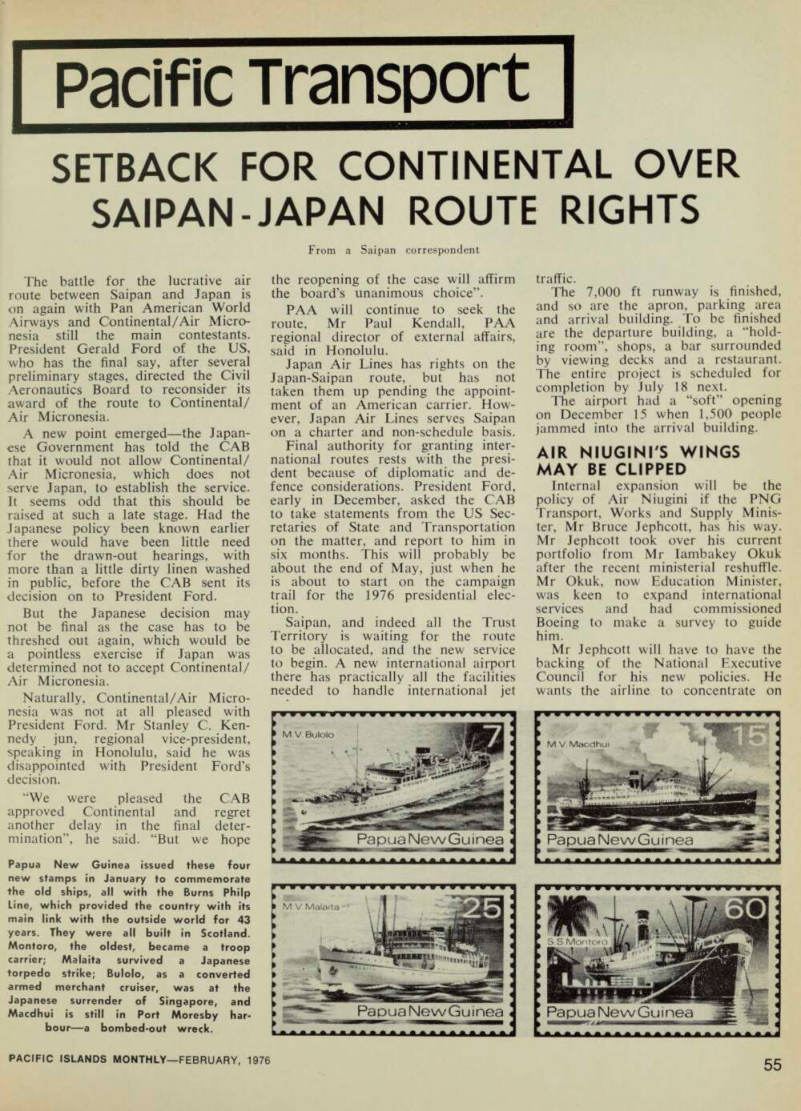
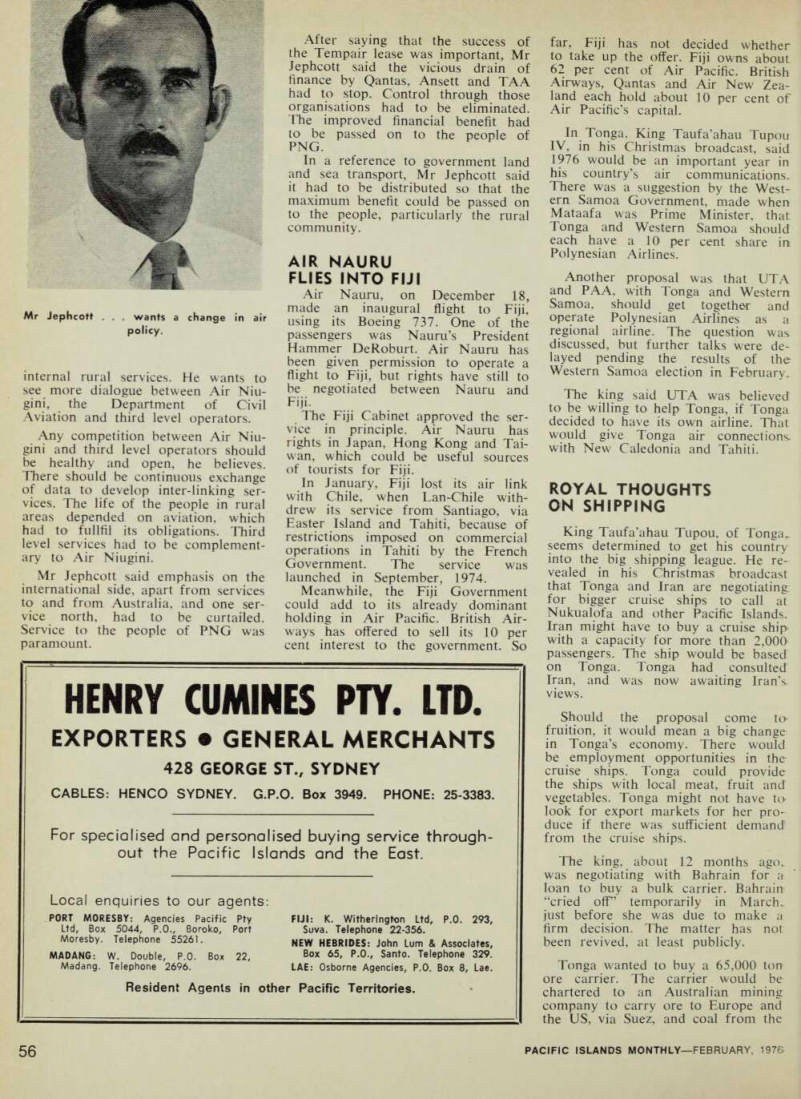
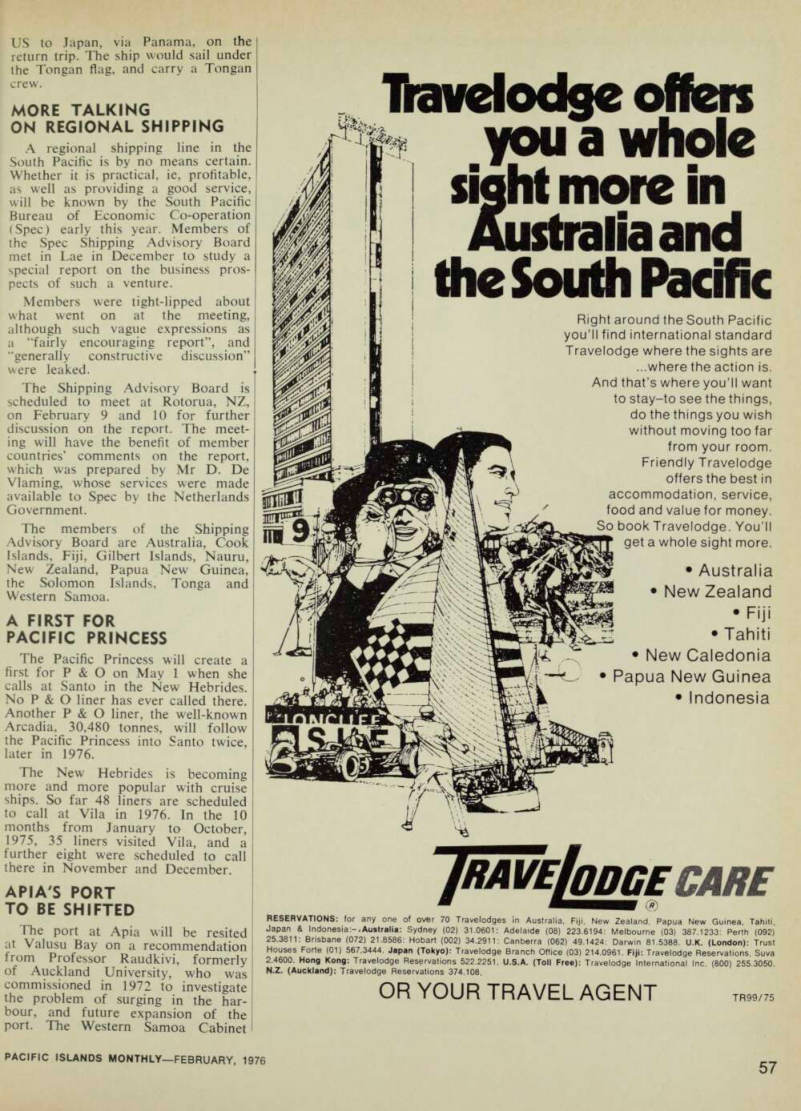
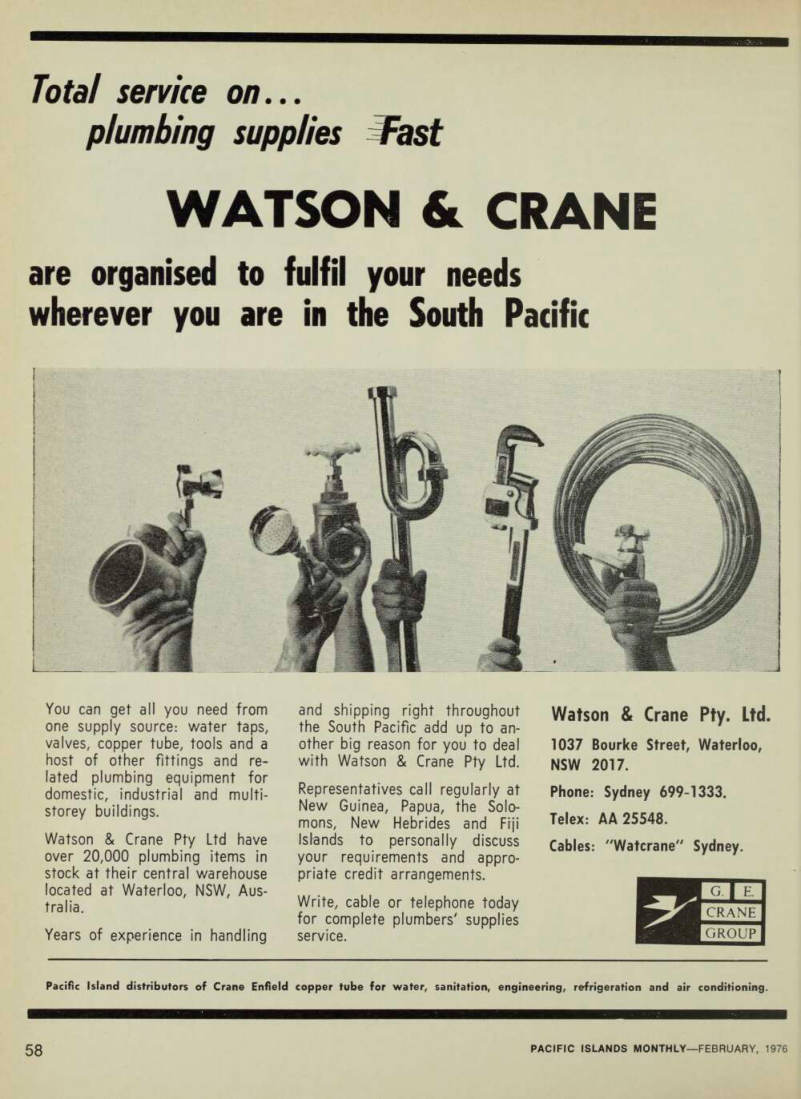
Papua New Guinea issued these four new stamps in January to commemorate the old ships, all with the Burns Philp Line, which provided the country with its main link with the outside world for 43 years. They were all built in Scotland.
Montoro, the oldest, became a troop carrier; Malaita survived a Japanese torpedo strike; Bulolo, as a converted armed merchant cruiser, was at the Japanese surrender of Singapore, and Macdhui is still in Port Moresby har bour—a bombed-out wreck.
internal rural services. He wants to see more dialogue between Air Niu gini, the Department of Civil Aviation and third level operators.
Any competition between Air Niu gini and third level operators should be healthy and open, he believes.
There should be continuous exchange of data to develop inter-linking ser vices. The life of the people in rural areas depended on aviation, which had to fullfil its obligations. Third level services had to be complement ary to Air Niugini.
Mr Jephcott said emphasis on the international side, apart from services to and from Australia, and one ser vice north, had to be curtailed.
Service to the people of PNG was paramount.
After saying that the success of the Tempair lease was important, Mr Jephcott said the vicious drain of finance by Qantas, Ansett and TAA had to stop. Control through those organisations had to be eliminated.
The improved financial benefit had to be passed on to the people of
Png.
In a reference to government land and sea transport, Mr Jephcott said it had to be distributed so that the maximum benefit could be passed on to the people, particularly the rural community.
Air Nauru
Flies Into Fiji
Air Nauru, on December 18, made an inaugural flight to Fiji, using its Boeing 737. One of the passengers was Nauru’s President Hammer Deßoburt. Air Nauru has been given permission to operate a flight to Fiji, but rights have still to be negotiated between Nauru and Fiji.
The Fiji Cabinet approved the ser vice in principle. Air Nauru has rights in Japan, Hong Kong and Tai wan, which could be useful sources of tourists for Fiji.
In January, Fiji lost its air link with Chile, when Lan-Chile with drew its service from Santiago, via Easter Island and Tahiti, because of restrictions imposed on commercial operations in Tahiti by the French Government. The service was launched in September, 1974.
Meanwhile, the Fiji Government could add to its already dominant holding in Air Pacific. British Air ways has offered to sell its 10 per cent interest to the government. So
far, Fiji has not decided whether to take up the offer. Fiji owns about 62 per cent of Air Pacific. British Airways, Qantas and Air New Zea land each hold about 10 per cent of Air Pacific’s capital.
In Tonga. King Taufa’ahau Tupou IV, in his Christmas broadcast, said 1976 would be an important year in his country’s air communications.
There was a suggestion by the West* ern Samoa Government, made when Mataafa was Prime Minister, that Tonga and Western Samoa should each have a 10 per cent share in Polynesian Airlines.
Another proposal was that UTA and PAA, with Tonga and Western Samoa, should get together and operate Polynesian Airlines as a regional airline. The question was discussed, but further talks were de layed pending the results of the Western Samoa election in February.
The king said UTA was believed to be willing to help Tonga, if Tonga decided to have its own airline. That would give Tonga air connections, with New Caledonia and Tahiti.
Royal Thoughts
On Shipping
King Taufa’ahau Tupou, of Tonga,, seems determined to get his country into the big shipping league. He re vealed in his Christmas broadcast that Tonga and Iran are negotiatings for bigger cruise ships to call at Nukualofa and other Pacific Islands.
Iran might have to buy a cruise ship with a capacity for more than 2,000 passengers. The ship would be based on Tonga. Tonga had consulted Iran, and was now awaiting Iran’s views.
Should the proposal come to fruition, it would mean a big change in Tonga’s economy. There would be employment opportunities in the cruise ships. Tonga could provide the ships with local meat, fruit and vegetables. Tonga might not have to look for export markets for her pro duce if there was sufficient demand from the cruise ships.
The king, about 12 months ago,, was negotiating with Bahrain for a loan to buy a bulk carrier. Bahrain “cried off” temporarily in March, just before she was due to make a firm decision. The matter has not been revived, at least publicly.
Tonga wanted to buy a 65,000 ton ore carrier. The carrier would be chartered to an Australian mining company to carry ore to Europe and the US, via Suez, and coal from the
Mr Jephcott . . . wants a change in air policy.
US to Japan, via Panama, on the return trip. The ship would sail under the Tongan flag, and carry a Tongan crew.
More Talking
On Regional Shipping
A regional shipping line in the South Pacific is by no means certain.
Whether it is practical, ie, profitable, as well as providing a good service, will be known by the South Pacific Bureau of Economic Co-operation (Spec) early this year. Members of the Spec Shipping Advisory Board met in Lae in December to study a special report on the business pros pects of such a venture.
Members were tight-lipped about what went on at the meeting, although such vague expressions as a “fairly encouraging report”, and “generally constructive discussion” were leaked.
The Shipping Advisory Board is scheduled to meet at Rotorua, NZ, on February 9 and 10 for further discussion on the report. The meet ing will have the benefit of member countries’ comments on the report, which was prepared by Mr D. De Vlaming, whose services were made available to Spec by the Netherlands Government.
The members of the Shipping Advisory Board are Australia, Cook Islands, Fiji, Gilbert Islands, Nauru, New Zealand, Papua New Guinea, the Solomon Islands, Tonga and Western Samoa.
A First For
Pacific Princess
The Pacific Princess will create a first for P & O on May 1 when she calls at Santo in the New Hebrides.
No P & O liner has ever called there.
Another P & O liner, the well-known Arcadia, 30,480 tonnes, will follow the Pacific Princess into Santo twice, later in 1976.
The New Hebrides is becoming more and more popular with cruise ships. So far 48 liners are scheduled to call at Vila in 1976. In the 10 months from January to October, 1975, 35 liners visited Vila, and a further eight were scheduled to call there in November and December.
Apia's Port
To Be Shifted
The port at Apia will be resited at Valusu Bay on a recommendation from Professor Raudkivi, formerly of Auckland University, who was commissioned in 1972 to investigate the problem of surging in the har bour, and future expansion of the port. The Western Samoa Cabinet I
early in December approved the re commendation covering resiting.
Professor Raudkivi recommended a programme of drilling and samp ling of the coral in the bay. The programme would include a hydro graphic survey of the area. The Pub lic Works Department will make the preliminary investigation. Details of the port will be investigated with the aid of a computer and hydraulic model studies.
The Apia wharf, which was opened in March, 1966, cost £BOO,OOO and, as was realised at the time, was sited in the wrong place.
At the opening ceremony, in which the Union Steam Ship Com pany’s veteran passenger-freighter Matua took part—being the first ship to berth there—doubts were privately expressed about the site. Some of the Matua’s crew prophesied to a PIM man, who was there, that there would always be trouble from surging.
The opinion expressed by a visit ing US warship’s crew was in much more colourful terms.
Raising The Wind
To Save Money
Sail power allied with engine power may be one way of cutting down operating costs of the Fiji inter island fleet. Tine Fiji Marine Depart ment is studying the question, prompted by several sharp increases in the price of fuel.
Some time this year a 100 ft diesel ship will be fitted with sails. If this pilot project shows worthwhile sav ings can be made, the ship may be turned into a staysail schooner. With sails used to assist the engines big fuel savings would be possible.
The prevailing south-east trade wind in Fiji would make the use of such ships a one-way proposition in most instances. Ships leaving Suva for Lau would have to rely on engine power for most of the trip. However, on the return trip, sails could be brought into full play.
Nauru Borrows
A German Ship
The Nauru Pacific Line has chartered the Weser Carrier, a semi container ship, from German owners to operate a service covering Fiji, Samoa, New Zealand and ports on the east coast of Australia. The ship has an overall length of 345 ft and a beam of 50 ft, with a speed of 19 knots. She will make two trips a month between Australia and Fiji with up to 5,000 tons of cargo.
The Weser Carrier was previously used by Bougainville Copper Ltd to carry copper from Bougainville to Hobart and other Australian ports.
She carries a crew of six German officers and 20 Papua New Guinea seamen.
Transport
Briefs
• Mr Paul Pora has been ap pointed chairman of the Papua New Guinea Airlines Commission, which operates Air Niugini. The other members are Messrs Joa Tauvasa, Elies Vuvu, George Blacker (PNG Banking Corporation), Captain R.
J. Ritchie (Qantas), Dr Harold Poulton (Ansett) and Captain R.
Bailey (TAA). Alternates are Messrs Paul Bengo (Prime Minister’s staff), Paul Kipo (Secretary, Transport De partment), Cedric Chee (Lae), Henry Deßobert (Governor, Bank of PNG), H. G. Cook (Qantas), B.
Costello (Ansett) and Captain L. J.
Thrift (TAA). • The Fiji Government shipyard in Suva is booked for the next five years. Ships to be built include a second Kaunitoni-class passenger cargo ship, a fourth cruiser for Blue Lagoon Cruises Ltd, a 140 ft landing barge which will be the longest ship built in Fiji, and a tug. • The Fiji pleasure cruise ship, Sayandra, 132 tons, has been bought by Mr Barrie LeFevre, managing director of LeFevre Enterprises Pty Ltd, of Australia. Mr LeFevre hopes to form a company in Fiji to pro mote charters. • Nissan Island Shipping, a PNG company, has opened a trade route covering Buka, Nissan Island and Rabaul. It recently bought a 130-ton ship, the Astronaut, for K 140,000.
The ship will ensure a regular link with Rabaul for the Nissan islanders who have had difficulty in shipping their produce there. The PNG- Chinese Association helped to arrange the purchase of the ship, and to negotiate a carrying contract with the Copra Marketing Board. • A Cessna 185 somersaulted just before making a forced landing on a Fauro Island beach, south of Bougainville, late in December. The pilot, Graham Barnett, 30, a Seventh-day Adventist mission school supervisor, a little shaken, walked away unhurt. He radioed a Mayday call just before the crash. • The Pacific Navigation Co, of Tonga, has chartered the Fijian Swift from the Reef Shipping Co, Auckland, to replace the Aoniu and Frysna. The Fijian Swift, on a bare boat charter, will be reregistered and renamed in Tonga. The small ships she replaces are nearing the end of their lives, and have been a drain on the strained finances of Pacific Navigation Co. Reef Shipping, which operates a service between Auckland and Fiji, expects to charter a 2,600 ship to replace the Fijian Swift.