Books, Reviews, writers
pp. 51-52 · Read in the full issue
There's A New Foot In Papua
New Guinea's Racist Boot
In his annual report for 1891/92, Sir William MacGregor, first ad ministrator of British New Guinea, observed that “perhaps nothing shows more clearly the progressive development of a young country than a connected account from time to time of the legislation effected, and af the circumstances under which new laws are passed or old ones amended”.
Much of the book, Race Relations and Colonial Rule in Papua New Guinea, consists of the kind of con nected account mentioned by Mac- Gregor. On 164 pages, supported by 336 notes, some of them lengthy, there is a recital of many of the laws and a cursory description of he institutions used by the German and Australian administrations to differentiate, especially in the econ omic and social spheres, between oersons on the basis of racial origin.
Some of the legislation, eg, the Land Ordinance, protected the slanders’ interests, and some, eg the Native Administration Ordinance, yas intended to simplify and stream ine the judicial system and to cover sorcery, adultery and other offences hat were not regarded as such in he metropolitan societies.
Many of the laws discriminated igainst the islanders. Restrictive aws, eg urban curfews, on holding iing-sings, on wearing non-traditional dothing on the upper part of the iody, on acting in a motion picture, md on drinking alcohol, applied to slanders but not to Europeans. There vas a special law, with the death icnalty as ultimate sanction, cover ng sexual offences by islanders igainst European women, and the 3 olice Offences Ordinance dealt nore severely with islanders than vith Europeans.
Colonel Ainsworth, a former chief lative commissioner in Kenya who dsited the Mandated Territory of 'dew Guinea in 1924, told the Aus ralian Government that the Native \dministration Ordinance was “so ramed as to aim at a form of direct idministration of native affairs by vhite officials that cannot be helpful
to the development of native so ciety”, but neither Lieutenant- Governor Sir Hubert Murray in Papua (where much the same kind of ordinance was in force) nor Administrator Wisdom or his suc cessor McNicoll in the Mandated Territory heeded Ainsworth’s advice.
Only after World War II had caused the Australian people to take more interest in the two territories did Canberra, further influenced by world opinion favouring decolonis ation and UN resolutions, make changes in its colonial policy that, among other things, removed dis criminatory legislation in Papua New Guinea. Even so, it was not until the mid-1960s that the slate was fully cleaned.
White racism, as defined by the World Council of Churches, is the conscious or unconscious belief in
the inherent superiority of persons of European ancestry, which entitles all white people to a position of dominance and privilege. The author of this book, Ted Wolfers, claims that white racism was part of the Australian colonial system and not, as some writers have suggested, the product of attitudes held and actions performed informally by individuals.
Indeed, says Wolfers, a political scientist with considerable experience in Papua New Guinea, “there were individual acts of care, kindness and assistance in development across the caste-barriers”.
That racism continues to be world wide and is not merely a pheno menon of relations between white people and those of other skins, colour and cultures, and that, as pointed out by Professor Encel, “Australia is a product of the colonial era and, like all colonial territories, there is a basic element of racism in its social fabric”, helps to explain but does not exculpate the racist aspects of Australian rule in Papua New Guinea.
What worries this reviewer is the author’s failure to deal with “the circumstances under which new laws are passed or old ones amended” which are part and parcel of Mac- Gregor’s prescription. To an econ omic determinist, Schumpeter’s ob servations on human atavism are undoubtedly more to the point than the loosely-impressionistic conclu sions arrived at by the author.
As stated by Leo Hannett, a Bou gainvillean, “Black Power is as rele vant to Niugini as betelnut”, and by Michael Somare, Papua New Guinea’s Prime Minister, “We like to keep Niugini black, just as Austra lians want to keep Australia white”, it is all about power.
According to Section 55 of the Constitution of the Independent State of Papua New Guinea, all citizens have the same rights, privileges, ob ligations and duties irrespective of race, tribe, place of origin, political opinion, colour, creed, religion or sex. But section 68(4) of the same Constitution lays down that during the five years after Independence
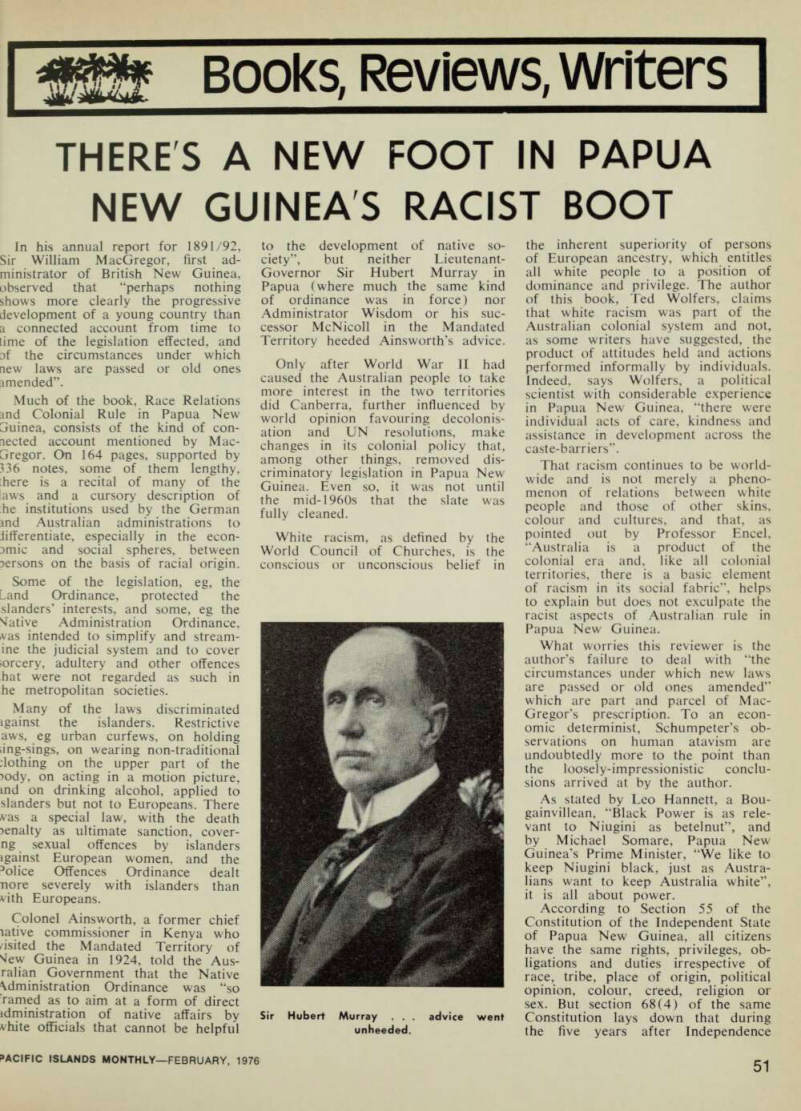
Sir Hubert Murray . . . advice went unheeded.
Day only a citizen who was born in the country before that day and has two grandparents, who were born in the country or the Solomon Islands or Irian Jaya or the Torres Strait Islands, “shall have the rights con ferred by Section 53 (Protection from Unjust Deprivation of Pro perty)”.
Section 53 and its concomitant Section 54, a special provision in relation to certain lands, and public statements by Sir Maori Kiki, Foreign Minister, leave no doubt that racism is as alive in Papua New Guinea to day as it was during the German and Australian regimes. Only the boot is on the other foot.
There could be several reasons why the new nation has adopted a
racist Constitution and practises racial discrimination in certain spheres. For one thing, about 85 per cent of the country’s secondary and tertiary industries are foreign-owned and foreigners hold most of the top positions in commerce and industry.
For another, there are as yet only a handful of nationals on the academic staffs of the two universities and
other tertiary institutions. Again, isn’t it all about power?
History teaches that racial dis crimination in any form degrades those who practise it. It is sad that, like many other nations, Papua New Guinea has not heeded the lesson.
This book is a useful account of some aspects of Papua New Guinea’s past but it falls short of presenting the whole picture. In spite of its title, it does not explain race-relations. It needs to be read and understood in the light of a number of caveats contained in the text, especially those in its Introduction and Conclusion. —Harry Jackman. (Race Relations and Colonial Rule in Papua New Guinea. By E. P. Wolfers. Pub lished by Australia & New Zealand Book Co, Sydney. $6.95).