Independent Santo!
pp. 12-75 · Read in the full issue

Christmas crackers from Jimmy Stevens
From a Vila correspondent
The fact that not everyone sits down to feast on plum pudding, Christmas cake or buche de Noel in December was highlighted by events that month in the New Hebrides which culminated in Nagriamel party leader Jimmy Stevens sending envoys to the United Nations to seek the removal of the British from the con dominium partnership and indepen dence for Santo by April 1, 1976 (April Fool’s Day!) Meantime, the elections for the territory’s first Representative Assem bly for which the population voted in November, had still not been completed. With French Overseas Territories Minister Mr Olivier Stirn planning a South Pacific visit in January, it really looked as though someone was holding up the assem bly and desperately playing for time.
Events seemed to crystallise around December 11 when a large crowd of supporters made it known that Na griamel leader Jimmy Stevens was contesting the validity of the elec tion results for six seats in Santo, after the overwhelming defeat of Nagriamel and the National Party victory.
An ultimatum was launched de manding an inquiry and response from the joint administration by De cember 27. If some people non chalantly spent the meantime writing Christmas cards, others were busy writing a list of grievances against the British authorities, ending with a demand that the UK should get out of Santo by April 1, 1976, OR
Else . . .
The list of charges against the British administration were in a let ter presented to the French and British delegates in Santo on De cember 27, during a massive rally by about 2,700 supporters of Jimmy Stevens. The letter was signed by Stevens and MANH party leader, Aime Malere.
A second letter, dated December 29, went a step further. Signed only by Jimmy Stevens and not by the
MANH group, this letter urged in dependence for Santo and other islands in the north, possibly the Banks, Malo, Torres, Maewo, Aoba and perhaps others. (This would mean separation from the Island of Vate and capital Vila). The letter repeated the desire to see an end to the British, but a continued French presence in the islands.
In a joint public communique dated December 31, the British and French resident commissioners stated that under the 1914 Protocol, neither France nor Britain could withdraw from the territory without the other.
Moreover, they considered that no leader of a political party could claim to speak for the whole or a part of the New Hebrides.
Concerning independence, they pointed out that any modification of the condominium’s political status would depend on the two governing powers acting in co-operation with such local bodies as the new Repre sentative Assembly.
Meanwhile, main recriminations listed against the British were that the British Administration had helped the National Party electoral fraud, that it obstructed economic develop ment by its policy over the Pekoa airfield and wharf at Santo, while only the French, through French settlers, had aided the development of Santo.
It was claimed, moreover, that only French possessions accepted Hebridean workers and took copra and meat exports from the New Hebrides. Furthermore, the French were giving back land to the locals.
The letter criticised the British land
policy adopted through the Land Trust Board. As for roads, only the war and the US had provided a suitable network, while in the area of sporting facilities the British were denounced as being as deficient as elsewhere.
All in all, the anti-British letter could not have been better written by a Paris public servant. And after all, wasn’t Jimmy Stevens received in France last July by President Valery Giscard d’Estaing, an honour not even accorded to leaders of the New Caledonian Territorial Assem bly?
Some see Jimmy Stevens’ dramatic move as an attempt to, • Get back into the limelight after his sun was eclipsed by the National Party’s successes at the polls, or • To give supporters something more to think about than the where abouts of Nagriamel funds.
That he wanted to create an in dependence bandwagon of his own was demonstrated by his comments at the rally when he strongly de nounced the British and the Presby terian ministers for supporting the National Party which seemed to have overshadowed him by calling for independence for the New Heb rides by 1977.
His attempt to get the United Nations to back his campaign for an independent Santo apparently fizzled out. His envoys got no fur ther at UN headquarters than the desk of a minor official.
It is interesting to note also, that
• Continued on p 75
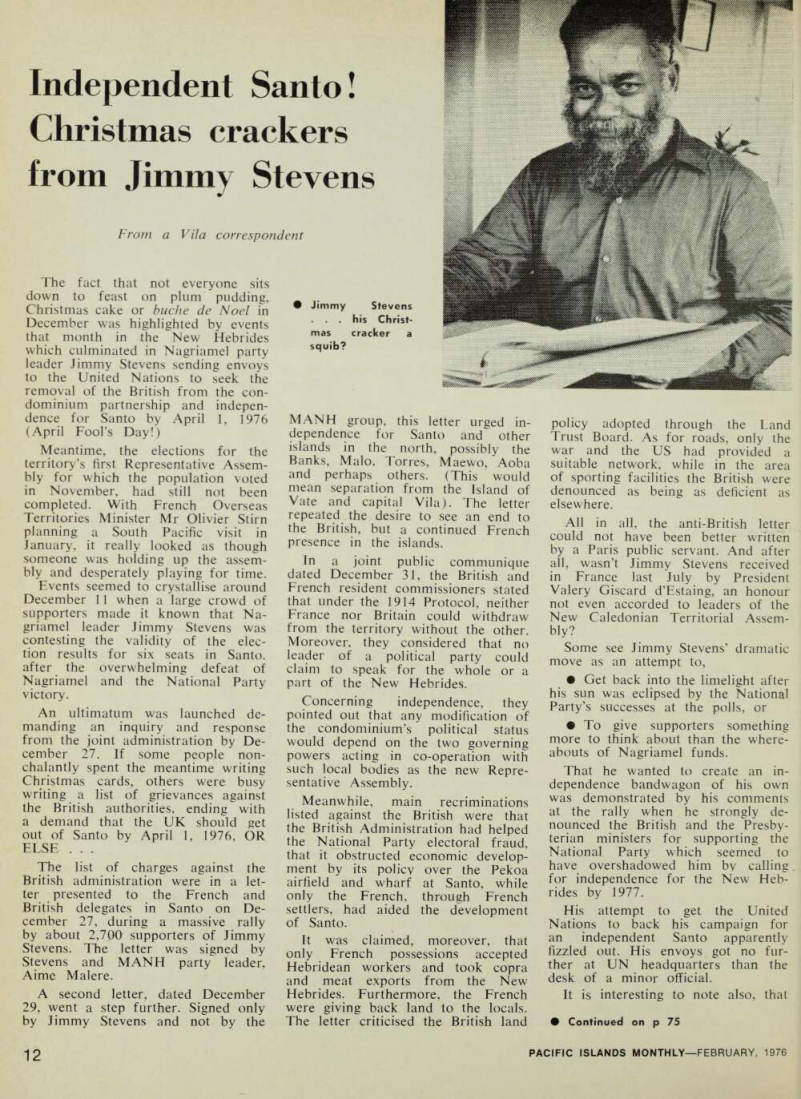
• Jimmy Stevens . . . his Christ mas cracker a squib?
investment in the New Hebrides by Caledonians (cattle industry) is re garded as highly beneficial while Australian companies setting up in the condominium have always been treated with suspicion by the French who openly in their Press interpret their presence as a desire by Australia to take over from the UK and estab lish an Australian empire in the South Pacific.
On the subject of investment, Jimmy Stevens was quoted as saying that the French authorities were wel come on the island provided they were prepared to invest. The French Pacific Press was also quick to claim that Nagriamel has the “substantial” financial backing of Hawaii business man Mr Peacock, who was interested in carrying out subdivisions for land sales in the New Hebrides.
Another backer is believed to be American (or Minerva Republican) Mike Oliver, who, in 1972, emerged as a parent of the Republic of Minerva, the reef in Tongan waters.
The republic, which was to have been a city built on the reef, was but a foetus in the minds of a busi ness group until it was aborted by King Taufa’ahau Tupou IV, of Tonga. The king annexed the reef
in the name of the Kingdom of Tonga.
Mr Oliver has been spending some time in the New Hebrides.
The French government-sponsored press gave extensive coverage to Jimmy Stevens’ outburst against the British. Of course, there is no doubt about which power wants to stay in the New Hebrides and about which neighbouring nation she most wants to keep out.
France is anxious to fortify hei position in the New Hebrides, which helps her stand in New Caledonia, in Tahiti and in the whole Pacific.
And France, ever scheming and flirtatious, is prepared to bestow her favours upon whatever other powers may be useful in helping keep off the one she sees as her prime rival in the South Seas, Australia.
These seductive favours could amount to a skilfully-devised land deal with the Americans here, a kindly gesture of a hotel deal with the Japanese there ... all on the understanding of course that France be maintained as mistress of the New Hebrides.
Moreover, the expense is so slight: a few planes to fly in voters here, or boats to ship supporters across there . . . and, as Britain has so much more to worry about far off in the EEC, a little harassment could soon wear her out!
Around the middle of January, one of Nagriamel’s envoys to the UN, Mr James Garae Bakeo (70), who describes himself as Nagriamel’s Foreign Minister, arrived in Fiji seeking Fijian recognition for the new State of Santo. He claimed that his federation now ruled all the islands in the north of the group.
They had their own flag, the Nagria mel symbol (the nagria and namele plants) with a black and a white hand clasped in racial unity on a blue background.
Pacsec 76
Police, fire brigade officers and others in the Islands interested in security, fire prevention and indus trial safety are invited to the Second Pacific Security Exhibition and Con vention which opens for three days from April 14 in the Exhibition Building in Melbourne.
The exhibition, sponsored by the Australian Security Industry Asso ciation and police forces and other appropriate bodies in Australia, will cover more than 5,000 square feet, showing the latest equipment services and technology from around the world.
Further details can be obtained from Peter Daniel & Co Pty Ltd, 11 Clarke Street, Crows Nest, Sydney (tel. 431235).