clings to past
p. 53 · Read in the full issue
Four colonial bosses but Yap clings to past
The Yap Islands are about 450 nautical miles southwest of Guam, 250 miles northeast of the Palau Islands, and their nearest neighbour in the west, the Philippines, is 1,100 miles away. There are four main islands and six small ones, forming a chain 16 miles long and from one to six miles wide, with a total land area of less than 39 square miles.
In 1886, when Spain established sovereignty over the islands, there were about 8,000 Yapese, a flourish ing people according to contemporary reports by foreigners and recollec tions of the few islanders surviving from those days. The existence of so many people in so limited an environment was, of course, only possible through superb organisation of the political, economic and social aspects of their society.
The Germans bought the islands from the Spaniards in 1899. In 1914, when Japan supplanted Germany as governing power, the population was but 5,500 and it fell as low as 2,600 by 1945 when the US took over.
Some of the decline was due to epidemics of measles and other in troduced diseases, but the main cause was the breaking down of traditional organisation and mores.
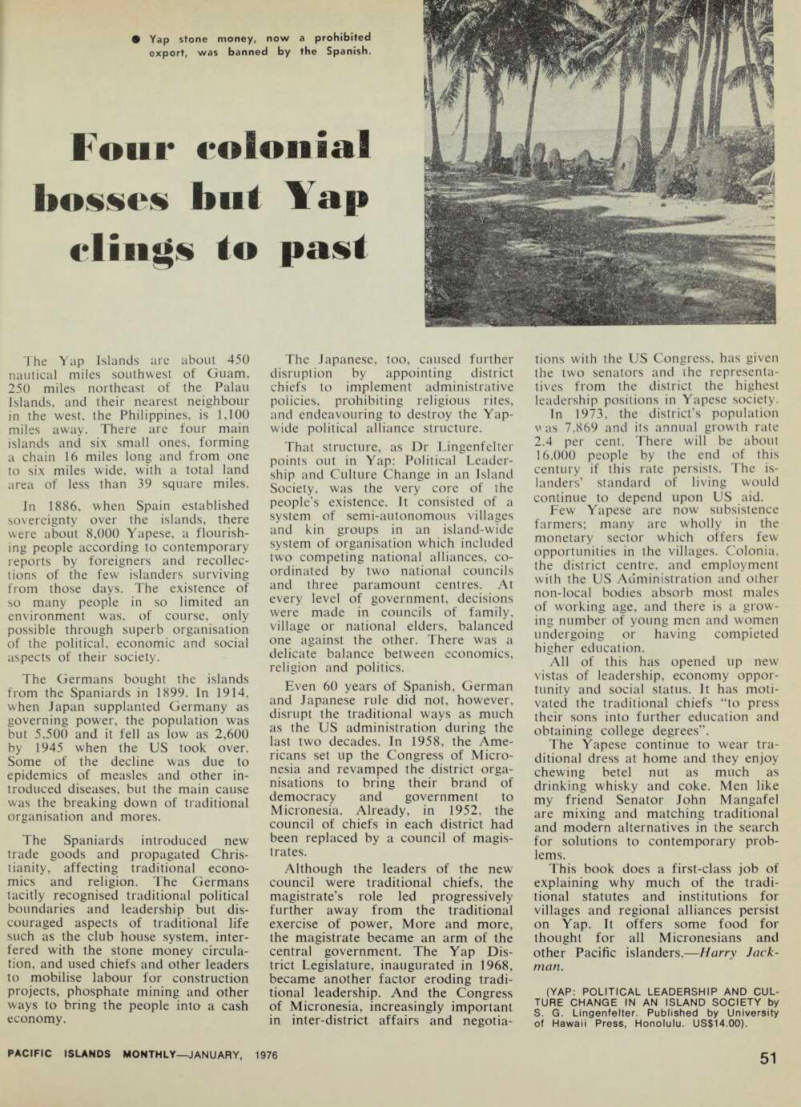
The Spaniards introduced new trade goods and propagated Chris tianity, affecting traditional econo mics and religion. The Germans tacitly recognised traditional political boundaries and leadership but dis couraged aspects of traditional life such as the club house system, inter fered with the stone money circula tion, and used chiefs and other leaders to mobilise labour for construction projects, phosphate mining and other ways to bring the people into a cash economy.
The Japanese, too, caused further disruption by appointing district chiefs to implement administrative
policies, prohibiting religious rites,
and endeavouring to destroy the Yap wide political alliance structure.
That structure, as Dr Lingenfelter points out in Yap: Political Leader ship and Culture Change in an Island Society, was the very core of the people’s existence. It consisted of a system of semi-autonomous villages and kin groups in an island-wide system of organisation which included two competing national alliances, co ordinated by two national councils and three paramount centres. At every level of government, decisions were made in councils of family, village or national elders, balanced one against the other. There was a delicate balance between economics, religion and politics.
Even 60 years of Spanish, German and Japanese rule did not, however, disrupt the traditional ways as much as the US administration during the last two decades. In 1958, the Ame ricans set up the Congress of Micro nesia and revamped the district orga nisations to bring their brand of democracy and government to Micronesia. Already, in 1952, the council of chiefs in each district had been replaced by a council of magis trates.
Although the leaders of the new council were traditional chiefs, the
magistrate’s role led progressively
further away from the traditional exercise of power. More and more, the magistrate became an arm of the central government. The Yap Dis trict Legislature, inaugurated in 1968, became another factor eroding tradi tional leadership. And the Congress of Micronesia, increasingly important in inter-district affairs and negotia
tions with the US Congress, has given the two senators and the representa tives from the district the highest leadership positions in Yapese society.
In 1973, the district’s population was 7,869 and its annual growth rate 2.4 per cent. There will be about 16,000 people by the end of this century if this rate persists. The is landers’ standard of living would continue to depend upon US aid.
Few Yapese are now subsistence farmers; many are wholly in the monetary sector which offers few opportunities in the villages. Colonia, the district centre, and employment with the US Administration and other non-local bodies absorb most males of working age, and there is a grow ing number of young men and women undergoing or having completed higher education.
All of this has opened up new vistas of leadership, economy oppor tunity and social status. It has moti vated the traditional chiefs “to press their sons into further education and obtaining college degrees”.
The Yapese continue to wear tra ditional dress at home and they enjoy chewing betel nut as much as drinking whisky and coke. Men like my friend Senator John Mangafel are mixing and matching traditional and modern alternatives in the search for solutions to contemporary prob lems.
This book does a first-class job of explaining why much of the tradi tional statutes and institutions for villages and regional alliances persist on Yap. It offers some food for thought for all Micronesians and
other Pacific islanders.
Harry Jack-
man.
(Yap: Political Leadership And Cul
TURE CHANGE IN AN ISLAND SOCIETY by S. G. Lingenfelter. Published by University of Hawaii Press, Honolulu. US$l4.OO).
• Yap stone money, now a prohibited export, was banned by the Spanish.