Tropicalities
pp. 18-19 · Read in the full issue
Admiral backs a super port
During a visit to the Palauan Islands, Admiral Kent Carroll, Com mander of the US Naval Forces in the Marianas, said that the most im portant thing happening now in the Western Pacific is the prospect of “Port Pacific” in Palau, a superport complex proposed for the northern reefs of Palau.
Backed by lapanese and Iranian government interests, the port would be capable of storing a three-months supply of oil for Japan.
Carroll commented: “The US is certainly not opposed to it. However, the people of Palau are the import ant key. There has to be no opposi tion to it. My personal feeling is that I predict the preliminary studies will show that it’s a viable concept and I think it makes a tremendous amount of sense. There will be tre mendous pressure in Palau from huge concerns and countries. I think it will be a difficult thing for the Pa lauans to turn down”.
He emphasised that, in his opinion, the positioning of the port in Palau would depend greatly on Palau’s close alliance with the United States.
“No country is going to put money into something without strong politi cal stability—and that can only be with the US”.
Questioned as to the military’s interest in obtaining a lease option on 30,000 acres of land in Babel thaup, Palau’s largest island, Carroll replied: “If we lose or pull out of additional areas in the Western Paci fic, we will have to pull back. Tinian is our priority area, but Babelthaup would be needed for contingency operations. We need operations grounds for amphibious operations.
We are losing many of the beaches we used to use for this type of train ing, so we’re looking for other areas”.
Carroll said that at present he does not foresee too many changes in the Trust Territory “unless some thing happens in the Western Pacific” such as the loss of bases the US now holds. This, he felt, is extremely un likely, but if it did happen, “the
Trust Territory would become im
portant overnight. The build-up
would be tremendous, Guam would be'first, then Tinian, and third Babel thaup. In the case of Babelthaup negotiations would first be necessary”.
Admiral Carroll made his first trip to Palau in November as part of a larger visitation schedule to all the districts of Micronesia. He was travelling as the official represen tative of Admiral Guyler, Com mander-in-Chief, Pacific. Admiral Carroll’s command area includes all the Trust Territory, New Zealand and Australia.
Cat was
for burning
A Catalina flying boat, one of World War Two’s historic aircraft, has been rescued from a team of eager firemen in Port Moresby. Fire men from the Civil Aviation Agency wanted to burn the abandoned flying boat to practise fire and rescue drill for airport emergencies.
But an aircraft restoration group from New Zealand stepped in and rescued the flying boat from its graveyard beside Port Moresby In ternational Airport.
After negotiating with officials of the PNG Air Museum, the restora tion group used a crane to lift the flying boat from a pile of old tyres which had been heaped round it to make a fire.
The flying boat—or part of it, anyway—was sent by sea to the Auckland Museum of Transport and
Technology.
With a wingspan of 104 feet, it was too bulky to be loaded in one piece in the freighter Capitaine Cook.
After restoration, the Catalina will go on permanent display in Auckland as an example of one of the most famous maritime reconnaissance and courier aircraft from all theatres of war in World War Two.
In return, the PNG Air Museum, which has yet to establish its public displays, will get the fully-restored cockpit sections of two famous World War Two fighters—a Spitfire and a Thunderbolt.
The Consolidated PBY Catalina was a distinctive aircraft with a high
pedestal wing, two engines, and two distinctive viewing blisters amidships.
It was a Catalina operated by the RAF which made the historic sighting of the Bismarck on May 26, 1941.
Nearly 4,000 Catalinas were built altogether in factories in the US, Canada and Russia.
In Australia, the RAAF carried out its Catalina training from a base at Lake Boga near Swan Hill.
During the postwar reconstruction of air services in PNG, Qantas operated Catalinas on passenger and freight services on the Papuan coast and to coastal outstations on New Britain and Bougainville.
Later, TAA took over the services, and the last Catalina to fly in PNG was withdrawn from service in 1967.
This was the one which has gone to New Zealand, and which was origi nally flown to PNG from Hong Kong where it had also been used in civil air services.
Has anyone
found a house?
The Papua New Guinea Govern ment has “lost” hundreds of houses in all parts of the country, so stock taking is being organised to find out how many houses the Government owns—or should own—and where they are.
There’s no doubt that the houses still exist, that people are living in them, and that they are still on the sites where the Government built them. But confusion in records cover ing many years in frustrating attempts to establish an accurate central register.
“We will just have to go out and look for them”, a Government officer said.
There are indications that some public servants may be living rent free in houses which have quietly slipped from the records. The situa tion is coming to light as the PNG Housing Commission prepared to take over responsibility for all Government houses and flats.
The former Australian administra tion in PNG and the PNG Govern ment have followed and inherited the typical colonial custom of providing
houses for all public servants, and at token rentals.
This was because public servants were either brought in from overseas or were drawn from distant, village type communities.
The records became increasingly confused because each government department kept its own housing records and because huge adminis trative upheavals accompanied recent political change.
The Government, wanting to en courage a more settled type of com munity, involving personal house ownership where possible, is centralis ing all Government housing through the Housing Commission in a plan which will take three years to implement.
The Commission will also operate on a strict commercial basis, stepping up rentals to economic levels and helping to finance personal ownership.
Language problem
spells disaster
Life in a sophisticated country has proved too much for some Paci fic Islanders trying to earn money in NZ to send home. They are earn ing good money, but at a price.
Language problems have had some disastrous consequences.
A Samoan working in a galvanis ing iron factory lost practically all of one arm after he put it in an acid vat to retrieve an object. He just could not understand what acid would do. Another Islander, during his first day on the job was put on a cutting machine. He amputated his fingers.
A family lived in darkness for a week because none of them knew how to change a light bulb, and none knew the word ‘bulb’. An other family cooked on a backyard fire because no one knew how to put 20c in the gas meter.
There is an obvious need to fill communication gaps somewhere.
Religious freedom,
Samoa-style
In an unnamed village in Savaii, Western Samoa, a man’s creed is governed not so much by his con science but by the village council.
Apparently, some children have been regularly attending the Roman Catho lic Sunday School, and refused to stay away. The village council met and decided to uphold a village tra dition that there be only one religion in the village—the original LMS.
Involved in this decision was the dismissal of three matai. Three fami lies were discouraged from being Catholics. The village apparently, in 1931, adopted a regulation that there
was to be only one religion (the LMS) for its people. But when the Catholic religion was introduced later it was welcomed with open arms, and established.
A Catholic villager claimed that more people were becoming Catho lics, so the chiefs decided to uphold something they themselves broke more than 40 years ago. The upshot now was that the children concerned were more dedicated Catholics than ever before, reported the Samoa Times.
NZ’s Mr Muldoon
annoyed Sir Albert
New Zealand’s new Prime Minis ter, Mr Robert Muldoon, with a long reputation for being rather an abrasive character, incurred the wrath of Cook Islands Premier, Sir Albert Henry, during the NZ elec tion campaign. Mr Muldoon said that immigration restrictions would be necessary to reduce the immigrant flow, and the dual citizenship rights of Islanders might be affected. Some months earlier he said that Islanders who got into trouble with the law should be sent home.
Sir Albert, who was in Auckland during part of the campaign, said the Cook Islands Government would not co-operate with a National Government, which attempted to impose such restrictions. Islanders had a free right of entry into NZ
for 60 years, and to stop them going there would be cruel.
It turned out to be a storm in a tea-cup. Mr Muldoon denied he would restrict Cook Islands migra tion to NZ. It was constitutionally impossible.
Vigilantes to
“ride” in Lae
Police in Lae, Papua New Guinea’s second city, have tacitly approved the formation of vigilante-type groups to combat night crime.
But a group would act only if one of its members was in trouble, and its weapons would be “golf clubs, cricket bats and things like that”.
Inspector Watson Beaton, of Lae, said he envisaged a scheme in which householders would form self-help groups among themselves and in their own street or neighbourhood.
If a member of a group was dis turbed at night by a thief or prowler he would ring one contact in the group who would then use a pre arranged telephone list to call out the others.
He believed that the arrival of a formidable collection of neighbours armed wtih golf clubs and cricket bats would chase away a lawbreaker or enable capture, and would act as a general deterrent.
Inspector Beaton was issuing an appeal for organised public support to help police.
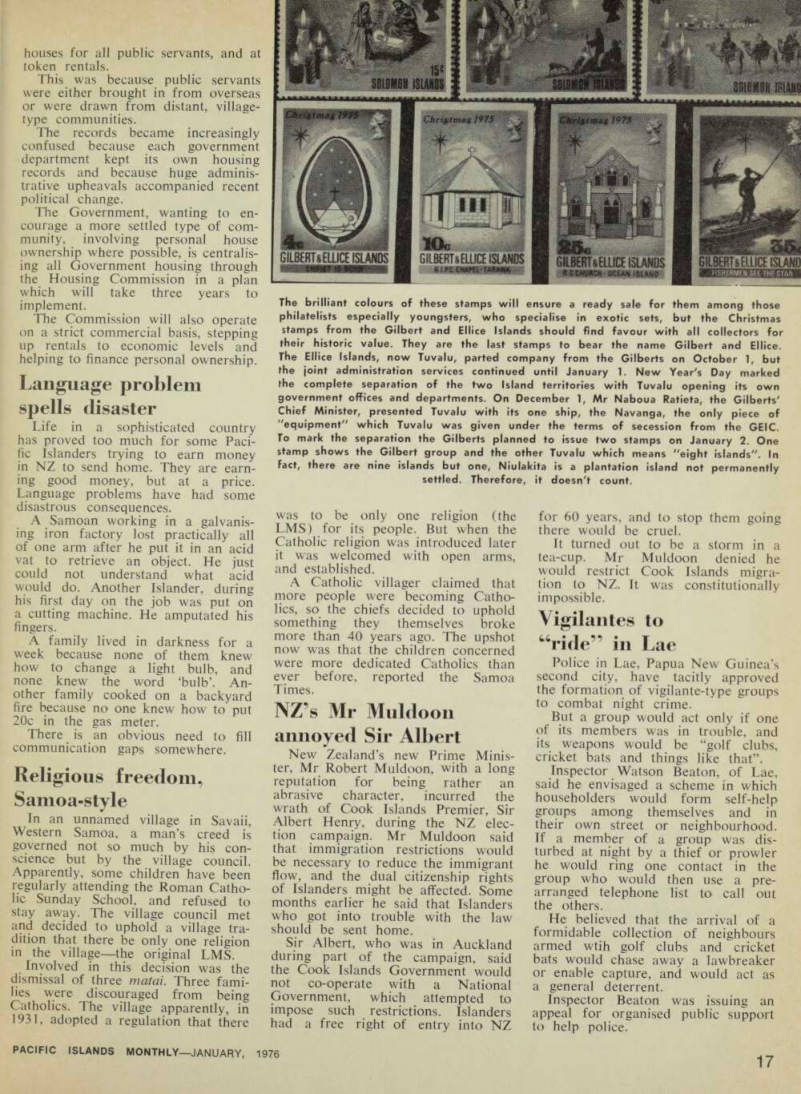
The brilliant colours of these stamps will ensure a ready sale for them among those philatelists especially youngsters, who specialise in exotic sets, but the Christmas stamps from the Gilbert and Ellice Islands should find favour with all collectors for their historic value. They are the last stamps to bear the name Gilbert and Ellice.
The Ellice Islands, now Tuvalu, parted company from the Gilberts on October 1, but the joint administration services continued until January 1. New Year's Day marked the complete separation of the two Island territories with Tuvalu opening its own government offices and departments. On December 1, Mr Naboua Ratieta, the Gilberts' Chief Minister, presented Tuvalu with its one ship, the Navanga, the only piece of "equipment" which Tuvalu was given under the terms of secession from the GEIC.
To mark the separation the Gilberts planned to issue two stamps on January 2. One stamp shows the Gilbert group and the other Tuvalu which means "eight islands". In fact, there are nine islands but one, Niulakita is a plantation island not permanently settled. Therefore, it doesn't count.