Pacific Islands Monthly
pp. 8-9 · Read in the full issue
The Story Of Solomon, His Coins
And His Return To The Top
From a Honiara Correspondent
Forced to resign on November 18 over an “unofficial” deal with a Cali fornian private mint for coins com memorating Solomon Islands self government, Chief Minister Solomon Mamaloni bounced back into the top seat 13 days later.
He was re-elected by 18 votes to four, with two abstentions in what was obviously a deal with his former opponents in the United Solomon Islands Party, which had formed the official Opposition. It cost Mama loni’s People’s Progress Party four portfolios and gave the USIP five seats in the eight-member cabinet.
Mr Mamaloni was re-elected on the first ballot. Two members, whose names haven’t been published, ab stained from voting. The Chief Minis ter had only one rival for the job, Mr Allan Taki, the newly-elected member for West Kwara’ae, who was nominated by Mr Andrew Ku kuti, member for Vella Lavella and the Shortlands.
According to the government news paper, The Solomons News Drum, when the result of the ballot was announced, “Mr Taki began shout ing mentally and he was led away by friends. He was later taken to the Central Hospital and admitted”.
Leading figure in the deal, which returned Mr Mamaloni, was Mr Jonathan Fifi’i, USIP leader who was jailed for two years in the early 1950 s for his part in the anti-govern ment “Marching Rule” movement.
Mr Fifi’i becomes Minister for Home Affairs, a most influential post in the Solomons.
A minority party of nine in the last parliament, the People’s Pro gress Party was short on good pros pective ministers. Mr Mamaloni needed the strongest team he could get to lead the country into self government. But the PPP is very much a minority in the cabinet. It has only two portfolios against five held by the USIP, which had a seat in the last cabinet held by Philip Solodia Funifaka, former USIP
leader. The eighth seat is held by an independent. The only minister to hold his old position is the reserved but highly-competent Willi Betu, the Finance Minister.
The new cabinet is: Mr Mama loni, Chief Minister; Mr Betu, Finance Minister; Mr Ashley Wick ham, Works and Public Utilities; Mr Fifi’i, Home Affairs; Mr Benedict Kinika, Education and Cultural Affairs; Dr Francis Kikolo, Health and Welfare; Mr David Thuguvoda, Natural Resources; Mr Pulepada Ghemu, Foreign Trade, Industry and Labour; Mr Jeriel Ausuta, Agricul ture and Lands.
If, indeed, self-government has already come to the Solomons, there has been no fanfare of trumpets.
The tentative date was to be between November 1 and December 1 but there has been no formal announce ment. The fact that the cabinet
members are called ministers—which didn’t happen in Fiji until self government—doesn’t signify any thing. They’ve been called ministers since August, 1974.
It’s probable that there will be some announcement when the Legis lative Assembly meets on January 5.
The new set-up spells the end of two-party government in the Solo mons. There was no love for the Westminster pattern from the first.
And the Solomons won’t be the only one to change in the Islands.
Ratu Sir Kamisese Mara, Fiji’s Prime Minister, isn’t fond of the system. He told PIM in one inter view in March, 1972, that the two party system “is politically unhealthy a developing country”. His com plaint was that, as there were no political parties in Fiji, the two party system had, of necessity, to find a racial division.
Mr Fifi’i said, after Mr Mama loni’s re-election, that the choice of cabinet reflected the end of party politics which had proved to be un workable in present circumstances.
The party system—which was really founded on personalities and not politics—had limited selection of cabinet. In Mr Mamaloni’s case, he had to find eight ministers out of nine PPP members.
He couldn’t do it and, therefore, at the outset, had to bring in Philip Solodia.
The agreement between the PPP and the USIP means the end of that system and, presumably, the end of the crisis caused by Mr Mama loni’s agreement with the Letcher Mint of California, He was said to have resigned because the Legislative Assembly refuted the mint’s claims to have had official authority to mint the coins. Mr Mamaloni re signed because, he said, a misunder standing over the authorisation of the coins had caused embarrassment.
But, was that the sole reason?
Hadn’t Mr Mamaloni jumped the gun so far as the British Government
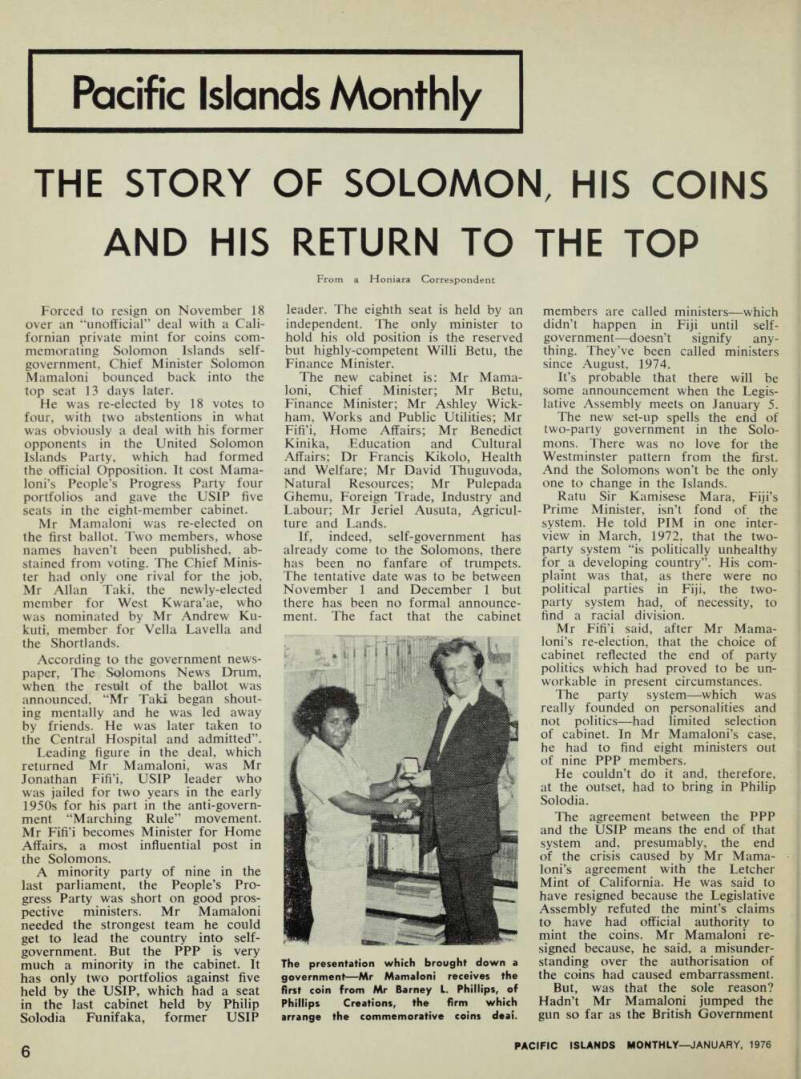
The presentation which brought down a government—Mr Mamaloni receives the first coin from Mr Barney L. Phillips, of Phillips Creations, the firm which arrange the commemorative coins deal.
and the British Treasury were con cerned? The Solomons wasn’t even self-governing when the deal with Letcher Mint was clinched on De cember 20, 1974. Probably, no one would have cavilled if the coins hadn’t been described as “legal ten der”.
The British Government, surely, would control the Solomons’ cur rency until independence and, in fact, would have to back it. It seems strange that no one else in authority —Governor Mr Donald Luddington, for instance—hadn’t heard about the deal until the coins were actually struck.
There was a ceremony even, in Honiara, and pictured here in PIM, with a representative of the Letcher Mint and its agents handing the first coin to Mr Mamaloni.
It’s on the cards that a violent gust from Whitehall blew Mr Mama loni out of his Chief Minister’s seat and it was that which was the real embarrassment and not because Mr Mamaloni’s ministers didn’t know about the deal.
Whatever the real facts are, the Letcher Mint could hardly be blamed. They were given an author isation signed by Mr Mamaloni as Chief Minister.
“On this memorial day”, says the authorisation over the signature of Mr Mamaloni, “we have authorised the Letcher Mint to strike the first gold and silver, legal tender coins in the history of our country”.
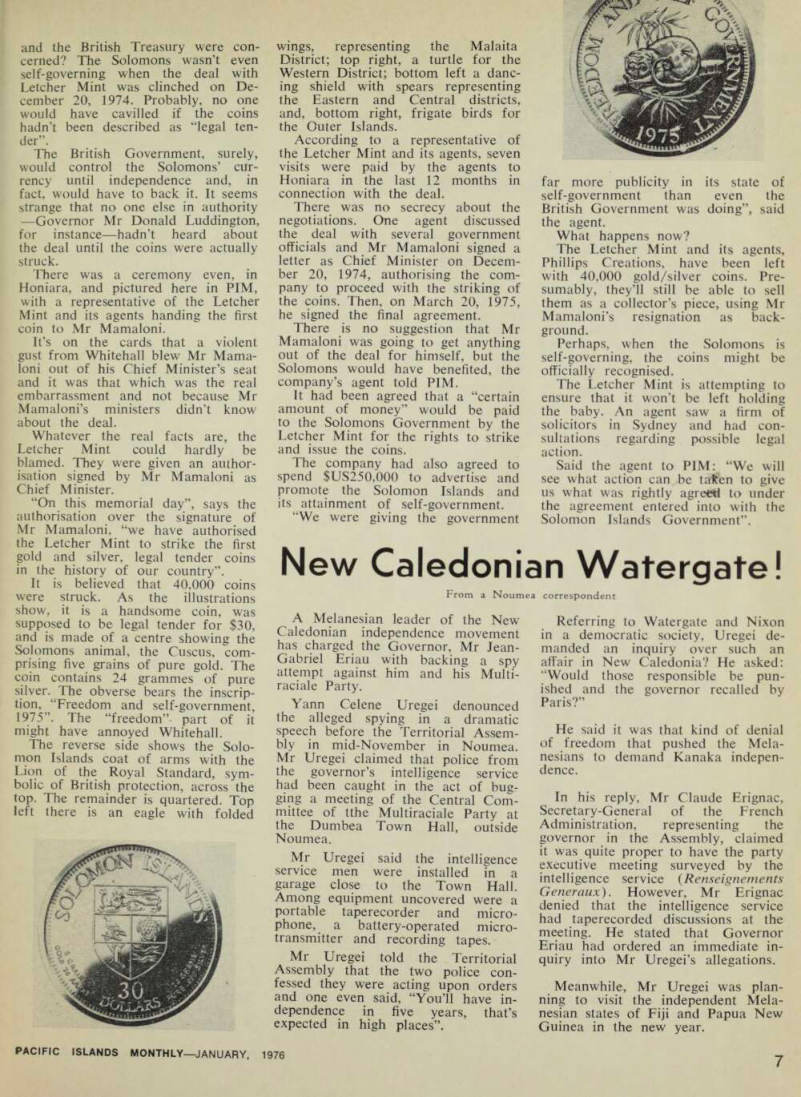
It is believed that 40,000 coins were struck. As the illustrations show, it is a handsome coin, was supposed to be legal tender for $3O, and is made of a centre showing the Solomons animal, the Cuscus, com prising five grains of pure gold. The coin contains 24 grammes of pure silver. The obverse bears the inscrip tion, “Freedom and self-government, 1975”. The “freedom” part of it might have annoyed Whitehall.
The reverse side shows the Solo mon Islands coat of arms with the Lion of the Royal Standard, sym bolic of British protection, across the top. The remainder is quartered. Top left there is an eagle with folded
wings, representing the Malaita District; top right, a turtle for the Western District; bottom left a danc ing shield with spears representing the Eastern and Central districts, and, bottom right, frigate birds for the Outer Islands.
According to a representative of the Letcher Mint and its agents, seven visits were paid by the agents to Honiara in the last 12 months in connection with the deal.
There was no secrecy about the negotiations. One agent discussed the deal with several government officials and Mr Mamaloni signed a letter as Chief Minister on Decem ber 20, 1974, authorising the com pany to proceed with the striking of the coins. Then, on March 20, 1975, he signed the final agreement.
There is no suggestion that Mr Mamaloni was going to get anything out of the deal for himself, but the Solomons would have benefited, the company’s agent told PIM.
It had been agreed that a “certain amount of money” would be paid to the Solomons Government by the Letcher Mint for the rights to strike and issue the coins.
The company had also agreed to spend 5U5250,000 to advertise and promote the Solomon Islands and its attainment of self-government.
“We were giving the government
far more publicity in its state of self-government than even the British Government was doing”, said the agent.
What happens now?
The Letcher Mint and its agents, Phillips Creations, have been left with 40,000 gold/silver coins. Pre sumably, they’ll still be able to sell them as a collector’s piece, using Mr Mamaloni’s resignation as back ground.
Perhaps, when the Solomons is self-governing, the coins might be officially recognised.
The Letcher Mint is attempting to ensure that it won't be left holding the baby. An agent saw a firm of solicitors in Sydney and had con sultations regarding possible legal action.
Said the agent to PIM: “We will see what action can be taken to give us what was rightly agreed to under the agreement entered into with the Solomon Islands Government”.