Business and Development
pp. 69-75 · Read in the full issue


Phosphate Sales Slump But Nauru's
Not Worried Over Future
By Stuart Inder
After a period of high production and high prices the Nauru phosphate industry—lifeblood of ic seven-year-old republic—is faced with a downturn. But President Deßoburt is confident that long erm prospects are good.
In its last full year, to June 30, 975, the republic-owned Nauru Phoshate Corporation sold 1,951,000 mnes to world markets, compared ith a record 2,394,000 tonnes the revious year, 1973-74.
But sales for this year, 1975-76, re down, and projections are that nly 1.5 million tonnes will be ipplied. This is only 65 per cent of ie capacity of the Nauru plant.
The drop in sales reflects the world ;onomy.
All major users have large stockiles. In Australia and New Zealand robably nine months supplies are eing held, and fertiliser plants there ave generally shut down or are suplying from stock. This has coincided ith a decline in phosphate use by irmers because of poor economic mditions, and also because of high rices for phosphate. For, despite the ockpiles, prices haven’t dropped for le consumer.
Fertiliser producers are naturally nxious to get prices down, but rock ippliers are holding firm and there as been no break in the agreed price mong the sellers. Current world price about SA6O per tonne.
President Deßoburt says the NPC es the present stockpiling and slow
sales as a temporary situation, as the world needs phosphate. The NPC sees stockpiling as being partly due to overbuying because of last year’s in creasing prices. Users bought larger quantities than they needed in the be lief that prices would continue to rise, The downturn caught Nauru’s big gest single purchaser, the British Phosphate Commissioners, in a tight spot, and Nauru allowed them to re duce their Nauruan contract arrange ments last year from 1.2 million tonnes to 1 million, and extended their credit terms. Last year Australia and NZ bought between them 1,633,700 tonnes of Nauruan phos phate. Next biggest buyer was Japan, with 195,113 tonnes, then Korea with 75,360, Taiwan 25,561 and Mexico 21,591.
Australia has been attempting to make itself less dependent on Nauru phosphate supplies by building up pro duction on Christmas Island, which it owns. The BPC controls production on this Indian Ocean dependency, and as there are no local people to pay royalties to, production on the island is comparatively cheap. It has been built up in recent years from 1.3 million tonnes annually to 2 million tonnes.
At one time of course, the BPC controlled production also on Nauru and Ocean Island. Ocean Island phos phate now is almost worked out.
President Deßoburt believes that Australia’s decision to develop Christ mas Island has been a good thing for Nauru, because the NPC has had to search for alternative markets for Nauru. To do this, Nauru, in the words of the NPC’s experienced managing director Bill Adams, has had to learn more about the quality and possibilities of its own phosphate in the five years since it purchased full control of the industry from the BPC (July 1, 1970 for $2l million), than the BPC had ever done in its long history on the island.
The BPC didn’t think it was neces sary, because in its day it sold Nauruan, Ocean Island and Christmas Island phosphate as one package. The NPC, since it has been operating in dependently, has gone to trouble and expense to prove that it has a better product than anybody, and worth users paying a premium price for, Nauruan phosphate is in fact the highest grade in the world, 84 per cent BPL guaranteed. Already new equipment at a cost of $1 million has enabled Nauruan phosphate to be more competitive by being crushed to a minimum of a half-inch, and the dust pelletised.
But the new development that causes excitement in Bill Adams’ office, is the new calcination plant, which will produce treated phosphate rock of unsurpassed grade (91 BPL).
This is aimed at a premium market of users wanting high grade material
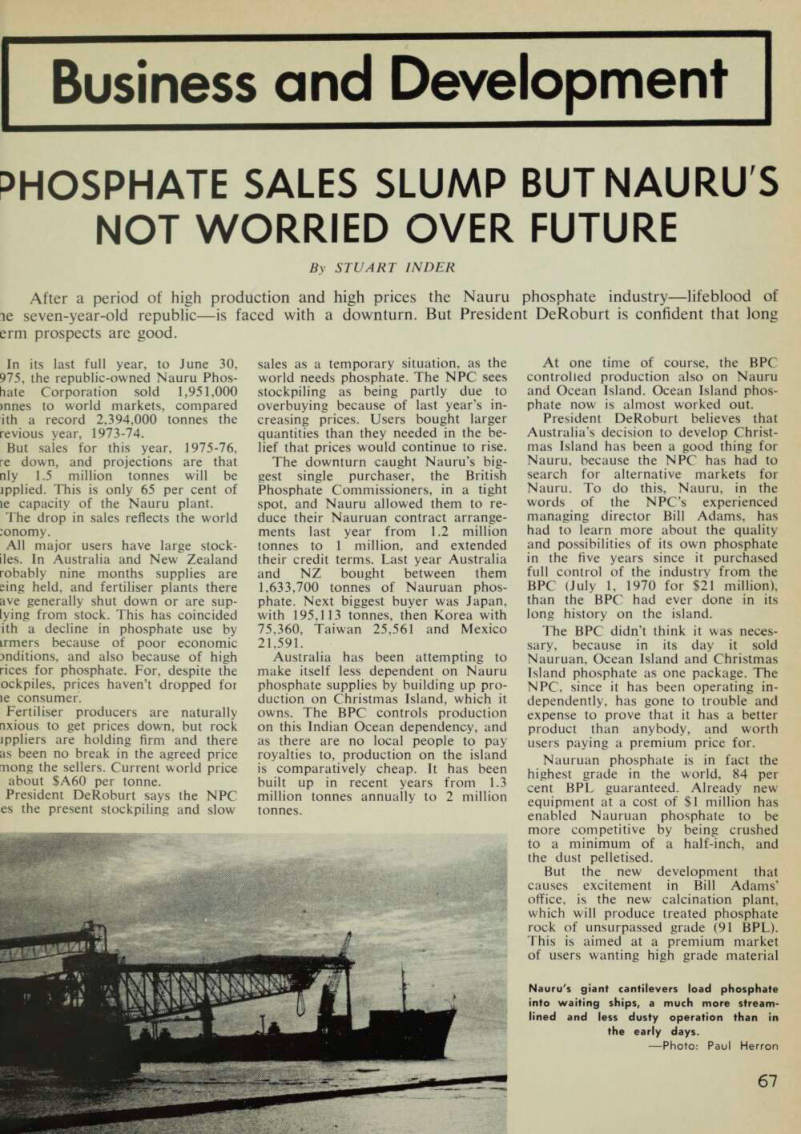
Nauru's giant cantilevers load phosphate into waiting ships, a much more stream lined and less dusty operation than in the early days. —Photo: Paul Herron
ir use in detergents and foodstuffs.
Production will be 400,000 tonnes is year, with first sales going out by e end of 1975.
The point here is that this is an itirely new market, which does not >mpete with the sales of Nauruan losphate on the general market.
Because of the high quality of auruan phosphate, prices have con lued high despite the downturn in ders, and Nauru is thus better off an most producers. It does not re :al its prices, which obviously vary ith contracts, but it has been getting arid prices and a bit more.
But production costs now are be nning to rise for the first time since e NPC took over from the BPC.
?Ilowing takeover, production costs
ir ton in fact dropped because of wer overheads and staff needed in »mparison with the BPC operation, asts have been kept steady until cently.
The NPC currently employs 106 patriates, mainly Australians, 326 tiinese, 862 Gilbert and Tuvaluans id 95 Nauruans on its combined >erations.
The Australian component can be pected to drop as a result of a cent decision by the Australian overnment to tax Australians work g in Nauru, if it can be shown they e there for a short contract period id intend to return to Australia.
In fact the decision has affected wer people than Nauru first feared, it it is likely to affect future re uitment from Australia. Already e recruiters have turned to NZ here the taxman’s views are more >eral, or in Nauru’s view, less short ghted. There is no income tax on auru.
But Nauru has time on its side. It convinced that the Australian and Z markets can only change for the :tter, and Indonesia is keen to make suitable arrangement. India, a tough mntry to do business with, is dicker s' But meanwhile, with neighbouring cean Island reserves about to finish, auru has at least 42 million tons ’ phosphate left, which would give life of about 15 years if production ere to go to the limit each year, id 17 to 18 years otherwise.
Even then, there would probably 5 another year or two’s production pockets not yet taken into the serves, and more still if it were ever ;cided to work below the present 80 contour.
The 80 ft contour keeps extraction ork to the higher central plateau of e island, or “topside” as the local rm has it, but undoubtedly there is losphate at lower levels.
Burns Philp profit
drops by $106,000
The current recession, inflationary pressures, a downturn in the tourist trade, lower copra prices and higher unemployment all had an adverse effect on the net profit of Burns Philp (SS) Co Ltd in the year ended June 30. The net profit was $1,111,634, compared with $1,217,936 in the previous year. The final dividend is lh per cent, making a 15 per cent payout for the year. Dividends were the same in 1973-74.
The chairman, Mr R. G. Kermode, said in the annual report that trad ing in Western Samoa, where import restrictions applied, remained res tricted. In American Samoa trading continued buoyant, and there was a satisfactory sales increase. In Tonga, the company benefited from high copra prices early in the year, and the substantial volume of remittances
sent by Tongan citizens working in New Zealand. That was reflected in a more favourable level of sales.
Mr Kermode said the company was adding to its facilities on Niue Island, where trading results were most en couraging.
In Fiji, profitability of merchandis ing operations continued to be a mat ter of considerable concern. Fire badly damaged part of the main Suva store in March, and much plan ning and work remained before trad ing there could return to normal.
Fiji will miss its
sugar target
Fiji is not so wealthy that it can afford to throw away S4O million which it could have earned from the 1975 sugarcane crop. Yet that is what is happening. The country had a 424,000-ton sugar production target for 1975. The shortfall will be more
than 155,000 tons of raw sugar. And the mills are closing early this year because there is no more cane to crush.
The ball seems to lie squarely in the court of the cane farmers. About 2,000 of them failed to reach their quotas. Many did fill their quotas and would have been happy to grow more cane if it was possible.
Even the record $52 a ton they will get for their cane this year has not proved sufficient incentive to higher production. The chairman of the Fiji Sugar Corporation, Mr A. D.
Leys, said at the annual meeting of the corporation, production for 1975 would probably be the lowest for 13 years.
The salvation of the industry, and with it, the economy of Fiji, lay in greater cane production. The low 1975 production must be a bitter blow to the Prime Minister, Ratu Sir Kamisese Mara, after his 1974 triumph in getting a substantial Com mon Market quota for Fiji. It will be at least another year, and probably two, before Fiji can grow enough cane to meet all commitments, pro vided the weather, farmers, millers and mill workers do the right thing.
There was still some good news though, on the sugar front. The final payment for the 1974 crop of 40.28 c a ton, brought the payout to a record $20.90 a ton for cane. That was double the previous record and should have made the growers smile. And from its smaller crop this year, Fiji will get an extra $l2 a ton for the 170,000 tons it will sell to Britain from the 1975 crop. Britain will pay about $479 a ton, or about! $BO million.
Lobster freezer
for New Caledonia
Among the various plans in recent years to build up a fishing industry in Noumea, the latest project seems the most extensive and ambitious.
This new scheme involves the trap ping of lobsters from the New Heb rides to the Loyalty Islands off the Caledonian mainland, to be frozen at a plant which could be installed at Nouville, in the harbour opposite Noumea.
The project was outlined in Nou mea in October by Mr Michel Niox, acting as adviser to the French com pany, Benichou S.A. Pacifique. If a loading vessel picked up some 72 tonnes of lobster a year from nine points in the New Hebrides and 11 bays in New Caledonia, the catch would be shipped to ponds and freez
ing plant at Nouville.
The output would then be avail able for export to France and Japan.
lydro-electric
:heme for Fiji
Completion of the first stage of a dro-electric power project in cen il Viti Levu in Fiji could see a ?e dream of politicians for many ars come true. The Fiji Govern ;nt has decided to go ahead with ; project, which could cost upwards $7O-$BO million.
The scheme has been recommended New Zealand experts, and the i Electricity Authority will imple ;nt it as soon as possible. The first irk will be in the Monasavu and ;atoka areas. The scheme will en l creating several lakes and build ; big dams. The government hopes start drawing power from the leme by 1980.
rab money for
aledonian nickel?
Arabian investors could be in ested in helping to finance the ig-talked of project to develop kel deposits in northern New ledonia.
According to a Parisian financial tvspaper L’Agence Nouvelle, the mch Government is studying the ssibility of Saudi Arabia joining
in the nickel project by taking a 25 per cent share, the other possible partners being the French Govern ment and the French mining group Pechiney Ugine-Kuhlmann.
Only a short while ago the US AMAX had been mentioned as one in the series of possible foreign part ners to get the project financed.
New air base
for Noumea
The French armed forces in New Caledonia plan to build a new air base at Tontouta, next to the inter national airport, almost an hour’s drive from the capital, Noumea.
Until now the French have oper ated a Fleet Air Arm base at Ton touta. The new Air-Marine base will belong to the Air Force under Com mandant Philippe Moulieras. Its chief function will be to operate the Puma type helicopters which are being gradually introduced to the territory. These helicopters can trans port 20 armed men and their equip ment at a speed of 280 kilometres per hour and land them rapidly at any point in the island.
Construction of the new aircraft parking area, repair hangars and accommodation for the troops is scheduled to begin in December and
be completed by the end of 1976.
When fully operational, the new air base will employ about 120 per sonnel.
A French aviation official flew from Paris in late October to study airport expansion projects in New Caledonia and New Hebrides.
At Tontouta, New Caledonia’s international airport, work is pro gressing to make the runway and parking zone capable of handling jumbos as well as building the new Air Force base.
In the New Hebrides the aviation official, Mr Montmarin, was in terested in the possibility of extend ing the runway at Bauerfield to take DCB aircraft while at Santo it is planned to equip the runway to take Fokker planes.
Relief work
in New Caledonia
A proposal to release an extra SAIO million to employ the jobless in New Caledonia has been made by Governor Eriau.
The funds could be lent from re serves of the CAFAT social services fund, if the Territorial Assembly is prepared to approve such an increase in the island’s borrowing. The SAIO
nillion could be used to create jobs ,nd at the same time build up the nfrastructure outside Noumea.
It is difficult to obtain accurate inemployment figures, due to the sland life-style, but official sources ndicate that the Labour Office in Noumea has this year registered a 0 per cent drop in the number of abs it has filled, compared with 974.
Already dole payments are being nade to the unemployed through the 'AFAT, which imposes a payroll tax f about 25 per cent on employers.
*NG plans to
jrotect kina
Papua New Guinea is to examine leasures for the protection of its iternational money reserves.
The Bank of Papua New Guinea -the country’s central bank—is pre aring policy submissions for govem lent to manage and protect the re erves as they accumulate.
PNG introduced its own currency 1 April, and it will cut loose from utomatic money parity with Aus ralia on December 31.
One immediate source of PNG [iternational reserves is Australian urrency withdrawn from PNG em ulation over the past seven months, nd still being withdrawn. The mount, which has not been dis losed, is being progressively banked n Australia to the credit of the PNG lovernment.
The need to develop policies for he protection of overseas reserves mmediately was given in the 1974-75 eport of the Bank of PNG.
The Finance Minister, Mr Julius Tian, tabled the report in the lational parliament in Port Moresby.
The bank confirmed its commit nent under government policy to de relop a “hard currency” strategy >ased on the PNG kina. It said this vould maintain the value of the kina, md would ensure an adequate level >f international reserves, but an im >ortant requirement was to develop >olicies which would protect the re erves against depletion.
The report said that immediate >rospects for economic growth with n PNG were “not bright”. There vas every reason to believe, how ;ver, that a sound base existed for uture economic growth.
The sound base was provided by leliberate structural changes to the :conomy over the past three years, md by the evidence of “considerable latural resources endowments”.
Development plan
for Pago harbour
A master plan for the use of American Samoa Government property in the harbour area from Faga’alu to Breakers Point is being developed.
The plan, when completed, will make specific recommendations for future development, land use, zoning and transportation.
The plan, financed by a 5U526,000 grant from Housing and Urban De velopment, will go to the governor and the Fono for approval.
Among the projects under con sideration: • An improved and expanded road
system through Fagatogo. The malae will not be affected by the changes. • A pedestrian circulation system and a “greenbell” between the Rain maker Hotel and Pago Park. • Expansion of the port adminis tration facility and building a security system for it. • The carrying out of the park and recreation recommendations in the American Samoa Recreation Area De velopment Plan of 1975. • Preservation of historic sites. • A central bus terminal near the Fagatogo Market. • Expansion of the Marine Re sources facilities and, • Improvements to the water, sewage, solid waste and electrical sys tems.