Torres Strait Islands, A Border
pp. 33-35 · Read in the full issue
Problem Which Cant Be Ignored
The new nation of Papua New Guinea and Australia have vowed to foster a lasting friendship but how long will it last? In a few months Australia may have a new government, a Liberal-Country Party coalition again, in which case there will be a stronger link between Canberra and the Queensland State Government. The latter takes a hard line over the future of the islands in Torres Strait, a political hot potato which is bound to feature on the parliamentary menu of both Australia and PNG in the next few months. Below, Mr lan Macphee, Federal Member for Balaclava (Victoria) looks at the problem.
The PNG Minister for Defence, Foreign Relations and Trade, Sir Maori Kiki, made a major policy statement to the House of Assembly on December 6, 1974. Sir Maori, now Deputy Prime Minister, said then that his country’s “relationship with Australia will remain a close and friendly one and that its main tenance will have one of the highest
priorities of our government”.
A severe test of this relationship will come soon over the question of demarcation of the border between Papua New Guinea and Australia.
The electorate of the Justice Minister, Mr Olewale, is adjacent to the border. At his urging, the gove ernment has adopted as policy the re drawing of the old border by agreeing on a line approximately equidistant from the mainlands of both countries.
This border policy has now been warmly embraced by all PNG leaders and they are able to present a most respectable argument in support of
this policy.
The claims of both countries in re spect of territorial waters often over lap because those claims run from each island in Torres Strait.
The continental shelf between the two countries is so shaped that the water is shallow in much of the Strait. This makes exploration for and extraction of minerals, gas and oil commercially feasible in view of numerous advances in technology.
Consequently, the dispute between
the two countries is of great impor tance.
Statements of international law and settlement reached in similar cir cumstances between other countries add support to the Papua New Guinea policy. It is understood that substantial progress has already been made in negotiations with the Aus tralian Government but that the Queensland Government is opposed to any change in the border.
The status quo will not satisfy the Papua New Guinea Government, however, and the matter could seriously damage the excellent rela tions which still exist between the two nations. This would be so es pecially if oil and mineral discoveries were made in that half of Torres Strait claimed by Papua New Guinea.
Exploration is now being conducted and such discoveries are likely.
Papua New Guinea is awaiting with interest the judgment of the High Court of Australia in the Seas and Submerged Lands Act test case.
If the Australian Government is successful in that case negotiations with Papua New Guinea might pro ceed without further delay.
The two national governments would have over 20 international pre cedents to guide them. With this guidance, it would be a serious criticism of both countries if agree ment could not be reached. If the High Court decision does not clarify the position of the Australian Gov ernment in this way (and assuming that Queensland maintains its present policy), Papua New Guinea would take even more interest than it does now in a similar dispute concerning off-shore islands claimed by both Greece and Turkey. This dispute is before the International Court of Justice.
Sir Maori Kiki told the House of Assembly that this matter is his gov ernment’s “first priority” in foreign affairs. His government expressly
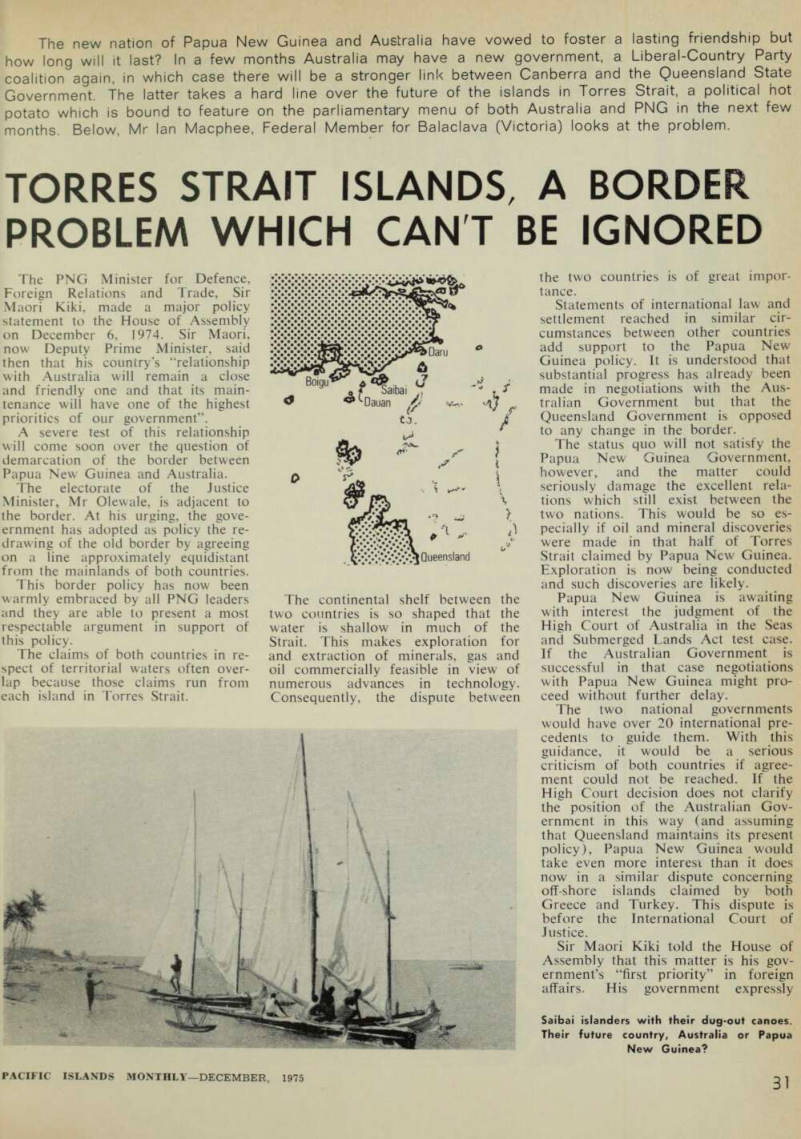
Saibai islanders with their dug-out canoes.
Their future country, Australia or Papua New Guinea?
recognises the need to protect the interests of the Torres Strait Islanders but is also determined to protect the “traditional rights of our people”.
Moreover, his government believes “that natural justice demands some degree of equality in the sharing of the natural resources of the area be tween the two countries”.
Sir Maori’s statement is echoed widely by other Papua New Guinea leaders and even on Independence morning the Papua New Guinea Post- Courier gave prominence to a strong statement on the subject by the Justice Minister, Mr Olewale.
The newspaper then ventured the : ollowing comment: “The government s believed to be concerned that the border be resolved because of the possibility of oil and other mineral liscoveries in the shallow areas of he Strait. It is feared that if settle nent is not reached, Queensland riming companies might move in and eap the benefits of such discoveries m Papua New Guinea’s doorstep.”
This is an important problem and t will not go away by being ignored. \ustralia has a moral obligation and practical necessity to resolve this problem as soon as possible.
Likewise, it must continue to assist he new nation with technical and naterial aid and in the extension of rade between the two countries.