Micronesians' Blue Print Making
pp. 8-10 · Read in the full issue
One Nation Of Many Islands'
From PAMELA G. HOLLIE on Saipan
The preamble to the constitution of the future government of Micro nesia espoused all that Micronesia hoped to gain from its 90-day, $1 million constitutional convention (Con-Con).
When the nearly 50 delegates filed past the table to sign the document on the closing day, November 8, they completed a significant step to ward the territory’s goal of self government.
Micronesia is a United Nation’s trusteeship, which has been adminis tered by the United States since 1947.
It is the last of the original 11 UN trust territories, and the only one which is expected to opt for some kind of “close association” with its trustee instead of independence.
Now in the last stages of the 28year administration by the US, Micro nesia is nearing the termination date of the trusteeship.
The constitution of the Federated States of Micronesia is the outline for the future government of Micronesia after the trusteeship is.---terminated around 1981. The constitution states that it will become effective not more than one year after the document is ratified by the Micronesian people. Because this may precede the termination of the Trus teeship Agreement, the constitutional provisions in conflict won’t come into effect until the trusteeship is termi nated.
The 23-page document contains 16 articles. The government will consist of a one-chamber legislature, each of the six districts electing one repre sentative for a four-year term and other representatives, according to state population, for two-year terms.
The executive will consist of a presi
dent and vice-president, who will be chosen from among the six or seven representatives serving four-year terms.
The government will be composed of loosely-federated states (now called districts under the trust terri tory). The three branches of the government are the executive, legis lative and the judicial. The greatest power rests with the districts. The central government will be weak, and relatively small. Power not expressly delegated to the national government is automatically a state power unless otherwise prohibited.
A prominent concern of the Con- Con was the use of Micronesia’s land, which is limited. The consti tution is silent on the right of emi nent domain. Micronesian land will remain in the hands of the people— Micronesian citizens only. A non
citizen, or a corporation less than 100 per cent owned by Micronesians, may not acquire title to land or waters in Micronesia.
The territory’s experience with the US led to sections in the constitution calling for the “renegotiation of any agreement for the use of land to which the Government of the United States of America is a party”.
The US holds long-term land agreements —some taken with its right of eminent domain—for use as military bases and testing sites.
The constitution also prohibits the testing, storage, use or disposal of radioactive, toxic chemical or harm ful substances on Micronesia’s land or waters.
These provisions are expressly aimed at America’s use of Micro nesia as a “strategic trust” under its trusteeship. In isolated instances,
)me islands have been rendered un ihabitable through US nuclear test ig or disposal of wastes.
The constitution is a relatively mple document. It calls for unity. incorporates the concepts of de locracy and a representative form P government, and still recognises le rights of traditional leaders in ic new government. It is the best )mpromise a widely-divergent nation Ice Micronesia could hope to pro ice.
Until the last four days of the 90ty convention, it was not certain hether the Con-Con would produce 5 document. Indecision over major sues in the formation of the govern ent forced the convention into ree days of closed-door sessions.
When the negotiators emerged, the on-Con had miraculously reached )mpromises that the six districts— alau, Yap, the Marshalls, Ponape, e Marianas, and Truk—could live ith. Every district signed the con itution including Kusaie, now part ; Ponape, which will become a dis ict in 1977.
From the beginning the Con-Con ced what seemed to be heavy odds ;ainst its success.
It was hoped that the Con-Con ould revitalise the political status Iks between the territory and the nited States. Talks between the two oke down in December, 1974, over nd disputes after seven years of :gotiations.
Lazarus Salii, chairman of the Dngress of Micronesia’s Joint Com ittee on Future Status, was one ho had hoped that the constitution Duld be clear on the question of atus. For the last five years, he had :aded talks with the US on “free sociation”, a status which is a tran ;ion towards full independence, but
requires that some duties, such as de fence and foreign affairs, be handled by the US in return for some other benefits in Micronesia.
The US has been under pressure from the UN to terminate its ad ministration, but the US maintained that it had not completed its res ponsibilities to the territory and that for national security reasons it must retain military bases in the area.
The constitution, it was decided, would provide instructions for the next round of talks, but it would not indicate status.
From the outset, the biggest chal lenges confronting the Con-Con were: Could it bring unity? Could a con stitution be written before the terri tory’s status was settled? Many dele gates were dubious.
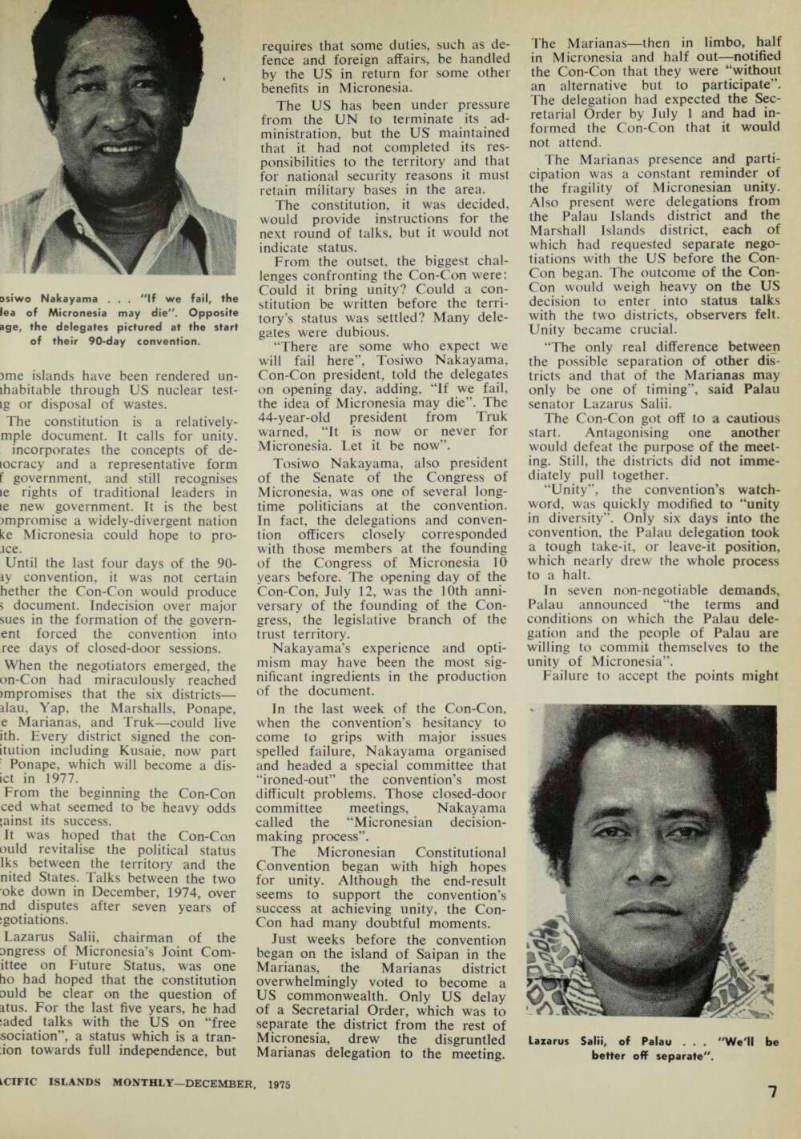
“There are some who expect we will fail here”, Tosiwo Nakayama, Con-Con president, told the delegates on opening day, adding, “If we fail, the idea of Micronesia may die”. The 44-year-old president from Truk warned, “It is now or never for Micronesia. Let it be now”.
Tosiwo Nakayama, also president of the Senate of the Congress of Micronesia, was one of several long time politicians at the convention.
In fact, the delegations and conven tion officers closely corresponded with those members at the founding of the Congress of Micronesia 10 years before. The opening day of the Con-Con, July 12, was the 10th anni versary of the founding of the Con gress, the legislative branch of the trust territory.
Nakayama’s experience and opti mism may have been the most sig nificant ingredients in the production of the document.
In the last week of the Con-Con, when the convention’s hesitancy to come to grips with major issues spelled failure, Nakayama organised and headed a special committee that “ironed-out” the convention’s most difficult problems. Those closed-door committee meetings, Nakayama called the “Micronesian decision making process”.
The Micronesian Constitutional Convention began with high hopes for unity. Although the end-result seems to support the convention’s success at achieving unity, the Con- Con had many doubtful moments.
Just weeks before the convention began on the island of Saipan in the Marianas, the Marianas district overwhelmingly voted to become a US commonwealth. Only US delay of a Secretarial Order, which was to separate the district from the rest of Micronesia, drew the disgruntled Marianas delegation to the meeting.
The Marianas—then in limbo, half in Micronesia and half out —notified the Con-Con that they were “without an alternative but to participate”.
The delegation had expected the Sec retarial Order by July 1 and had in formed the Con-Con that it would not attend.
The Marianas presence and parti cipation was a constant reminder of the fragility of Micronesian unity.
Also present were delegations from the Palau Islands district and the Marshall Islands district, each of which had requested separate nego tiations with the US before the Con- Con began. The outcome of the Con- Con would weigh heavy on the US decision to enter into status talks with the two districts, observers felt.
Unity became crucial.
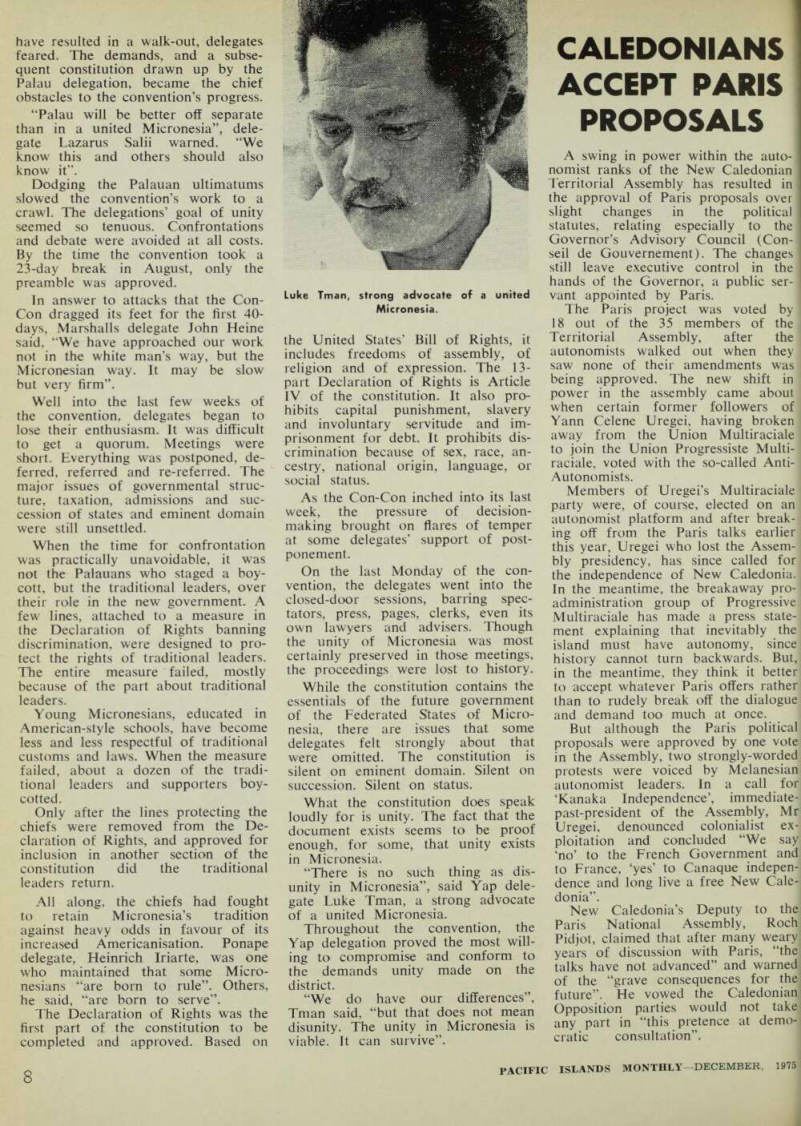
“The only real difference between the possible separation of other dis tricts and that of the Marianas may only be one of timing”, said Palau senator Lazarus Salii.
The Con-Con got off to a cautious start. Antagonising one another would defeat the purpose of the meet ing. Still, the districts did not imme diately pull together.
“Unity”, the convention’s watch word, was quickly modified to “unity in diversity”. Only six days into the convention, the Palau delegation took a tough take-it, or leave-it position, which nearly drew the whole process to a halt.
In seven non-negotiable demands, Palau announced “the terms and conditions on which the Palau dele gation and the people of Palau are willing to commit themselves to the unity of Micronesia”.
Failure to accept the points might
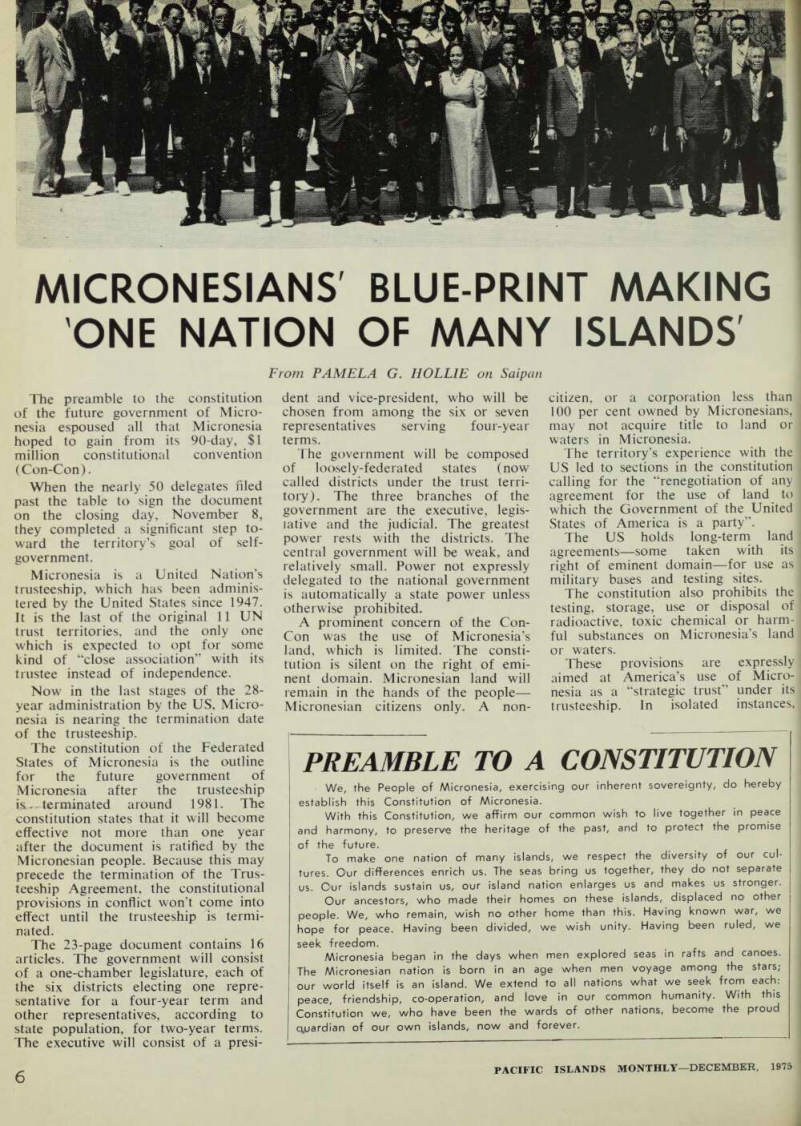
posiwo Nakayama . . . "If we fail, the dea of Micronesia may die". Opposite page, the delegates pictured at the start of their 90-day convention.
Lazarus Salii, of Palau . . . "We'll be better off separate".
have resulted in a walk-out, delegates feared. The demands, and a subse quent constitution drawn up by the Palau delegation, became the chief obstacles to the convention’s progress.
“Palau will be better off separate than in a united Micronesia”, dele gate Lazarus Salii warned. “We know r this and others should also know it”.
Dodging the Palauan ultimatums slowed the convention’s work to a crawd. The delegations’ goal of unity seemed so tenuous. Confrontations and debate were avoided at all costs.
By the time the convention took a 23-day break in August, only the preamble was approved.
In answer to attacks that the Con- Con dragged its feet for the first 40days, Marshalls delegate John Heine said, “We have approached our work not in the white man’s way, but the Micronesian way. It may be slow but very firm”.
Well into the last few weeks of the convention, delegates began to lose their enthusiasm. It was difficult to get a quorum. Meetings were short. Everything was postponed, de ferred, referred and re-referred. The major issues of governmental struc ture, taxation, admissions and suc cession of states and eminent domain were still unsettled.
When the time for confrontation was practically unavoidable, it was not the Palauans who staged a boy cott, but the traditional leaders, over their role in the new government. A few lines, attached to a measure in the Declaration of Rights banning discrimination, were designed to pro tect the rights of traditional leaders.
The entire measure failed, mostly because of the part about traditional leaders.
Young Micronesians, educated in American-style schools, have become less and less respectful of traditional customs and laws. When the measure failed, about a dozen of the tradi tional leaders and supporters boy cotted.
Only after the lines protecting the chiefs were removed from the De claration of Rights, and approved for inclusion in another section of the constitution did the traditional leaders return.
All along, the chiefs had fought to retain Micronesia’s tradition against heavy odds in favour of its increased Americanisation. Ponape delegate, Heinrich Iriarte, was one who maintained that some Micro nesians “are born to rule”. Others, he said, “are born to serve”.
The Declaration of Rights was the first part of the constitution to be completed and approved. Based on
the United States’ Bill of Rights, it includes freedoms of assembly, of religion and of expression. The 13part Declaration of Rights is Article IV of the constitution. It also pro hibits capital punishment, slavery and involuntary servitude and im prisonment for debt. It prohibits dis crimination because of sex, race, an cestry, national origin, language, or social status.
As the Con-Con inched into its last week, the pressure of decision making brought on flares of temper at some delegates’ support of post ponement.
On the last Monday of the con vention, the delegates went into the closed-door sessions, barring spec tators, press, pages, clerks, even its own lawyers and advisers. Though the unity of Micronesia was most certainly preserved in those meetings, the proceedings were lost to history.
While the constitution contains the essentials of the future government of the Federated States of Micro nesia, there are issues that some delegates felt strongly about that were omitted. The constitution is silent on eminent domain. Silent on succession. Silent on status.
What the constitution does speak loudly for is unity. The fact that the document exists seems to be proof enough, for some, that unity exists in Micronesia.
“There is no such thing as dis unity in Micronesia”, said Yap dele gate Luke Tman, a strong advocate of a united Micronesia.
Throughout the convention, the Yap delegation proved the most will ing to compromise and conform to the demands unity made on the district.
“We do have our differences”, Tman said, “but that does not mean disunity. The unity in Micronesia is viable. It can survive”.
Luke Tman, strong advocate of a united Micronesia.