feel the economic pinch
pp. 78-81 · Read in the full issue
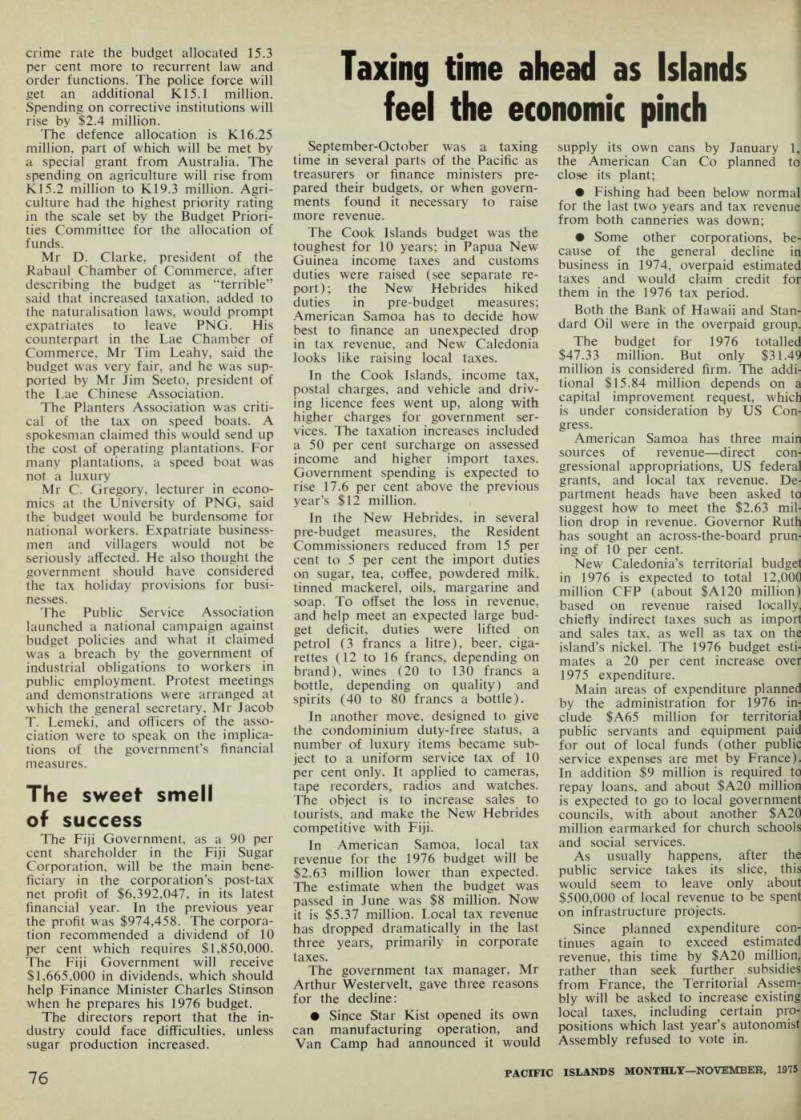
Taxing time ahead as Islands feel the economic pinch
September-October was a taxing time in several parts of the Pacific as treasurers or finance ministers pre pared their budgets, or when govern ments found it necessary to raise more revenue.
The Cook Islands budget was the toughest for 10 years; in Papua New Guinea income taxes and customs duties were raised (see separate re port); the New Hebrides hiked duties in pre-budget measures; American Samoa has to decide how best to finance an unexpected drop in tax revenue, and New Caledonia looks like raising local taxes.
In the Cook Islands, income tax, postal charges, and vehicle and driv ing licence fees went up, along with higher charges for government ser vices. The taxation increases included a 50 per cent surcharge on assessed income and higher import taxes.
Government spending is expected to rise 17.6 per cent above the previous year’s $l2 million.
In the New Hebrides, in several pre-budget measures, the Resident Commissioners reduced from 15 per cent to 5 per cent the import duties on sugar, tea, coffee, powdered milk, tinned mackerel, oils, margarine and soap. To offset the loss in revenue, and help meet an expected large bud get deficit, duties were lifted on petrol (3 francs a litre), beer, ciga rettes (12 to 16 francs, depending on brand), wines (20 to 130 francs a bottle, depending on quality) and spirits (40 to 80 francs a bottle).
In another move, designed to give the condominium duty-free status, a number of luxury items became sub ject to a uniform service tax of 10 per cent only. It applied to cameras, tape recorders, radios and watches.
The object is to increase sales to tourists, and make the New Hebrides competitive with Fiji.
In American Samoa, local tax revenue for the 1976 budget will be $2.63 million lower than expected.
The estimate when the budget was passed in June was $8 million. Now it is $5.37 million. Local tax revenue has dropped dramatically in the last three years, primarily in corporate taxes.
The government tax manager, Mr Arthur Westervelt, gave three reasons for the decline: • Since Star Kist opened its own can manufacturing operation, and Van Camp had announced it would
supply its own cans by January 1, the American Can Co planned to close its plant; • Fishing had been below normal for the last two years and tax revenue from both canneries was down; • Some other corporations, be cause of the general decline in business in 1974, overpaid estimated taxes and would claim credit for them in the 1976 tax period.
Both the Bank of Hawaii and Stan dard Oil were in the overpaid group.
The budget for 1976 totalled $47.33 million. But only $31.49 million is considered firm. The addi tional 5i5.84 million depends on a capital improvement request, which is under consideration by US Con gress.
American Samoa has three main sources of revenue—direct con gressional appropriations, US federal grants, and local tax revenue. De partment heads have been asked to suggest how to meet the $2.63 mil lion drop in revenue. Governor Ruth has sought an across-the-board prun ing of 10 per cent.
New Caledonia’s territorial budget in 1976 is expected to total 12,000 million CFP (about SAI2O million) based on revenue raised locally, chiefly indirect taxes such as import and sales tax, as well as tax on the island’s nickel. The 1976 budget esti mates a 20 per cent increase over 1975 expenditure.
Main areas of expenditure planned by the administration for 1976 in clude SA6S million for territorial public servants and equipment paid for out of local funds (other public service expenses are met by France).
In addition $9 million is required to repay loans, and about SA2O million is expected to go to local government councils, with about another SA2O million earmarked for church schools and social services.
As usually happens, after the public service takes its slice, this would seem to leave only about $500,000 of local revenue to be spent on infrastructure projects.
Since planned expenditure con tinues again to exceed estimated revenue, this time by SA2O million, rather than seek further subsidies from France, the Territorial Assem bly will be asked to increase existing local taxes, including certain pro positions which last year’s autonomist Assembly refused to vote in.
»lew search
or Fiji wealth
A French company, Societe ationale de Petroles D’Aquitaine, as mapped out areas of Viti Levu ad Vanua Levu in Fiji to search for lid, copper, lead, zinc and silver, he areas, which the company has iplied to prospect were surrendered / the Barringer group after pre ninary investigation. The first year •ogramme covers reconnaissance ex oration, including geological impling, mapping and a study of mlogical work done by the Fiji overnment and other mining com mies.
>anks merge
i New Caledonia
The oldest of New Caledonia’s 'e banks, the Banque de I’lndochine, ned on October 1 with the Banque Suez et de I’Union des Mines to come the Banque de I’lndochine et Suez, or more simply, the Bank Indo-Suez. Head office of the bank Noumea is on the corner of the ae de I’Alma and the Avenue Foch.
While the Banque de Suez was incipally involved in France and
Europe, the Bank of Indo-China has been particularly active in Asia and overseas from France. The newly formed Bank of Indo-Suez is a wholly-owned subsidiary of the French company, Compagnie Finan cier de Suez. In New Caledonia, the bank has 20 branches and agencies throughout the territory as well as a branch in the New Hebrides.
One reported aim of the new banking group is to engage in inter national investment projects and assist the expansion of French over seas trade.
Boom year for
Air New Zealand
Air New Zealand overcame a generally adverse economic climate in many of its trading areas to turn in a net profit of $4,365,146 in the year ended March 31, compared with $4,061,124 in the previous year. The directors recommend a dividend of five per cent, which will go to the owner of all the shares—the NZ Gov ernment.
The airline carried more pasengers than ever bef0re—825,569, compared with 649,214 the previous year. The amount of cargo carried increased spectacularly from 57.9 million tonnes in 1973-74 to 89.6 million tonnes.
Air New Zealand operates a fleet of five DC 10s and six DCBs. Another DC 10 was scheduled to arrive in October, 1975, and yet another, which will give it seven DClOs, is due in September, 1976. Air NZ also owns a Britten Norman Islander which is on charter to Cook Island Airways.
It holds 380,000 shares in Air Pacific and 20,000 in Polynesian Airlines.
It also has investments in hotels.
Fairy godmother
to the Islands
New Zealand is being something of a fairy godmother to the Pacific Islands in 1975-76 with aid of $17,285,000 for capital and expert assistance projects. The 1975-76 bi lateral aid programme is likely to involve more than 300 individual de velopment projects, the Prime Minis ter, Mr W. E. Rowling, said in Par liament recently in answer to a ques tion.
Many projects had started; other had to be confirmed or clarified after discussion with the recipient govern ment. Cook Islands is doing the best with $3,450,000, followed by Fiji with $3 million, Western Samoa $2 million; Niue Island, $1,950,000; Papua New Guinea, $1.7 million; Tonga $1.5 million; Tokelau Island,
150,000; Solomons, $170,000; Gil ;rt and Ellice, and New Hebrides, ich $130,000; other, $105,000; and gional projects, $2.7 million. The ant to the Gilbert and Ellice was ade before Tuvalu came into Jstence.
iji island
ells for sl.6m
Naisosovu Island, in Nadi Bay, ji, covering 114 acres was sold in :tober for $1.6 million to an merican syndicate, which was rmed in Fiji. The island was owned r Mr I. Schofield, an American, ho sold it to Cambridge Credit r iji) Ltd, a subsidiary of Cambridge edit in Australia. Mr Schofield re tssessed Naisosovu when Cambridge edit went into receivership.
Head of the syndicate which bought aisosovu is Mr David Summers rmer manager of Soqulu Plantation, iveuni. The syndicate will manage velopment of the island, and Fiji X-change Club will run it a quality tennis resort.