Pacific Transport
pp. 67-69 · Read in the full issue

Air Nauru Will Be Around When
Islands Plan Regional Airline
From STUART JNDER on Nauru
South Pacific aviation ministers will be meeting on Nauru at the end of October to discuss their common troubles—and to take perhaps a stage further the greatest of their unsolved problems. That is, does the South Pacific need a regional airline, or will it have airlines of the region?
Will the South Pacific continue to support and further expand the Suva based Air Pacific as the strong regional airline, or will it be pre pared to co-habit with smaller Island-owned flag carriers?
Whatever the final wash-up, it seems quite certain that the company which brought the regional airline issue to a head, Air Nauru, has no intention either of quitting the arena or of being absorbed into Air Pacific.
It might be prepared to do some absorbing of its own.
Air Nauru is a fact of life, to be lived with, and delegates to the forthcoming conference will have every opportunity of noting the physical presence of the airline as they sit around the conference table at Nauru’s ultra-modern civic centre only a Jumbo-jet length from Nauru’s fully bitumenised 5,600 ft strip.
From that strip every day, one or other of Air Nauru’s three jets, two F2Bs and a Boeing 737, head in various directions. The roar of jets overhead is now a familiar sound in the mid-Pacific island, where only a few years ago a poor grass strip was used only for occasional emer gencies, and regular contact was by ship to Melbourne.
Independence, of course, made the jet age possible, for Nauru is pre pared to spend on itself the kind of money that no big international com mercial airline combine could spend in operating through Nauru, even if it wanted such a link.
Air Nauru this year is understood to be budgeting for an expenditure Df about $8.5 million, for an esti mated revenue of about $2.5 million.
Last year it spent $l2 million for about $1 million less, but that in :luded the purchase of the 737.
Utilisation of the F2Bs is about 4.000 hours a year each on regular services; the 737 hasn’t had a year yet but it’s planned to use about 3.000 hours. One of the F2Bs is on a lease-purchase, one on a lease which has just been renewed, and the 737 is an outright purchase.
Air Nauru employs 23 pilots to operate the jets, mostly Australian, and 22 hostesses, mostly Islanders, although currently the hostess staff is below strength at 13 while more are being recruited. The undoubted first-class service that Air Nauru is noted for doesn’t seem to have suf fered meanwhile.
Air Nauru is operating to an extra ordinary variety of destinations, made possible by its central position in the Pacific, only 26 miles below the equator.
It flies: • Twice weekly between Mel bourne-Noumea-Honiara-Nauru. e Twice weekly Nauru-Tarawa- Majuro-Nauru. © Twice weekly Nauru-Ponape- Guam-Okinawa-Kagoshima (Japan). 9 Weekly Nauru-Wallis-Apia. 9 Weekly Nauru-Guam-Taipei- Hong Kong.
The company is planning to add a second service to Hong Kong, making
its schedule twice weekly, but the second service would go Nauru- Manus (PNG)-Koror (USTT)-Manila- Hong Kong.
The Manus link is interesting. It is merely a technical stop, but it does give Air Nauru a foot in the newly-independent state of Papua New Guinea. Following PNG self government two years ago. President Deßoburt had talks with PNG officials about possible new routes linking PNG and Nauru, and it was agreed that further consideration would be put over until after inde pendence.
Air Nauru still has traffic right difficulties, as it does not have rights at all its stops, and there are restric tions on others.
The republic has rights in Mel bourne, Tarawa, Majuro, Okinawa, Kagoshima, Apia and Hong Kong.
It has rights in Honiara and Noumea only on southbound flights from Nauru. It has currently applied to the US and Japan for rights Nauru-Ponape, Nauru-Guam and Guam-Kagoshima.
Its varied links are naturally creating interest among South Pacific governments, which wonder which way Air Nauru is headed, and one
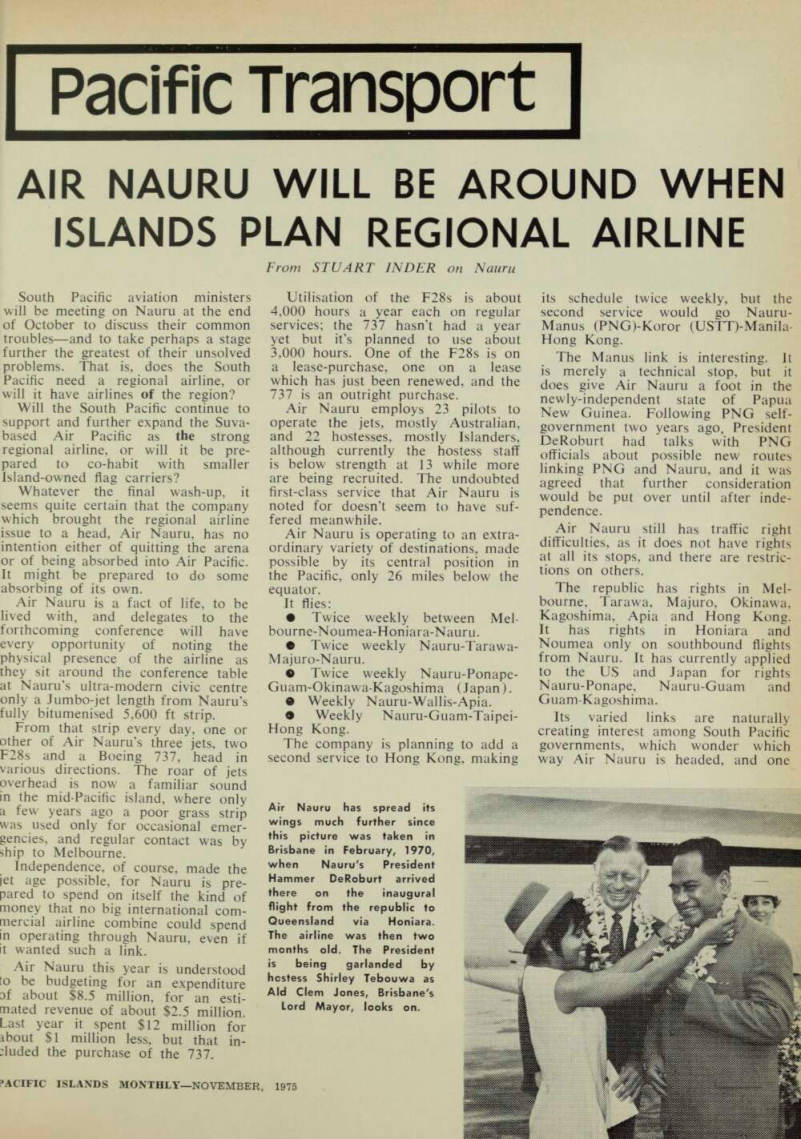
Air Nauru has spread its wings much further since this picture was taken in Brisbane in February, 1970, when Nauru's President Hammer DeRoburt arrived there on the inaugural flight from the republic to Queensland via Honiara.
The airline was then two months old. The President is being garlanded by hostess Shirley Tebouwa as Aid Clem Jones, Brisbane's Lord Mayor, looks on.
najor decision that is expected to ome out of the ministerial con erence at the end of October is the stablishment of some sort of consul ative body that can at least make ecommendations on the further de elopment of civil aviation in the slands.
At present all negotiations are overnment-to-government, with no eneral organisation responsible for joking at the overall affects that light flow from the granting of rights ) various airlines in the region.
If such an organisation can be dablished, then civil aviation in the outh Seas will have reached an im ortant new—and necessary—stage in s development.
President Deßoburt is not unhappy jout progress of the republic’s air ne, which he sees as a necessary ijunct to a small island with big /erseas investments which must be rviced and protected. Nauru has to ; involved in the world and it can’t > that by ship, or by a fortnightly ght of somebody else’s airline. And e fact is that Nauru can afford its rline and to support it while it :pands.
Its forthcoming rights to Guam ill make a big difference to expan -3n plans.
But more important, an announce ent is momentarily expected of affic rights being granted Air Nauru r Nadi and Suva, which will make possible for a direct north-south ik from Guam through Nauru to ji. This should quickly develop into lucrative route.
President Deßoburt grins when he ports what some of his pilots are irrently saying: “Sir, if we don’t atch out we are going to find our- Ives making money!”
Crew morale is extremely high, id there is a belief that the early tablishment days are now over and e sky is now the limit. Both freight id passenger loadings are improving ' the month, and the airline is get ig better known. Its aircraft are odern, and cabin services are good.
President Deßoburt’s view is that ere is room for a number of gional airlines in the Pacific, and at Air Nauru is destined to be a ajor one. He certainly has proved has the drive and the resources make it happen. • Five out of 40 cruise ships tiich will visit the New Hebrides in •76, will call at Santo. The Russian ip, Leonid Sobinov, will call twice, id the Fairstar will make three 11s. Bookings have been made as r ahead as January, 1977, for the ursky and the Fairstar to visit the ew Hebrides.
Air Pacific Plans
Services Improvement
Air Pacific will step up its services from Fiji to New Zealand and Aus tralia when its BACIII jet, on lease to Air Malawi, is returned about mid- December. The jet was originally leased because there was not enough work for it in the South Pacific region, and because Air Pacific wanted to cut costs. Air Pacific flies BACIII services to New Zealand, via Tonga, and to Brisbane, via New Caledonia.
In another move to improve ser vices, the airline plans to introduce Britten-Norman Trislanders to the Nausori-Nadi run. This will release HS74Bs for more regional work. The airline now has four Trislanders, and is using them to provide a better coverage within Fiji.
These moves followed a recent board meeting in Suva, at which it was reported there was a severe
downturn in revenue, compared with original budget results. It was re- P.? rt , ed hat. Passenger r evenue was l ,k . e ‘ y *° more . tha " *700,000 fe low estimate ? on domestic services, a ' s ° s'Smficant cost in creases to be faced ' „.
Conpac Expands
Its Png Service
.. D A , Conpac, the Burns Philp-Australia est P aclfi ‘ Ime, has rationalised lts servi ces from Australia to Papua ld P ea amos ai ? d Nj mos - The Nimos in future will a Sydney-Lae-Port Moresbys X dn ey service every 23 days. Pre- Vl °usly the Nimos called at Brisbane on northbound voyages from Sydney, The Samos, which previously sailed direct for Papua New Guinea from Melbourne, will now call at Brisbane on northbound voyages, Her route for the 28-day round trip