Yesterday
p. 61 · Read in the full issue
he story of one of the unsolved narine mysteries of the century began 0 unfold when the small island trader, oyita, 70 tons, was found floating nd derelict, about 70 miles north of abasa, Fiji, on November 10, 1955. here was no sign of the crew, and here has never been, in spite of a oprt of inquiry and official and nofficial investigations. The Joyita left >pia for the Tokelaus, two days away, arrying a complement of 25, and was ot found for five weeks. After being sund she was towed to Malau and ten Suva where she was sold at uction to Mr David Simpson, a Vanua evu planter. She seemed to be dogged y a hoodoo after being reconditioned, he went aground on Horseshoe Reef 1 the Koro Sea early in 1957. The oyita, beached and rotting at Levuka, iter passed into the hands of author iscount Maugham.
stead of trying to settle several ousand Eurasians from Indo-China in ew Caledonia—if there was any serious tention of doing so—the French overnment should look rather towards e New Hebrides, where at least )0,000 hectares of land were owned f the French Government, some New iledonia people claimed, according a PIM report. The suggestion that aw Caledonia might be regarded a potential home for the displaced irasians followed the reported >ssibility that 20,000 troops might mceivabiy be transferred from do-China to New Caledonia. Consensus opinion in New Caledonia was that ch a move would be more than ifortunate for the island, as most of e Eurasians were believed to be ithout capital, or agricultural or dustrial training. (ere was consternation in Papeete hen Chief of Police Waksmouth issued warning that there was a danger of i explosion from a dump of petrol urns on the waterfront. The dump of 1,000 empty petrol drums had been lilt up for some weeks preceding e arrival of the Thorshall, which was load them. Drums with a trace of strol were said to be more dangerous an full drums, especially when jcked in the blazing sunshine. A police lard was posted day and night und the dump to keep smokers away I the ship arrived to take them vay. Then Papeete relaxed.
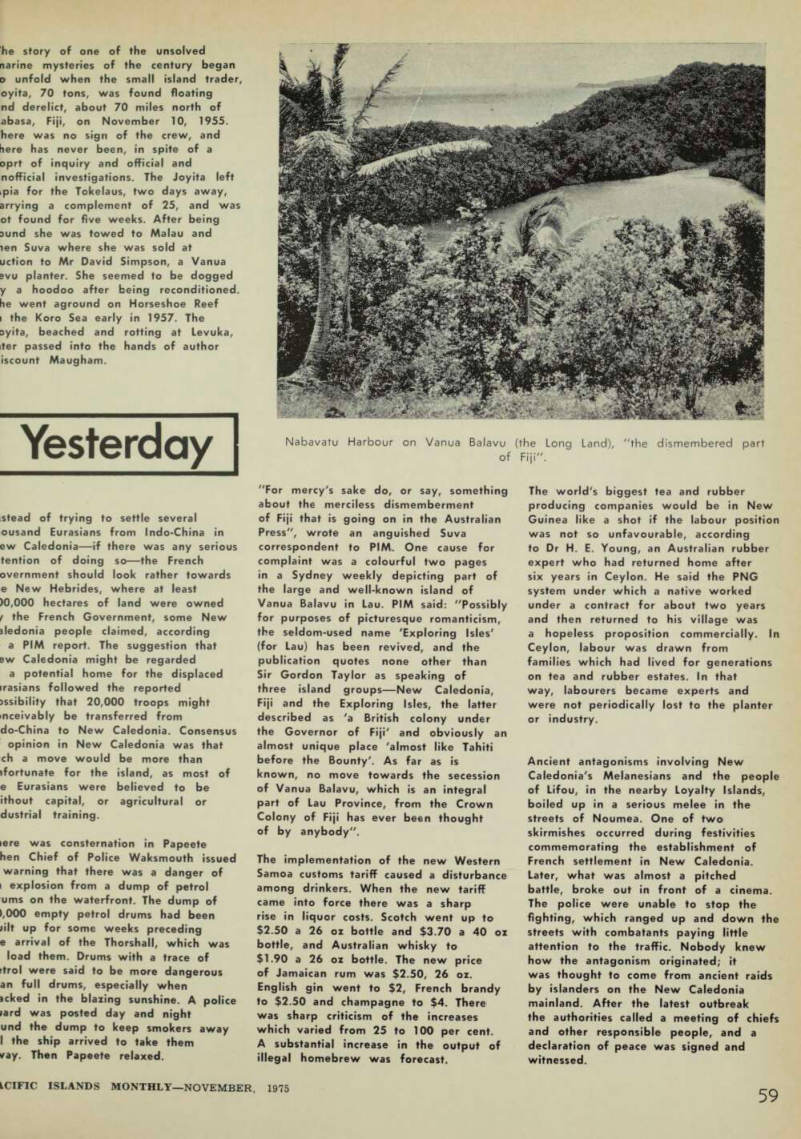
"For mercy's sake do, or say, something about the merciless dismemberment of Fiji that is going on in the Australian Press", wrote an anguished Suva correspondent to PIM. One cause for complaint was a colourful two pages in a Sydney weekly depicting part of the large and well-known island of Vanua Balavu in Lau. PIM said: "Possibly for purposes of picturesque romanticism, the seldom-used name 'Exploring Isles' (for Lau) has been revived, and the publication quotes none other than Sir Gordon Taylor as speaking of three island groups—New Caledonia, Fiji and the Exploring Isles, the latter described as 'a British colony under the Governor of Fiji' and obviously an almost unique place 'almost like Tahiti before the Bounty'. As far as is known, no move towards the secession of Vanua Balavu, which is an integral part of Lau Province, from the Crown Colony of Fiji has ever been thought of by anybody".
The implementation of the new Western Samoa customs tariff caused a disturbance among drinkers. When the new tariff came into force there was a sharp rise in liquor costs. Scotch went up to $2.50 a 26 oz bottle and $3.70 a 40 oz bottle, and Australian whisky to $1.90 a 26 oz bottle. The new price of Jamaican rum was $2.50, 26 oz.
English gin went to $2, French brandy to $2.50 and champagne to $4. There was sharp criticism of the increases which varied from 25 to 100 per cent.
A substantial increase in the output of illegal homebrew was forecast.
The world's biggest tea and rubber producing companies would be in New Guinea like a shot if the labour position was not so unfavourable, according to Dr H. E. Young, an Australian rubber expert who had returned home after six years in Ceylon. He said the PNG system under which a native worked under a contract for about two years and then returned to his village was a hopeless proposition commercially. In Ceylon, labour was drawn from families which had lived for generations on tea and rubber estates. In that way, labourers became experts and were not periodically lost to the planter or industry.
Ancient antagonisms involving New Caledonia's Melanesians and the people of Lifou, in the nearby Loyalty Islands, boiled up in a serious melee in the streets of Noumea. One of two skirmishes occurred during festivities commemorating the establishment of French settlement in New Caledonia.
Later, what was almost a pitched battle, broke out in front of a cinema.
The police were unable to stop the fighting, which ranged up and down the streets with combatants paying little attention to the traffic. Nobody knew how the antagonism originated; it was thought to come from ancient raids by islanders on the New Caledonia mainland. After the latest outbreak the authorities called a meeting of chiefs and other responsible people, and a declaration of peace was signed and witnessed.
Nabavatu Harbour on Vanua Balavu (the Long Land), "the dismembered part of Fiji".