Magazine Section
pp. 53-55 · Read in the full issue
IN THE DAYS WHEN OCEAN WAS OLD
Ocean And Nauru Was A Pup
Seventy-five years ago, Mr (later Sir) Albert Ellis discovered that Nauru was a vast heap of ihosphate and his discovery urged him on to look for more. He found it on Ocean Island. Today, Ocean Island and its people, the Banabans, are the centre of a multi-million dollar action in the British High Court and a subject for discussion by the United Nations. Late in 1900, the first shipment of ihosphate left Ocean Island. Three years later, a small girl, Albert Ellis's daughter, arrived on Ocean ' sland. Now, so many years later, as Mrs Joan Milne, of Khandallah, Wellington (NZ), she writes his story for PIM.
By Joan Milne
[Z’O-NA-MAURI and Te Akabo— over the years a fair amount has een written about Ocean Island lostly in newspaper articles, agricul iral journals, magazines, as well as i the odd book. Its very early history » sketchy and it was not held in any nportance. It appears in Admiralty harts under the name of Paanopa eing named after a British vessel diich “discovered” it in 1804. The ame over the years evidently became anaba and the inhabitants Banabans. ; had, supposedly, no commercial alue; it was subject to droughts; it as isolated but carried a moderate opulation for its size and at times a :w of the beachcomber types of lose days.
The story of the finding of the ast phosphate deposits has been told ad it does not need repeating, but I ould like to stress that Albert Ellis, ly father, was a prospector and he rospected on many islands for phos laate as an employee of the Pacific lands Company.
Because of experience and a trained ft he recognised a certain piece of >ck for what it was. At no time aring his long career in the phos aate industry did he work on his vn behalf. The work of shipping it phosphate started from scratch, ;gan remarkably quickly; equipment >ed being brought from other work gs. Indeed, the other workings were an all-time low so Ocean Island as a life-saver. Late in 1900 Ocean land’s people saw the first shipments aving.
Three years later, a small five eek-old baby girl arrived by ship
with her mother. I suppose one re members incidents back to the age of three and as I was 5i when I left, a few indelible memories remain and they are memories, not hearsay.
Also because of those fleeting early years, there was forged this strong and lasting love for a small sea-girt isle and its inhabitants. Nostalgic thoughts? Yes. Emotional? Yes—and somehow a strong, continuing yen.
It is because of these I have an under standing and certain sympathy for some of the desires of the Banabans at the present time quite apart from the money aspect.
Ocean was old Ocean When Nauru was a pup.
Ocean will be old Ocean When Nauru’s swallowed up. ran the old ditty only it doesn’t seem to be working out that way.
One would naturally begin with one’s mother and father. My father was always a quiet, unassuming man.
Recently, I have read two criticisms of him which have shown that the writers did not know him at all. He was described as a ‘merchant adven turer’ and the other suggested that he was a selfish man.
The first is absurd. His whole pattern of life refuted that: his books are completely straight-forward, un complicated and speak for them selves. As for being selfish, he was a good New Zealander who was con vinced the farmers of his country needed phosphate in fertiliser form for their farms and that they needed it at low cost. In that aspect, maybe, he had a one-track mind.
Over the intervening years, perhaps phosphate has been used extrava gantly but that was not his depart ment.
He had a number of sayings.
Some that come to mind are: “That will spill the milk in the coconut: it’s good to bear the yoke in one’s youth: you can’t make omelettes without breaking eggs: give way in little things but not in big”.
When travelling one either ‘roughed it’ or ‘suffered in comfort’.
In the days when Albert Ellis and his brother George were prospecting through the Islands for guano and phosphate deposits they really did rough it. Sailing ships, schooners, brigantines, storms, becalmed, camp ing, coping with rats, cockroaches, lice of all varieties—it was all very much in the pioneering class.
My dad had many stories he could tell and every now and then they fitted irrto daily life. He took a dim view of complaints regarding food and would call to mind trips when all biscuits had to be tapped to release livestock and there were horrid stories about evil-smelling butter and doubt ful salted meat.
Two stories used to thrill me and were in constant demand. One, how his rug ‘woolly’ saved the life of a native chief and the other the sighting of a small open craft in mid-ocean with some French escapees who by that time were in sore plight. They were taken on board, murderous weapons and all. But all his tales of adventure have been factually written with no straining after effect. Early upbringing and his wandering pros
pecting years left a profound faith which he kept through life.
“They that go down to the sea in ships That do business in great waters These see the works of the Lord And His wonders in the deep.” —Psalm 107.
The manager’s house at Ocean Island had a verandah running right round it and all the rooms opened out on to it. Directly opposite the office was the telescope on its stand.
That was the first of all memories of my dad—looking out to sea through the telescope; that, and end less pacing up and down. Many anxious days and nights were spent when there was a possibility of wind change—whether a ship could be brought in or another have to slip the buoy and put out to sea.
The phosphate was loaded off the jetty into baskets on the lighters which, in turn, were towed out to the ship riding out at the moorings, always of course with steam up.
On the later trip, I found it a never-ending fascination to watch the Island labour at work, loading and, if there was a good surf running, marvel at their incredible skill in handling the lighters. The roar of the waves, the constant shouting of the workers; somehow, the shouting was so much part of the excitement, clouds of phosphate dust, sun, blue sky, blue sea, and the ship riding out beyond the reef. Unforgettable.
But it was always the verandah—life was largely spent on that wide, shady verandah that caught the sea breezes.
How the enormous coconut crab was brought on to the verandah to claw its way around I don’t know.
No doubt, it was lured into one of the native coconut twine kits but eight pounds of crab creaking round and its huge pincers periodically doing a wave around its head made a small girl keep well to the rear.
Not so spiders—big black furry ones could be tickled into activity with a stick.
My father always had a dog or dogs. Gip and Joey I remember—fox terriers. They were wonderful play mates especially Gip who suffered herself to be dressed up and yet could turn into a ball of fury if any of the village dogs skulked around the house. Flying feet, yelps, battle and without fail a triumphant foxy re turned.
Always before breakfast, my dad and the dogs would take a turn out to the phosphate fields and, somehow, even at that hour of the morning, he always wore immaculate whites which naturally brings me to the washing women—the Janies.
They plied their trade under the
house, that large open expanse of shade and air. They must have really worked as from memory everyone wore white and all whites were starched and ironed.
They worked, laughed, and lived their days through and were a vital part of the life of the house.
When my mother died, I didn’t understand much of what was happening till the weeping and the wailing of the Janies told of their burden, The Gilbertese and Banaban ‘Boys’ were fun—always very vocal and good-humoured.
The Gilbert Islander who kept an absolving and brotherly eye on me when I was out and around was always ‘My Boy Jimmy’.
TI ... ... ’ ... i .
He spoilt me putting up with a lot.
Tears were shed on both sides when the final loam eyou bine kaibuke eh? You going away m the big steamer.
The arrival of ice was always a big time. Precious blocks wrapped in blankets and slung on poles were carried up from the boat harbour by a couple of boys. No refrigerators in those days and very few steamers equipped with the necessary but when available, a block of ice always came to the manager’s house—then butter, instead of being spooned as oil, was spread. ‘Bailee butter’ squealed an excited little girl. Another very vocal time was the rare occasion of a fire. A worrying and terrifying time. Water was scarce—only tank water available, and most precious, so, if fire, alas, broke out, it was attacked and beaten with coconut leaves and, sort
of, guided on its course to an open clearing or the beach, The vivid mental picture of night, a band of leaping crackling flames, dark figures, darting, lashing, always yelling, beating—excitement without bounds.
To this day, I can’t bear to see water wilfully wasted and have kept this fascinated terror of fire, To go to the reef was the highlight
of living.
We would walk between the high pinnacles and there, believe it or not, was Jacko, the Teasing Monkey’s Cave. I really believed he lived there; scurried up the coconut trees and I always popped something through that round hole for his next meal.
The reef had pools with a wealth Qf sma „ coloure s foh and when the water sur g e d out there was coloured naku te coral Mermaids were alwa art of the Two more big sea moments.
Being carried down the side of the ship to the waiting plunging boat and m y father nearly losing his footing, The remark of his secretary, a man w ho was no friend of mine, “My WO rd Joanie the big shark nearly got y o u that time”.
No doubt. I’d asked for it but the big shark threat was very real and even on land I’d throw hurried glances to see if IT was or was not following me. Then the final trip, My mother had died and I was being taken back to relations in Auck land. A grey morning, mountainous seas and the blood-chilling cry ‘Man overboard’. The command ‘stay put’ the rush of feet, clinging to look out of the porthole, the shudder as
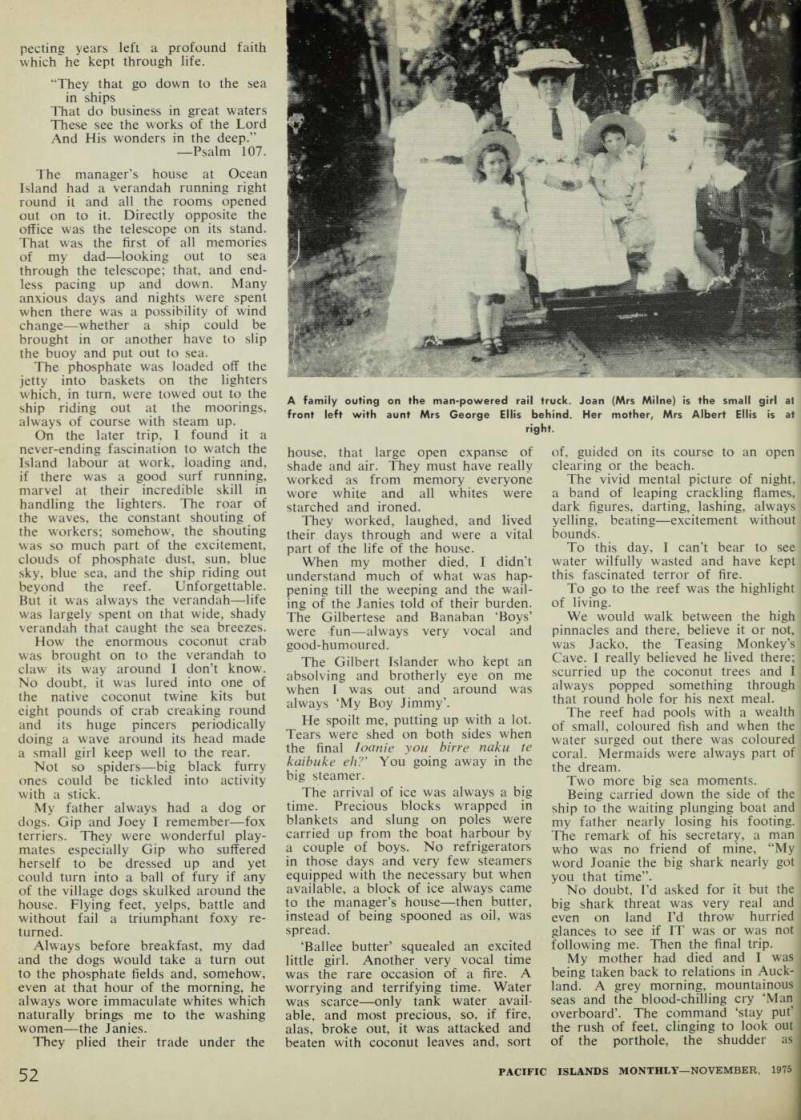
A family outing on the man-powered rail truck. Joan (Mrs Milne) is the small girl al front left with aunt Mrs George Ellis behind. Her mother, Mrs Albert Ellis is at right.
ngines changed to astern, the slow wing round: the tiny little boat with nen rowing, climbing up those mounains—endless time. He’s safe, thank jod, they’ve got him.
My father was a very helpful actor in that rescue. Rushing to the >ridge, he spotted the man and, linging to the rail, held at arm’s ;ngth a handkerchief always pointing :> that dark spot in the grey ocean. le had excellent long sight. I renember later in the day looking dth great awe at the man who had terally been in deep waters.
My mother was a greatly-loved /oman. Being a registered nurse, she aturally served throughout the commnity and occasionally I was llowed to go on rounds with her. /hen moving around the Island one avelled on the railway.
Normally, a Walt Disney type of >co pulled the rake of trucks from le phosphate workings to the rushers. However, when used by us ungs were different, a seat being xed to a platform on wheels, and we ere poled along by two Gilbertese, If the visited patient was a child sweetie was generally popped into s mouth. She was also the manajr’s wife and, having come from a imily of strong - minded homelakers, that flair was well to the fore id everything was fittingly done.
Hospitable, she was gay and had a tremendous sense of humour.
The dining-room must have been restful and cool on the hottest day.
It had three walls of trellis with a shelf right round holding crotons and such-like with their variegated leaves.
The light shade was the dried stretched skin of a porcupine fish.
The kitchen was ruled over by a Japanese cook named Sato and his wife was my long-suffering nurse maid.
Thinking back, I realise what a blest little girl I was. Looking at old photographs, one wonders how the women could tolerate the clothes they wore compared with the Mother Hubbard and patio dresses of these days. Those dresses were long, had tight waists, long sleeves and high collars. The women seemed to wear this type of dress even to picnics.
Fish and skinny poultry would certainly be the mainstay for diet, otherwise we were dependent on tinned food. I don’t think my mother had good health and imagine the lack of fresh foods we take so much for granted had a lot to do with this.
Papaw and sour-sop are the only fruits I remember growing there. That she was remembered by the Banaban population with love was forcibly brought home to me when we had the great pleasure of visiting Rabi
Island about 11 years ago. Why else did the name of Florence occur so frequently? Why else did the older women suddenly brim over and, when 1 asked what they were saying, the answer came, “They say you are like your mother”. Also at Rabi we met Ben Corrie, my father’s interpreter from long ago and, I imagine, my oldest friend. We had an emotional time together. My mother had nursed him back to life after a severe accident.
We had a wonderful and generous welcome from the Banaban com munity. Whatever their feelings are now, it was obvious the memories of the past, my father’s visit to Rabi and all past links were strong with respect and affection on both sides.
This one-time ooma woman felt at home and welcome.
Ocean Island—it’s all a very dif ferent scene today. Big business, modern houses, refrigerators, club house with swimming pool: cantilever loading, sophisticated machinery and as near-perfect method of mooring buoys as can be devised: bougain villea, frangipani, iced beer, frozen foods, all mod cons. Still a little sea girt isle. Still the day-long, night-long boom of the surf, the rustle of coco nut trees, the white beaches and the magic that makes dreaming possible.