for its people
pp. 37-39 · Read in the full issue

Bikini, a home too hot for its people
From MIKE MALONE at Saipan
The displaced people of Bikini doll, in the Marshall Islands, reloved from their home islands Imost 30 years ago to make way for uclear testing by the United States id not go home in September as lanned—their homeland is still hot”.
A postponement was officially anounced by the US Department of iterior so that “analysis and evalution of the latest radiological survey” luld be completed. But a prelimiary US government report in August arned that foods grown on Bikini re unsafe for human consumption id “should not be eaten”.
The survey, taken in June by the nergy Research and Development dministration (formerly Atomic nergy Commission) revealed gamma y exposure rates “considerably gher” than on neighbouring islets at surround Bikini’s 200-ft deep goon, where a fleet of ships sunk the 1946 tests still he.
And, despite an extensive SUS 4 illion clean-up, rehabilitation and incultural replanting programme idertaken on Bikini since 1968, inuding construction of 40 concrete »uses and community buildings, the port said Bikini should be cona USe T i u tGF A - 1 was declared “safe”
' the Atomic Energy Commission in 67, President Johnson pledged to turn the Bikini people as soon as massive clean-up programme was mpleted. Moon-like craters were led in, and over 40,000 trees,
mainly coconut, planted in neat rows on the atoll’s two principal islands, Bikini and Enyu.
Interior Department officials called the former nuclear test site “the best planted island in the Pacific” and en thusiastically described Bikini as a future “showcase island”.
The results of the latest unpubli cised report, however, said no more homes should be built on Bikini, but instead on nearby Enyu, four miles away, where radioactive levels are lower. Fish, birds, bird eggs, and coconuts were declared safe to eat. but the report said final analysis of the June survey might not be avail able until early 1976.
Bikini, part of the Trust Territory, has been administered by the United States since taken from Japan in World War 11.
Early in 1946, Bikinians were per suaded by the US Navy to leave their atoll for what they believed would be a short time. Taking only what personal belongings they could carry, the islanders were moved to isolated Rongerik, an uninhabited atoll islanders say possesses many poison ous fish.
The Bikini people nearly starved, In 1948, they were evacuated to a “ ten t c * ty ” on Kwajalein, then a navy base; today a top-secret missile test ing range for the US Army. Eight months later, the Bikinians were moved to a tiny, uninhabited island called Kili, which is one-seventh the size of Bikini. Lacking a lagoon and adequate farmland, food on Kili has
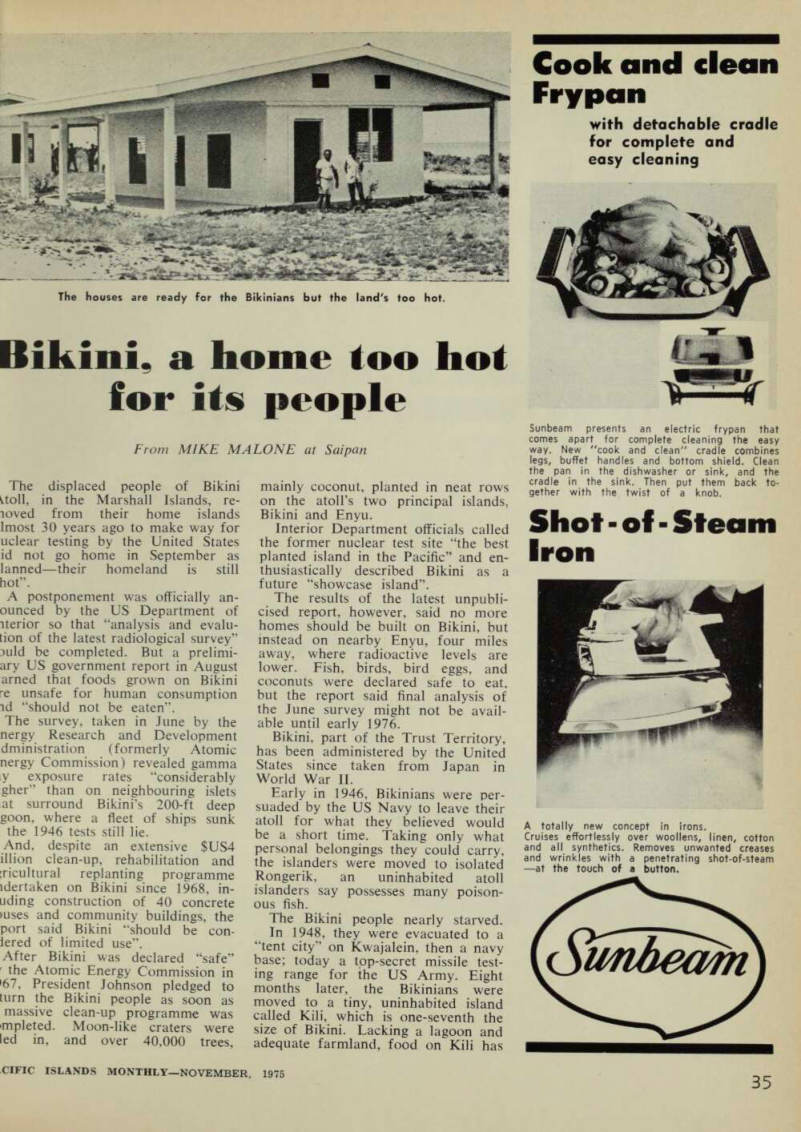
The houses are ready for the Bikinians but the land's too hot.
been air-dropped by military aircraft from Kwajalein.
Today, the gentle Bikini islanders speak of their former homeland with a strange mixture of nostalgia for the □ld days and resentment of the United States’ treatment during nearly three decades of exile.
Many of the old people still hope
they will be laid to rest near their ancestors. The young, on the other hand, have never seen this place called Bikini, which their elders speak so fondly of.
Adverse world opinion prompted the US Government to set up a $300,000 trust fund in 1956 so the islands could receive an annual divi dend. But, in 1973, Bikinians filed a lawsuit against the Trust Territory Government because the fund had diminished by over one-third.
The Bikini people’s representative in the territory’s national legislature, Ataji Bales, led a delegation of Bikini leaders to Washington last year demanding $3 million in compensa tion for their long years of hardship.
The ex gratia payment was recently authorised by the US Congress.
Bales, a member of the Congress of Micronesia, has grown accustomed to dealing with Americans over the years and has championed the causes of other displaced islanders in his constituency, including Kwajalein and Eniwetak atolls. On Kwajalein, dis placed Marshallese live in a 63-acre ghetto while their islands serve as a target-range for incoming missiles launched from Vandenberg Air Force Base, in California.
Like the Bikini people, the dis placed people of Eniwetak also saw
their islands turned into a nuclear tesf site and for years have demanded to be returned home.
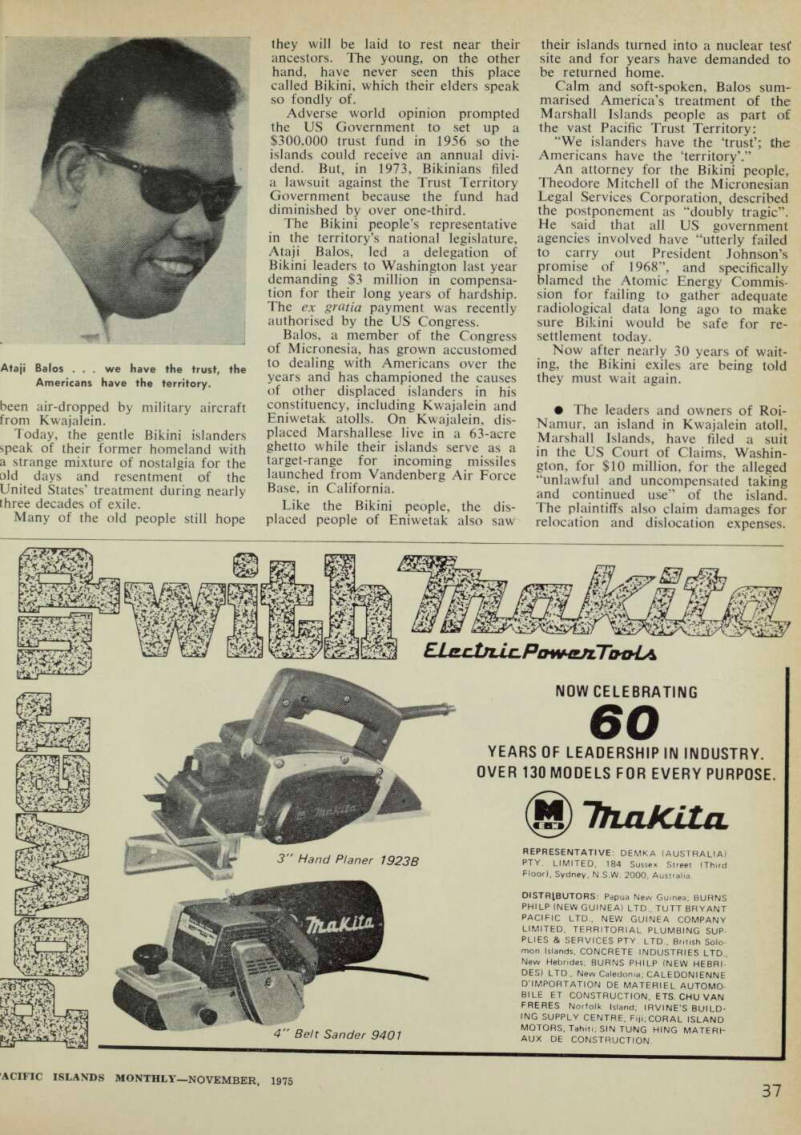
Calm and soft-spoken, Bales sum marised America’s treatment of the Marshall Islands people as part of the vast Pacific Trust Territory: “We islanders have the ‘trust’; the Americans have the ‘territory’.”
An attorney for the Bikini people, Theodore Mitchell of the Micronesian Legal Services Corporation, described the postponement as “doubly tragic”.
He said that all US government agencies involved have “utterly failed to carry out President Johnson’s promise of 1968”, and specifically blamed the Atomic Energy Commis sion for failing to gather adequate radiological data long ago to make sure Bikini would be safe for re settlement today.
Now after nearly 30 years of wait ing, the Bikini exiles are being told they must wait again. • The leaders and owners of Roi- Namur, an island in Kwajalein atoll, Marshall Islands, have filed a suit in the US Court of Claims, Washin gton, for $lO million, for the alleged “unlawful and uncompensated taking and continued use” of the island.
The plaintiffs also claim damages for relocation and dislocation expenses.
Ataji Bales . . . we have the trust, the Americans have the territory.