'South Pacific Commission Needs
pp. 8-9 · Read in the full issue
A Heart Transplant'
From STUART INDER, on Nauru
The South Pacific Commission is sicker than any of us thought, and it needs more than a blood transfusion to recover. I suspect it needs a heart transplant That’s my diagnosis after having sat through the 15th South Pacific Conference, held here on Nauru from September 29 to October 10.
I’ve never attended a South Pacific Conference so depressing in its frustrations or in its inability for most of its sitting days to stir itself into anv kind of action.
When it did, only in the final day or two, it made the one significant decision of the whole meeting. And that was to set up a review committee to re-evaluate urgently the entire function of the South Pacific Commission' Having thus recorded that result, I don't intend to bore you, as we were all bored silly at the conference, with a point by point description of the meeting's tedious progress; about who said what and who drafted what amendments to already thrice- ters of no special significance anyters ot no special signmc y simply accept my word that there was the greatest percentage of wasted wordage at this conference than in any previous, and probably the great-
est weight of unread paper. Although there was so frequent a reference to doing things “the Pacific Way” that the term finally became a bad joke, it was a most un-Island conference.
There was too much formality in the conference hall itself, too many un-Pacific expressions such as “in deference to the Distinguished Delegate from . . .”, and “Yes, I agree with my Distinguished Friend on his valuable contribution to debate, but might I suggest we make this minor amendment to read as follows . . . ’
The simple digging stick was replaced by a bulldozer fitted with a grading blade, and we were all covered m a continual dust cloud.
Papua New Guinea’s Deputy Prime Minister and Minister for Foreign Affairs, Sir Maori Kiki, once exploded in one of the conference’s tooinfrequent moments of plain speaking, “We have had an ear bashing!
If people have nothing to say they should just shut up!
Another time, Mahe Tupoumua, there as an observer in his capacity of director of the. South Pacific Bureau for Economic Co-operation, information on a particular matter, “I have brought no paper on it because there is too much paper here”, and proceeded to offer instead a stinging verbal blast
about the conference’s lack of direc tion, and action.
Looking back at the recent history of both the SPC and the conferences which have now become identified as the one package, we perhaps should have realised that this con ference would meet trouble. It was after all, two or three years back that people first began to count all the words and the money spent, and measure them against the commis sion s achievements. Clearly, nobody had liked what they saw.
But last year at Rarotonga there was a false summer The delegates had finally t n *c‘ ence of the colonial powers to a C ceptable levels, and had streamlined Procedures to such an extent that PIM man John Carter was able to report from that 14th Conference, Sweet reason permeated the atmos phere like at no other conference m SPC history .
The SPC had really run out of red blood corpuscles without any body noticing, and the sweet reason ableness was m fact a sign of al preaching semi-coma. Which i surely why the 15th Conference met onNauru withsuch awM leftargy.
Yet it parted on a hopeful note
|»N»s e with Presid^ni
lion Civic Centre, with President
of improving their subsistence econ omies. If the SPC was not meeting the basic needs of the village (and Ratu Mara left no doubt that he thought it wasn’t) then it should be re-examined, he said.
French Representative Henri Nettre agreed to the extent there was need for the SPC to concentrate on practical, consolidated pro grammes.
But soon after this injection of spirit, and after a game of golf, Ratu Mara flew back to Fiji, leaving his criticism to fester.
With the patient being, as we now know, in a weakened state through anaemia, reaction was slow. Especi ally as by now the whole conference was adrift.
It was sent occasionally a few yards in this direction or that by the indeterminate paddling of Dr Joseph Williams, Cook Islands’ Minister of Health and Education, and Palauni Tuiasosopo, Assistant to the Governor of American Samoa. Dr Williams had the kind of precise, carefully modulated delivery that appeared to prevent him from stating anything briefly. He also appeared fascinated by the theory and practice of the resolution, and could be depended upon to draft resolutions, move them, second them, amend them, speak to them and otherwise pay homage to them in all their parts.
Mr Tuiasosopo, I suspect, simply liked talking, and it’s time his best friend took him aside.
Both men did have many useful contributions to make, especially in committee, but in the final analysis I believe that their verbal trigger happiness over the entire course of the conference probably had the effect of despatching at birth some
Deßoburt being aware of differences of opinion on the work of the com mission but stressing that Nauru was not of the school of thought, if it existed, “which considers that the commission has had its day”.
Where else but through the com mission, he asked, could the metro politan and Island countries meet as friends and equals? He said the SPC was not unreceptive to constructive criticism, but it was the responsibil ity of the conference to ensure that the Islands got value for money from the commission, and this could be done by delegates “approaching the agenda with a view to securing clear cut decisions”.
One soon began to suspect that there was to be no immediate clear cut decision-making despite the Pre sident’s warning. But things did again begin to sound promising next day when Fiji’s Ratu Sir Kamisese Mara, the only Prime Minister at the con ference, pitched in with criticism on the lack of a grass roots approach within the SPC.
He suggested the larger donor countries might still exert too much influence on projects; the commission was not attuned to assisting Islanders on the basic need of shelter and food, of using their local resources.
worthwhile comments by Islanders which otherwise may have seen the light of day and sparked much needed debate and interest.
As it was, we usually only heard these sorts of matters being discussed privately, in small groups over drinks during the busy social rounds that accompanied the conference. Thus the frustrations grew, and fed on each other. , Conference chairman Kenas Aroi had the authority to put better order into affairs, and to encourage greater distribution of speakers. But surpris ingly in a man with the reputation of being a competent, firm Speaker of the Nauru Parliament, he never appeared comfortable or confident, and the conference heard most from the conference chairman via the whispered exchanges on procedure between him and SPC secretary general Fred Betham that were picked up by the sensitive micro phones.
And so, drearily, to the major business.
The SPC Budget took a great deal of time to dispense with, despite the work of the Planning Committee which had met in Noumea earlier this year, and a conference ad hoc com mittee established to re-examine the figures in light of later information on income and costs. The ad hoc committee chopped thousands from the budget estimates with an un expectedly firm hand (see separate story on the next page). Without the work of the committee, the drift-
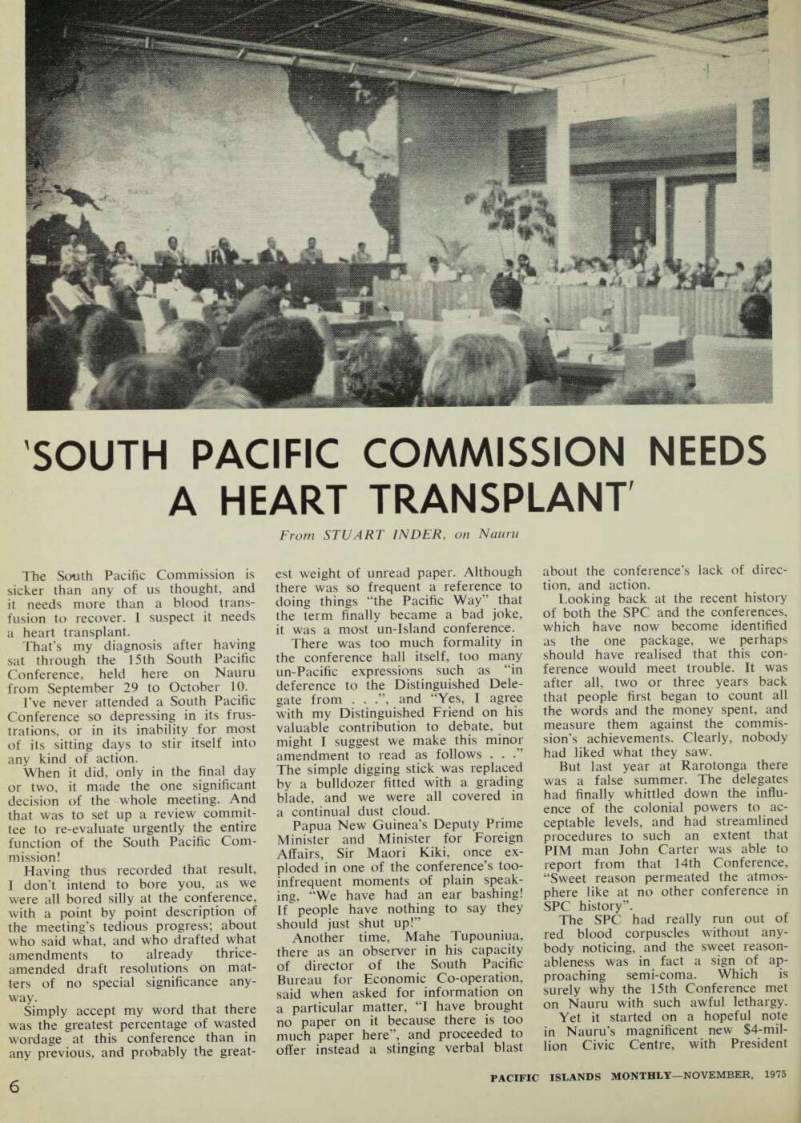
Island style. Fiji's Prime Minister, Ratu Sir Kamisese Mara, dancing with Miss Ofa Panapasa, of the SPC Secretariat staff at one of the conference's many social functions. Opposite page, the conference in session.
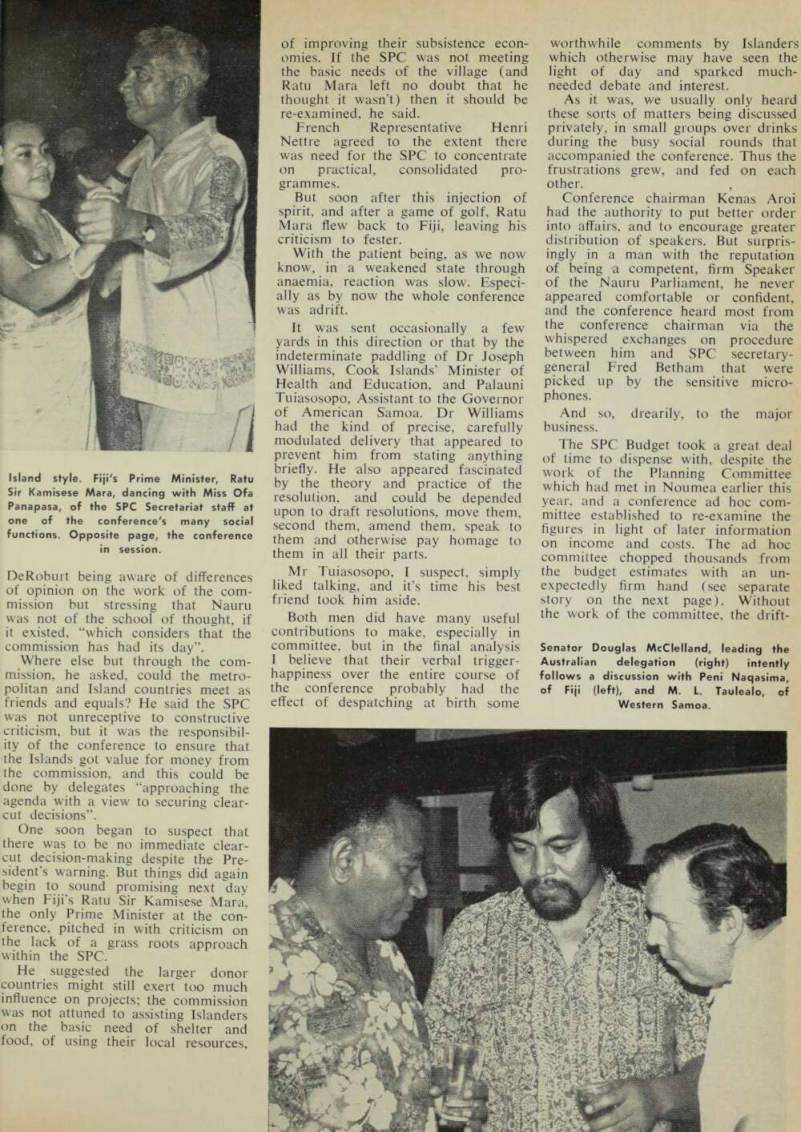
Senator Douglas McClelland, leading the Australian delegation (right) intently follows a discussion with Peni Naqasima, of Fiji (left), and M. L. Taulealo, of Western Samoa.