An island
pp. 83-86 · Read in the full issue

agent for 55 years
Life as an Islands Agent has its ups and downs, but it appealed to Mr Norman C. Nelson, whose life it was for 55 years. Mr Nelson, on June 30, stepped aside as managing director of the island agent, Sydney-based Nelson and Robertson Pty Ltd, of which his father was a co-founder in 1895. Mr Nelson joined the firm on July 7, 1920, and became managing director on his father’s death in 1942.
Nelson and Robertson was origin ally a shipping company, but it was starting to diversify when Mr Nelson joined the staff. There was then a staff of 10, most of them engaged in some shipping activity. Now there is a Sydney staff of 56, covering a wide range of activities affecting the Pacific Islands, and a tourist section, some thing which would not have been dreamed of not so long ago.
In the Islands the firm’s main acti vities have been in New Guinea. But it has expanded throughout the South Pacific, except in French-controlled islands. There is a simple reason for not “going French”, No one in the office could speak the language. And now the firm has enough on its plate, so there is no need to go into places like New Caledonia and French Poly nesia.
Someone from the firm visits the islands in which it trades, twice a year. There is little Mr Nelson doesn’t know about them and their inhabitants, many of whom he counts among his close friends.
Much of Nelson and Robertson’s strength was, and still is, in New Guinea. There is a European staff of 20 in the various New Guinea offices, and, of course, a number of Papua New Guineans, many of them, he says “very promising”. Some of them have been trained at Sydney head quarters.
Mr Nelson saw his firm go through the vissicitudes of World War 11, suffering heavy losses about 80 per cent of the business. This would have knocked many firms out of business, but Nelson and Robertson had a shipping line to fall back on.
The heaviest losses were in Rabaul where it owned a hotel. The Japan ese took over the hotel to use as a naval headquarters. Then the Ameri-
cans came along, bombed it and damaged it badly.
Mr Nelson was vice-president of an association formed in Sydney to ap proach the Australian Government about compensation for war damage.
He was one of a deputation who saw the then Prime Minister, Mr Chifley, who gave them a “very good hear ing”. Mr Chifley persuaded the Aus tralian Government to bring New Guinea into the Australian war damage scheme. Nelson and Robert son, along with others, were fairly treated, in Mr Nelson’s words, although they did not get full com pensation for what they lost.
He has seen many changes in his 55 years with the firm. In 1946 the company ceased to become a ship owner when it sold the Poonbah. He has seen big changes in politics in a number of countries, but he prefers not to comment about them, as he believes politics are something for the people themselves.
Businesswise, he thinks the growth of the co-operative movement in Papua New Guinea is one of the biggest changes. A lot of Chinese storekeepers have left PNG and the co-op stores have taken their place.
Nelson and Robertson now trade with these co-op stores, supplying a great deal of foodstuffs in particular, as they did with the privately owned stores.
The move to shipping cargo in containers was a big, and welcome, change in Island trading. Container isation enabled the agent to give a faster service. A whole cargo for the New Guinea Highlands, for example, could be unloaded at Lae, loaded into a lorry and taken to its destination where it could be quickly and con veniently broken down. And with
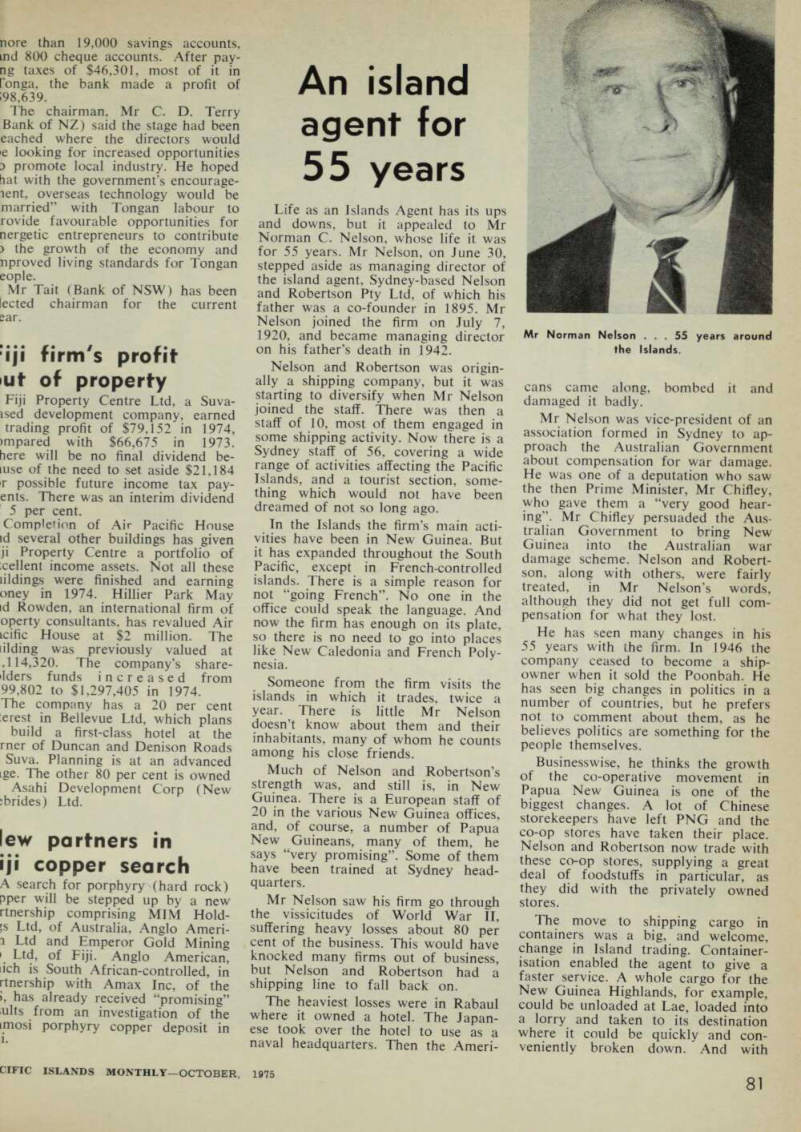
Mr Norman Nelson... 55 years around the Islands.
ontainer cargoes there was less pe erage.
Mr Nelson says his career as an dands agent was “very, very interest tig”, and he would go in for the ame sort of career if he had his time ver again.
“You meet a lot of people, which :ads to good contacts,” he said.
As a sideline, Mr Nelson is the onsul for Uruguay, largely a purely onorary position till recently, follow ig the arrival of a number of Uru uayan immigrants in Australia. His ather before him was the consul, as as the consul for Argentina.
Wien Uruguay insisted she wanted a jparate consul, Mr Norman Nelson’s ame was put forward, and accepted, le will step down as consul at the nd of 1975.
He pays a generous tribute to the ampany’s staff, a number of whom ave been with the firm for many ears. He mentioned Mr W. E. Ryall nd Mr H. R. Cooper, who joined le firm soon after it was founded.
Ir Ryall, now dead, retired about 15 ears ago, while Mr Cooper, who re red about three years ago, is still live. There are others on the staff ho have upwards at 25 years’ scr ee.
Although he has given up his posi □n as chief executive, Mr Nelson mains chairman of the board. He cpects to go into the office for lard meetings, and to meet people id talk to them across his desk. The ;sk, incidentally, is a massive piece r furniture, used by his father and lr Robertson, one on each side, any years ago. He has been suc :eded as managing director by his >n, Mr Ivan Nelson, which means at for 80 years control of the firm is been in the hands of three gen ations of the Nelson family.
Mr Nelson looks a healthy 74, with i alert mind, and an ability to lickly recall events of the past. He ill spend much of his retirement in s home in the Sydney suburb of St es, where he has lived for about ) years, tending his flower and igetable garden. And when he wants me recreation there is a handy iwling green.
NG Government
o-it-yourself plan
Papua New Guinea’s Chief Minis '» Mr Michael Somare, is fed up what he calls “unacceptably gh” tenders for government pro mts. Some time ago he warned reign construction companies he >uld go ahead and set up a national instruction corporation, but delayed tion in the hope that they might
reduce tenders to a level acceptable to the government.
Now, because foreign firms have increased tenders against possible or imaginary risks, he intends to make good his threat and set up the corpo ration.
Gastronomic contract
for Bougainville
A KlO million contract to provide catering services for the Bougainville Copper mining operation, goes be yond feeding a vast number of people. The contract, awarded to SHRM (NG) Pty Ltd, in association with Panguna Catering Services Pty Ltd, Bougainville, also covers clean ing, maintenance and security services and some other “logistic-support operations”. It is for three years.
Minister warns
PNG companies
PNG’s Minister for National De velopment, Mr Gavera Rea, has warned foreign companies that they will be penalised if they begin new business activities before registering with the National Investment and Development Authority.
The Minister said in September that a small number of foreign com panies had started new business, but had not registered.
Mr Rea said he would not hesitate to use the penalties set out in the NIDA Act if there were further breaches. All foreign companies and others wanting to start a business in which they were not engaged on December 6, 1974, had to apply for registration with NIDA.
The purchase of 10,000 wet metric tonnes of copper from Bougainville Copper Ltd for K 2.9 million, and cocoa worth $400,000 from Angco Pty Ltd, could be the forerunner to bi lateral trade between China and Papua New Guinea. The copper and cocoa were bought by a trade delegation from China which visited Papua New Guinea in August-Sep tember.
The Chinese are also inter ested in buying timber, palm oil, coffee and coconut oil.
Multi-million
Fiji land deal
A further development, but not on such a grand scale as Pacific Harbour, is planned on 6,000 acres at Deuba, about 35 miles west of Suva in Fiji.
SPP Taisei Ltd, which is owned by Taisei Corporation, of Japan, and Southern Pacific Properties Ltd, of Hong Kong, will buy the land from Pacific Hotels and Developments Ltd, a subsidiary of South Pacific Pro perties, the Pacific Harbour de veloper.
The Fiji Government has approved, in principle, a plan to develop the land, for which about S 5 million will be paid. The area will be developed progressively. Most of it will be small village-type complexes, with much bigger public areas and reserves than in the Pacific Harbour development.
SPP Taisei will also buy two hotel sites in the Pacific Harbour area, one just over the Queens Road from the Beachcomber Hotel, and the other near the golf course.
The chairman of Southern Pacific Properties, Mr Peter Munk, and the managing director of Pacific Hotels and Developments, Mr Gerald Bar rack, have both reported on Pacific Harbour. Mr Barrack, when he an nounced the SPP Taisei development, said Pacific Harbour was “really on the move”. Only about 200 of more than 1,300 house sites remained to be sold, and everything in the $20,000 and upwards price range had gone.
Mr Munk, in the annual report of Southern Pacific Properties, said that although the 1,100-acre scheme was completed in 1974, property sales were markedly reduced compared with previous years, but Pacific Har bour itself was being sold by big tour operators as a premier destination.
A building contractor’s failure
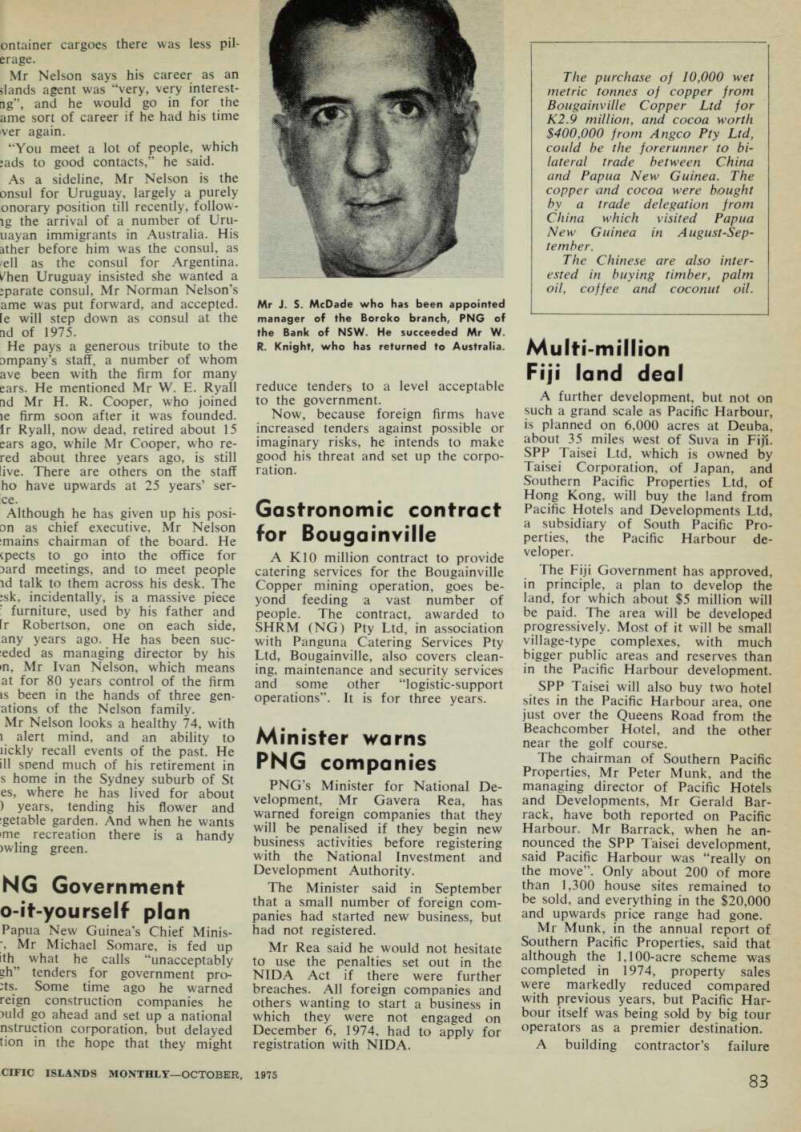
Mr J. S. McDade who has been appointed manager of the Boroko branch, PNG of the Bank of NSW. He succeeded Mr W.
R. Knight, who has returned to Australia.
caused a $575,000 loss at Deuba. Mr Munk said the contractor was Pettit and Sevitt (Fiji) Ltd. As Southern Pacific Properties had presold villas at a fixed price, it had to make up the difference between that price and completion cost after getting another contractor.
Mr Munk said the value of un developed land held in Fiji by Paci fic Hotels and Developments was estimated, at the end of 1974, at $5,549,975. Unsold land in the Paci fic Harbour development was valued at $12,385,000.
Tourism growing
in Solomons
With controlling interests sold in two key companies and a third travel agency starting business shortly, the travel scene in the Solomon Islands is on the boil.
The industry claims about $1.3 million-worth of international busi ness a year written in the Solomons and a small, but growing tourist trickle.
It is hopeful of a bigger tourist industry being developed—with something significant possibly open ing up in the Western Solomons— before international travel for ex
patriates starts to drop off drastically from 1979.
Meantime, competition for the established market will certainly in crease with the arrival of the third travel agency, financed by Kings Travel, of Brisbane, Island agents C.
Sullivan and Co and the Lawson family.
Kings, incidentally, are on the brink of a similar new agency setup in Papua New Guinea, with local equity a prequisite.
The manager of the new Honiara operation, Mrs Diene Lawson, who will have 10 per cent equity, claims she will take some of the lucrative government employee travel business away from the already-established travel agencies, Guadalcanal and Mendana.
Mendana’s principal, Mr Paul Brown, claims there is not room for three travel agencies in the Solomons and he maintains the Lawson com pany will have a hard time getting IATA accreditation because it has to be proved that new, rather than established, business is being found.
Mendana itself is part of the above story because it and the Solomons airline, Solair, with aviation buff, John Seaton, have gone largely into Papua New Guinea hands.
Mr Dennis Buchanan’s 50-plus
aircraft Talair Group, for undis closed sums, has bought controlling interests in both Mendana Inter national Travel, which billed $785,00C of international business in its most recent year, and Solair.
Six years old, Mendana was con trolled by Mr Brown and an Austra lian solicitor, Mr David Thompson.
Mr Brown remains as managing director.
It is understood that the Talair group, which recently took over an other PNG air group, Macair, may offer the Solomons Government a share in both these Honiara-based operations. • Tonga’s revenue from tourism in 1974 rose by more than 50 per cent, compared with 1973, to a record 5T2.14 million. Visitors stayed longer and spent more, according tc statistics prepared by the Tonga Visitors Bureau. Air visitors num bered 6,403. They stayed an average of 11 days, and spent an average of 5T17.25 a day. The number of cruise ship visitors, staying a day and spend ing an average of STIB.BI, was 36,308. Most cruise ship visitors were Australian (85 per cent). Australians and New Zealanders comprised 39 per cent of the visitors who arrived by air.