Business and Development
p. 79 · Read in the full issue
World Bank's Decision Shocks Png
On Eve Of Independence
From a Fort Moresby correspondent
jovernment circles here are still Dvering from the surprise decision World Bank President McNamara t an independent Papua New inea will be considered as ‘un jitworthy’ without Australian Gov ment guarantees of her loans, he decision is seen as a body blow i time when possible outside assist e will be needed to permit the ntry’s development to proceed un cked. Delegations from both the itralian and Papua New Guinea ernments intended challenging the ision at the World Bank’s annual :ting in Washington in September i the risk of a head-on clash veen the World Bank and the ua New Guinea Government th Australia as a very concerned >oker). 0 add insult to injury it has not e unnoticed that the Fiji Govern it received a World Bank loan 1 after it became independent in 0. McNamara is understood to :oncerned about PNG’s heavy de jence on expatriate skills, and on high level of budgetary support fired from Australia. Mr Whit ’s repeated assurances of con ed financial assistance to PNG do appear to have reassured the bank ’ much. n the political front, the PNG eminent argues that to build up a ied nation from such a large ber of individual groups of )le requires a sound growing lomy, which in its turn demands ide assistance. r ill McNamara’s decision, by dng PNG access to a major ce of international loan finance, ribute to political instability in future—a sort of inverted aid ess? ) far the country’s political de pment has come a long way. A titution drawn up in a truly ocratic manner has been adopted, llenges to the central government i groups seeking regional auto y have been successfully resisted.
The economy is generally strong, and in addition to existing or proposed development projects such as the Bougainville copper mine (which has been successfully renegotiated), the pulp milling industry, the exploitation of the Ok Tedi mineral deposits and the Purari River scheme, many other projects are being investigated and are likely to be proceeded with. The go ahead on these could substantially strengthen the economy.
Likely projects include exploitation of the Frieda River copper deposits;
the expectation of a greatly enlarged Ok Tedi ore body; the mining of a low grade porphyry copper and gold deposit at Yandera; and the develop ment of natural gas reserves in the Gulf District.
In the area of government adminis tration, the expected expatriate man power shortage never materialised, as personnel were recruited from countries other than Australia. The Philippines have been an important source of skills in this respect.
On balance, the World Bank’s de cision is a surprising one. The more so since the bank’s own 1974 mission to Panua New Guinea was generally understood to have given a favourable report on the country. Despite de pressed export prices and sharply in creased oil prices Papua New Guinea’s economy has continued to grow and her visible trade balance has remained in surplus.
The very real danger of the bank’s decision lies in the effect it will have on confidence in Papua New Guinea’s new currency, the Kina, and on the terms on which the government can borrow money on the international money market. It is to be hoped that the decision to class Papua New Guinea as uncreditworthy will not ultimately harm the country’s de velopment prospects.
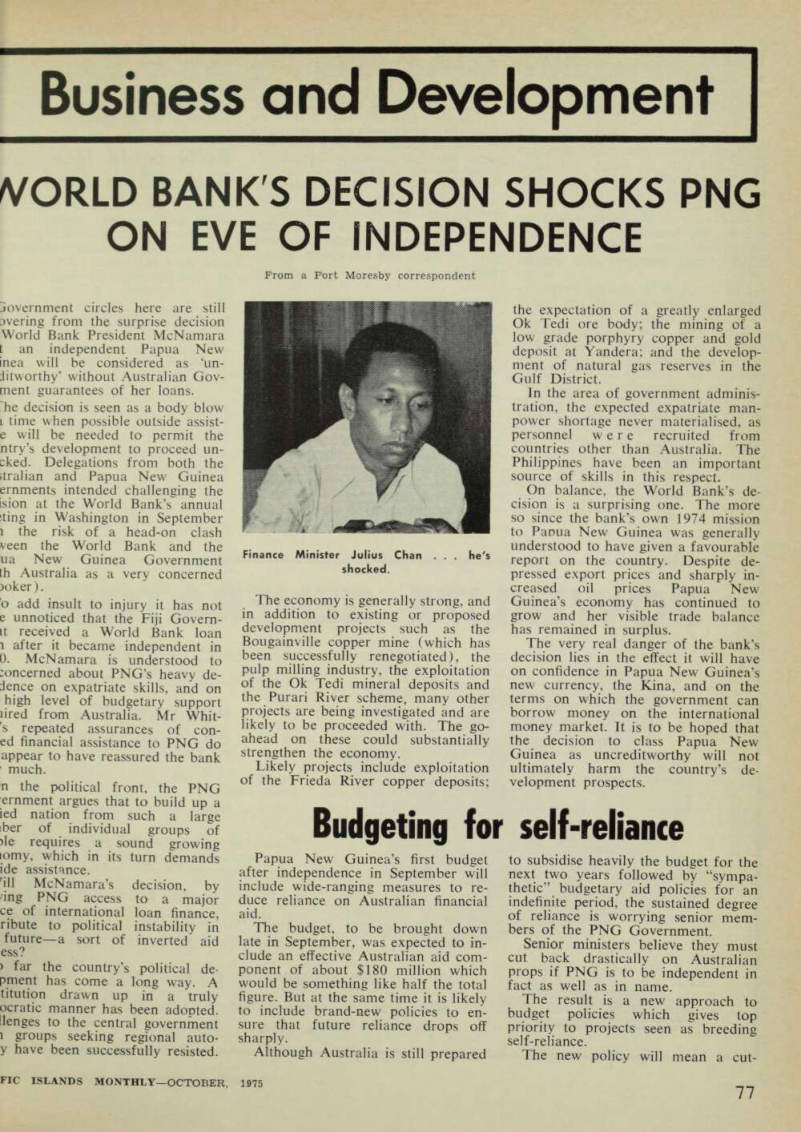
Finance Minister Julius Chan... he's shocked.