Tropicalities
pp. 29-31 · Read in the full issue
Rich soak
the poor
“A classic example of the rich people getting richer at the expense of the poor people,” said Micronesia Congressman Herman R. Guerrero in Saipan around the middle of August, But the congressman wasn’t talk ing about money. He was talking about water, lots of it, which, he said, was flooding the houses of the people on Saipan.
He blamed the new, luxurious Continental Hotel for the flood, alleging that in the current rainy season rainwater was flowing from the hotel’s car-park and into the houses on a nearby estate.
Mr Guerrero said the water col lected on the hotel roof and then ran off on to the car-park. There had never been similar flooding before the hotel was built.
Another hotel, the Inter-Continental, which is nearing completion nearby, might cause more flooding, the con gressman suggested and complained, “While the rich owners of the Con tinental Hotel are sitting high and dry, its neighbouring poor are suffer ing, low and wet”.
Artist gives
PAG ‘the bird’
An Australian artist producing a bird of paradise fountain for Papua New Guinea Independence cut his working design into pieces and freighted the pieces to Brisbane to wards the end of August.
His action was the climax to a controversy which arose because an Australian instead of a Papua New Guinea national was designing the fountain. The artist, Mr Hal Holman, of Port Moresby, said “I’ve cut up the bird with a hacksaw. He’s dead, and wrapped up in an eight-foot bundle, and as far as Papua New Guinea is concerned he stays dead and finished”.
Mr Holman plans eventually to
reassemble the design model, which has already been exhibited in Port Moresby, and will attempt to attract interest from tourist and civic authorities in Queensland.
He said “a great fuss” was made of the fact that Papua New Guinea was the home of the bird of para dise, but Queensland had two species of its own. For that reason he be lieved there would be Queensland interest in his design.
Mr Holman, who formerly worked for the PNG Government, initiated the idea of the fountain and sub mitted his plan to Cabinet which approved the design, and at least $40,000 towards the cost was pro mised in public support—mainly from the PNG Chinese community.
The final design was to have been in bronze or stainless steel, 35 ft high, and with streams of water lit from below forming the bird’s plumes.
Mr Holman said the project had ground to a halt because of the public controversy and because of some “white-inspired jealousies”.
Song and dance
in the Cooks
The 10th anniversary of self government in the Cook Islands was a gay affair, particularly in Raro tonga which was crowded with visitors. A clean town, if you can call the business centre a town, gar dens and orchards in full bloom pro vided an appropriate backdrop.
There was a week of song and dance. Teams from the various islands competed for two major prizes—the Duke of Edinburgh Cup for the outright winner of the High School events and the Air-NZ Trophy for the winner of the senior events.
Tereora College won the Duke’s cup, and Manihiki Island the Air-NZ trophy.
The Cook Islands National Art Theatre, formed in 1969, played a dominant role in the celebrations. It worked with the various clubs, en couraging them to perform traditional numbers of a high standard. The efforts of the performers, and the re ception given them by the big crowds, left no doubt that CINAT has done a remarkable job since its formation.
Fiji model
of independence
A film on Fiji’s independence cele brations in 1970, which has beer screened in many countries, helped tc allay the fears of Papuans that inde pendence for Papua New Guinea would bring war between expatriates.
Papuans and New Guineans.
After the film had been shown in Port Moresby and in many villages, a Central District Government liaison officer, Mrs Rosa Lailai said the people had been very surprised tc see that Independence Day was a time of festival and celebration, and not war.
“Many villagers had thought that there would be a big fight to chase all the expatriates away to gain inde pendence,” Mrs Lailai said.
“The people have told me that Miss Josephine Abaijah had said this sort of thing to them. However, they were very pleased to see Fiji’s indepen dence film showing people of dif ferent races, religions and cultures taking part in the celebrations to gether.
“It has taken away many of the people’s doubts and fears about inde pendence.”
French VIP
visitor soon
The French Ambassador to Aus tralia visited New Caledonia late July and called the Noumea press together to tell them that relations between France and Australia are now excellent, after the nuclear pro test era.
The ambassador, H. E. M. Treca, took up his Canberra post only two months previously and was on his way to Paris where he was expected to discuss plans for French Prime Minister Jacques Chirac to visit the South Pacific in November.
Mr Treca emphasised that a “page has been turned” and that trade be tween France and Australia is in creasing considerably. The ambassa dor felt Caledonian tourist revenue could be improved if less expensive accommodation was available for
Australian visitors in Noumea. The ambassador underlined the role of New Caledonia in creating a favour able impression for France in the Pacific, with cultural activities such as the summer schools each January for visiting Australian and New Zea land teachers.
Some articles in the Noumea press have continued to be hostile towards Australians. However a Noumea cor respondent believes Mr Treca’s re ference to the importance of growing French trade with Australia could alter this attitude.
The March visit to Australia and New Zealand of Mr Olivier Stirn, French Minister for Overseas Terri tories, underlined the fact that France is keenly interested in obtaining Australian uranium and in selling French aircraft and other goods to Australia and New Zealand. Mr Stirn also said that French Prime Minister Jacques Chirac intended to visit Australia and New Zealand this year.
Island nights
in NSW
The Country Women’s Association of New South Wales has gone all Island-conscious, an association cor respondent told PIM. Each year, the association studies a country. This year they chose the Islands, ferreted out all the information they could about them and then held an Island day to demonstrate and test their knowledge.
There was doll-dressing in Island costumes, with points for authenticity, a quiz and a display of Island dancing and singing. It all helps to foster friendship, but PIM has another sug gestion for the Country Women’s Association.
How about ending the year’s study with a whip-round for a donation to present to some needy cause in the Islands?
S
Voiv du Cagou
doses down
One of the Caledonians’ strongest critics of the French Administration has been subdued with the closure of a once-popular weekly newspaper, Alain Bernut’s Voix du Cagou. It was an organ of Bernut’s party in the Territorial Assembly, the Mouvement Populaire Caledonien, and it was started by Bernut when he was elected to the Territorial Assembly in July 1967 and left the weekly Journal Caledonien.
Most Caledonians are now weary of the autonomy struggle. This re
duced Bernut’s advertising support and made the paper unprofitable. The MPC party, which has two members in the Territorial Assembly, has in dicated it may publish a monthly political bulletin from the beginning of next year. Before the end of this year, the party plans to send a dele gate to Paris to make official contact with the French Socialist Party.
A new radical weekly has been appearing since early this year. It is Les Caledoniens (The Caledonians), published by J-P Caillard, who has studied at university in Paris and is the son of a well-known Caledonian doctor.
Les Caledoniens devotes its pages to the cause of Caledonian protest movements supported by students and “kanakas”. The paper claimed on its front page early July that its printers had been subject to “the worst pressure from their advertising clients as well as from our guber natorial super-prefect”—a reference to opposition from the local French Governor.
The paper attacks the latest poli tical “reform” proposed by Paris, leaving essential powers such as army, justice and police in the hand of the French authorities. Needless to say the paper carries no advertis ing. This kind of outspoken comment doesn’t attract them.
As a further indication of the pressures existing in the Caledonian Press, Michel Gerard, editor of the Islands daily La France Australe went into hospital late in July allegedly suffering from “serious de pression”.
Michel Gerard had been under stress for several months over con flict with the French/Australian ma jority shareholders, the SLN Mining Company. y
It. W. Robson’s
national dav
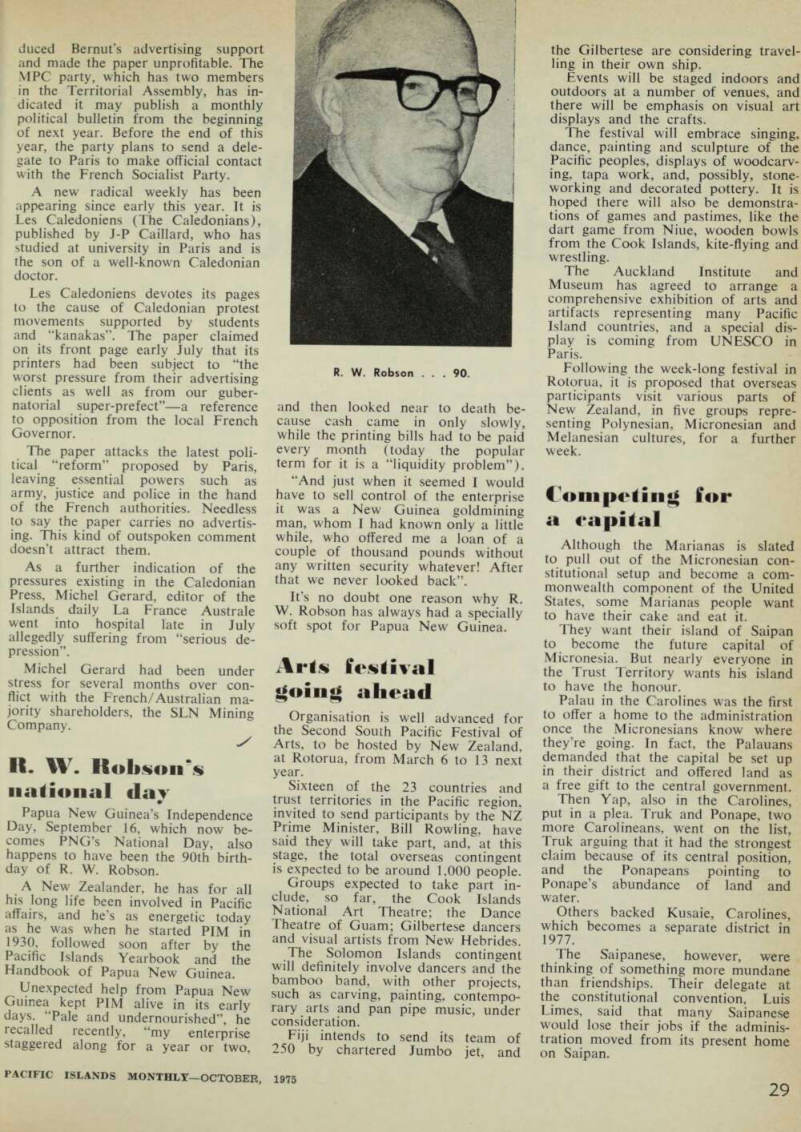
w Papua New Guinea’s Independence Day, September 16, which now be comes PNG’s National Day, also happens to have been the 90th birth day of R. W. Robson.
A New Zealander, he has for all his long life been involved in Pacific affairs, and he’s as energetic today as he was when he started PIM in 1930, followed soon after by the Pacific Islands Yearbook and the Handbook of Papua New Guinea.
Unexpected help from Papua New Guinea kept PIM alive in its early days. “Pale and undernourished”, he recalled recently, “my enterprise staggered along for a year or two,
and then looked near to death be cause cash came in only slowly, while the printing bills had to be paid every month (today the popular term for it is a “liquidity problem”).
“And just when it seemed I would have to sell control of the enterprise it was a New Guinea goldmining man, whom I had known only a little while, who offered me a loan of a couple of thousand pounds without any written security whatever! After that we never looked back”.
It’s no doubt one reason why R.
W. Robson has always had a specially soft spot for Papua New Guinea.
Arts festival
going ahead
Organisation is well advanced for the Second South Pacific Festival of Arts, to be hosted by New Zealand, at Rotorua, from March 6 to 13 next year.
Sixteen of the 23 countries and trust territories in the Pacific region, invited to send participants by the NZ Prime Minister, Bill Rowling, have said they will take part, and, at this stage, the total overseas contingent is expected to be around 1,000 people.
Groups expected to take part in clude, so far, the Cook Islands National Art Theatre; the Dance Theatre of Guam; Gilbertese dancers and visual artists from New Hebrides.
The Solomon Islands contingent will definitely involve dancers and the bamboo band, with other projects, such as carving, painting, contempo rary arts and pan pipe music, under consideration.
Fiji intends to send its team of 250 by chartered Jumbo jet, and
the Gilbertese are considering travel ling in their own ship.
Events will be staged indoors and outdoors at a number of venues, and there will be emphasis on visual art displays and the crafts.
The festival will embrace singing, dance, painting and sculpture of the Pacific peoples, displays of woodcarv ing, tapa work, and, possibly, stone working and decorated pottery. It is hoped there will also be demonstra tions of games and pastimes, like the dart game from Niue, wooden bowls from the Cook Islands, kite-flying and wrestling.
The Auckland Institute and Museum has agreed to arrange a comprehensive exhibition of arts and artifacts representing many Pacific Island countries, and a special dis play is coming from UNESCO in Paris.
Following the week-long festival in Rotorua, it is proposed that overseas participants visit various parts of New Zealand, in five groups repre senting Polynesian, Micronesian and Melanesian cultures, for a further week.
Competing for
a eapital
Although the Marianas is slated to pull out of the Micronesian con stitutional setup and become a com monwealth component of the United States, some Marianas people want to have their cake and eat it.
They want their island of Saipan to become the future capital of Micronesia. But nearly everyone in the Trust Territory wants his island to have the honour.
Palau in the Carolines was the first to offer a home to the administration once the Micronesians know where they’re going. In fact, the Palauans demanded that the capital be set up in their district and offered land as a free gift to the central government.
Then Yap, also in the Carolines, put in a plea. Truk and Ponape, two more Carolineans, went on the list, Truk arguing that it had the strongest claim because of its central position, and the Ponapeans pointing to Ponape’s abundance of land and water.
Others backed Kusaie, Carolines, which becomes a separate district in 1977.
The Saipanese, however, were thinking of something more mundane than friendships. Their delegate at the constitutional convention, Luis Limes, said that many Saipanese would lose their jobs if the adminis tration moved from its present home on Saipan.
R. W. Robson... 90.