identity
p. 21 · Read in the full issue
New nation searches for its identity
From LEE McKENZIE in Port Moresby
It pays to be choosy when only the est will do. That goes double for *apua New Guinea searching along lany different roads for a national lentity and the marks of unity. Its ;aders think a new name, a national nthem and a national dress will help.
Which is one reason why the National Broadcasting Commission’s udience has been bombarded for 'eeks with the five “finalists” in the ational anthem competition.
This daily airing was not a good lea. Comment was unfavourable.
Funereal and depressing”, “mis onary hymns”, “colonial and dull”, un-Melanesian” were some of the riticisms. The judges retorted, “These nthems need to be played and under ood overseas, it’s no good using istruments native only to PNG,” to istify their choices. “Would the rench translate their Marseillaise?” ueried one critic. The “forlorn five” m a poor second to the widely tiown and used song Papua.
Anyone who heard the broadcast om the South Pacific Games in iuam featuring the PNG women’s asketball team’s lusty, proud ren ition of Papua, would stick to this > a “winner”.
Despite its strong Papuan flavour, national theme could be added with ;veral language versions.
So PNG’s anthem competition ap -ars to have suffered the same fate > the Australian brave try—to re tain dormant, if not moribund.
That old perennial showed up, a jw name for that unwieldy inherit ice “Papua New Guinea”. Since te 60s names like Pagini and Para
disea have been bandied about. The ruling political party grabbed one contender, “Pangu”, first.
One loyal public servant proposed “Somare” after Mr Somare. His idea was rubbished as too like Somaliland or smacking of dictatorships. So the old handle stuck for the time being.
The government was not down hearted and pursued their policy of fostering unity and national pride in a national dress competition, or ganised by the YWCA.
Then Chief Minister Michael Somare, in tailored “lap-lap”, collar less shirt and leather sandals told the audience before presenting the prizes that “our people when overseas look like second-rate Australians”.
The winner, second and third place getters were pictured next day in the Post-Courier. It was refreshing to see
the new Police Commissioner Pious Kerepia from Buka, Bougainville, in second place wearing handsome civilian gear.
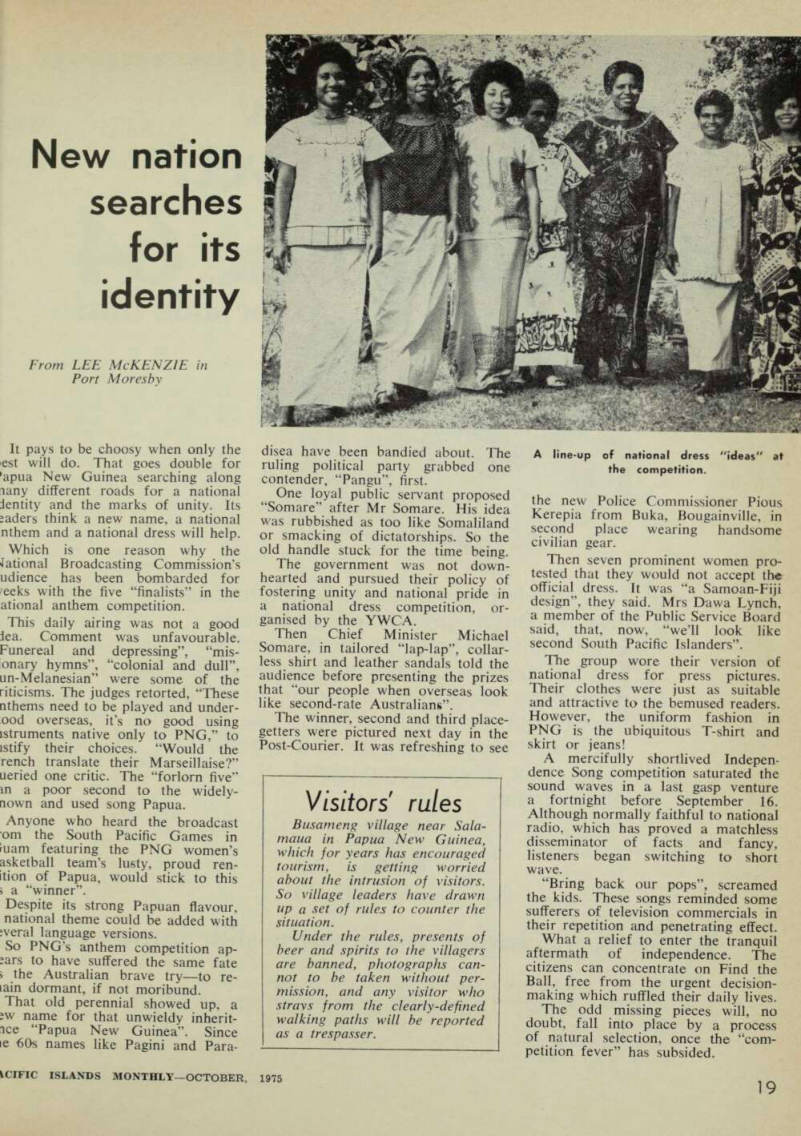
Then seven prominent women pro tested that they would not accept the official dress. It was “a Samoan-Fiji design”, they said. Mrs Dawa Lynch, a member of the Public Service Board said, that, now, “we’ll look like second South Pacific Islanders”.
The group wore their version of national dress for press pictures.
Their clothes were just as suitable and attractive to the bemused readers.
However, the uniform fashion in PNG is the übiquitous T-shirt and skirt or jeans!
A mercifully shortlived Indepen dence Song competition saturated the sound waves in a last gasp venture a fortnight before September 16.
Although normally faithful to national radio, which has proved a matchless disseminator of facts and fancy, listeners began switching to short wave.
“Bring back our pops”, screamed the kids. These songs reminded some sufferers of television commercials in their repetition and penetrating effect.
What a relief to enter the tranquil aftermath of independence. The citizens can concentrate on Find the Ball, free from the urgent decision making which ruffled their daily lives.
The odd missing pieces will, no doubt, fall into place by a process of natural selection, once the “com petition fever” has subsided.
A line-up of national dress "ideas" at the competition.