Conciliation
pp. 17-20 · Read in the full issue

Prime Minister
Som Are:
Is His Style
If Papua New Guinea Prime Minister Michael Somare’s just lublished autobiography does nothing Ise, it makes clear that the belief ic has in conciliation, which has ieen so apparent in his handling of be many problems leading up to his ountry’s independence, is a belief bat is basic and deep-rooted in him.
Born into the Sana section of the ait clan, in the Murik Lakes area f Papua New Guinea’s Sepik, he fas taught from a boy that his clan ad “the magic of peace”. Every lan had its own magic, and the lagic of his clan was that it knew bout peace, that it knew how to invite people” (because you couldn’t fin people by being angry with lem).
“My people taught me that men re equal and should have equal pportunities”, he writes in his auto iography, Sana. “Disputes can be lived by discussion, and decisions lould be arrived at by concensus, man must protect himself against /il attacks, but once he has publicly tposed his enemy he must not think f any further revenge.
“My people believed that almost ly dispute could be settled by talk, hey believed in reconciliation rather tan retribution. Even in cases of itchcraft or suspected witchcraft it as considered wrong to retaliate, ou defended yourself by exposing ic evil-doer. Exposing his machin ions to the public rendered him dpless”.
Although born in Rabaul, where s father happened to be stationed
as a policeman, and where he lived for his first six years following his birth there in April 1936, Somare regards his home village as Karau, in the Sepik. Today he holds the Sana, the chiefly title of his clan, passed to him from his grandfather, via Michael Somare’s own father, Somare, who died in 1972.
But that came much later, and meanwhile young Somare was to enjoy what he recalls as a pleasant, fairly carefree boyhood during the Japanese occupation of New Guinea.
He had been taken back to the Sepik by his father just before the Japanese struck in 1942, and when the Japanese eventually occupied the Murik Lakes, young Michael went to a Japanese school for nine months or a year (he can’t recall exactly). It was his first schooling, and he enjoyed it, and he enjoyed the Japanese schoolmaster. The Japanese in that area were a good lot, he recalls, who respected local women and didn’t plunder the food gardens.
The local people were sorry to see them forced out by the advancing Australians, and when they did go there was no more schooling for young Michael for some time, for
PI M’s editor, Stuart Inder, reviews Sana, the autobiography of Michael Somare, published in September by Niugini Press, Port Moresby, our copy from Jacaranda Press, 20 Falcon Street, Crows Nest, Sydney, price $4.95.
Australia didn’t provide a school in his area. This was the time when Australia was picking up the pieces after the war and many areas suffered serious neglect, to the lasting detri ment of Australia’s reputation.
When the young Michael finally went to school again at Boram, then Dregerhafen, he was obviously a bright student, if inclined to be talkative, and was in time selected for a 12-month teacher-training course at Sogeri, near Port Moresby.
This was followed by his first school teaching job in New Ireland, then over the next few years in the Sepik and Madang.
The turning point in his life came in 1961 when he was selected for a crash course in political education in Port Moresby so that he and other young teachers could explain to local populations the election procedures of the PNG Legislative ouncil.
It made him politically aware, and when, after another stint at teaching, he became an announcer-reporter with the Administration-run Radio Wewak, seconded from the PNG Education Department, he found an outlet for his growing interest in the policies and methods of colonial government.
He was finally and irrevocably
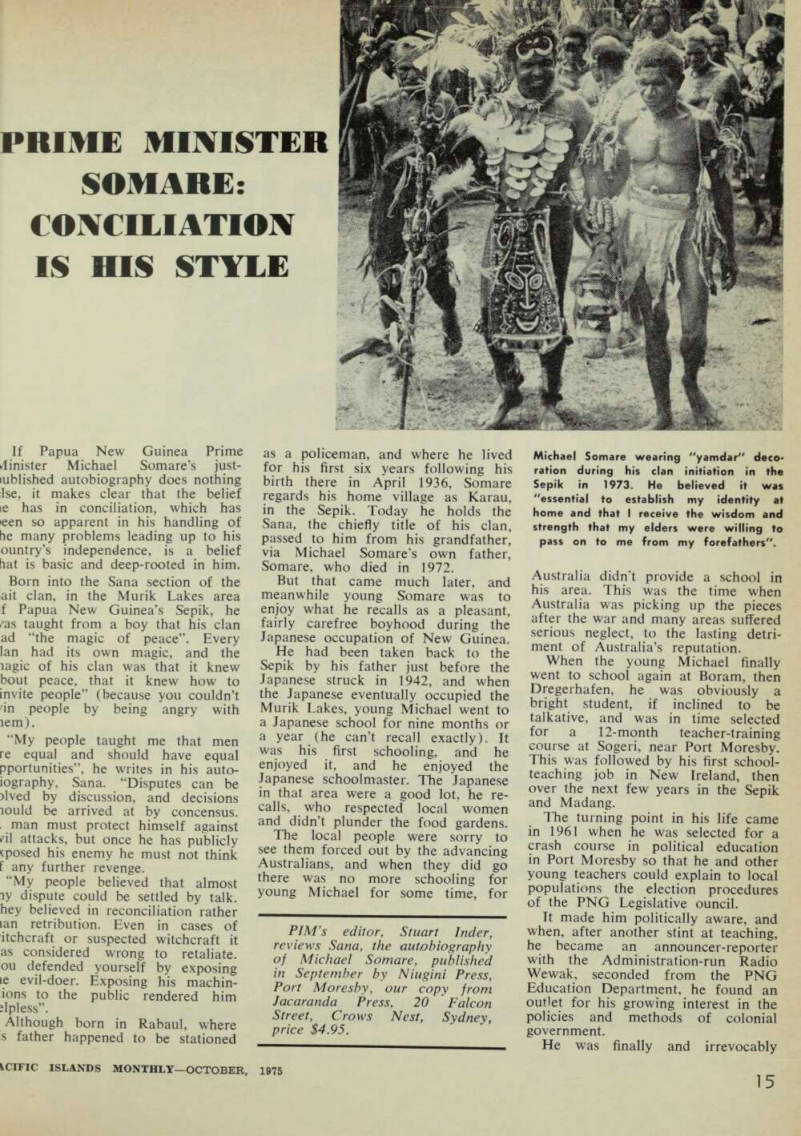
Michael Somare wearing "yamdar" deco ration during his clan initiation in the Sepik in 1973. He believed it was "essential to establish my identity at home and that I receive the wisdom and strength that my elders were willing to pass on to me from my forefathers".
activated the day that the then Minister for Territories, Mr C. E.
Barnes, froze the salary scales paid to local public servants (that is, tfiack public servants). It had been lecided by Australia that PNG ihould operate on a salary structure he emerging national government :ould afford in the future. From hen onwards, those given new ippointments as local public servants vere to receive salaries about half ff those currently being paid to xpatriates for the same job.
“This new rule angered all of us”, ie writes. “There was probably no •ther single issue that made Papua tew Guineans more aware of the ijustices of colonialism”.
He comments: “I knew that some expatriates 'ere making a lot of money in our ountry. But they paid their employ es poorly. In all towns Europeans the best land for themselves i so-called ‘high covenant’ areas, apua New Guineans were isolated i their poorly built compounds, /ith the new salary scheme it be ime practically impossible for any apua New Guinean to move into tie of the more comfortable houses.
“I was on the old public service ilary and was therefore able to live i a good flat. But when the salary ljustment came, those who were nployed after me, and who were 'ten better educated than I. found impossible to afford this kind of xommodation. I did not think this as good enough, I became angrier id angrier and spoke out very loudly that time.
“The government did not like it all, and I became very unpopular ith them. My boss wrote several tiers of complaint to Port Moresby, e said that each time I read the ws there were political overtones it. This was correct, of course, it I did not think that, at that time the history of our country, a civil rvant should keep out of politics”.
His sense of anger grew after he is sent to the Administrative Col te in Port Moresby to do a matri lation course, for there he met my like-minded Papua New iineans such as Albert Maori Kiki, ivera Rea, Jack Karakuru and Ebia ewale (who was president of the idents Representative Council at ! Port Moresby Teachers’ College), mare records that at the college ly had the advantage of “some Islanding teachers”, such as David lenoweth, “Tos” Barnett, Cecil >el Ted Wolfers, to whom, he fs “all of us owe a great deal”.
There, the like-minded people -med The Bully Beef Club, an in
formal study group to inform them selves on political affairs.
That early group made Albert’s house (he is now Sir Maori Kiki, PNG Minister for Foreign Affairs) the breeding ground for politics.
“Sometimes we were late for classes because we had spent the whole night arguing”, he admits. ‘Often we did not finish our assign ments”.
The “Special Branch”—that rather inept organisation sponsored by the Australian Government which had the job of keeping an eye on poten tial trouble-makers, took an interest in their affairs.
“There were very few educated Papua New Guineans then”, he re calls. “Only a few of us could see and understand what was actually happening, and it was our duty to tell the people”.
So back in Wewak again on his radio job he continued, deliberately, to speak up against what he regarded as injustice and to be heartily in volved in union affairs, until his de partmental chief decided to bring him back to Port Moresby, where they could “keep an eye on him”.
So they “promoted him” to a new headquarters position, which under the new salary scale actually meant he had to take a salary cut!
He says now that in more ways than one it was the best thing they could have done for him. He found himself in Port Moresby, in the
centre of political activity, at a time that the first PNG House of Assembly was on the boil and elec tions for the Second Assembly of 1968 were not far off.
He was soon up to his neck in politics, became one of the founders of the Pangu Party on June 13, 1967, and stood for his Sepik district on the Pangu ticket for the 1968 Assem bly, campaigning boldly for early self-government. He took his seat after a poll count which put him far ahead of his nearest rivals.
There is fascinating material in the autobiography on how the small group of Pangu party members laid the foundations in that second As sembly for the success they had in forming a government at the begin ning of the third House in 1972.
Pangu members rejected posts as assistant ministers, which they could have had, because they believed their long-term future lay in forming an effective opposition.
He gives us a detailed account of how, after the 1972 elections, he worked to form what is still today the National Coalition Government, and the first Independence govern ment. He was unopposed in the 1972 poll.
“When I look back on the form ation of the National Coalition”, he writes, “it seems that the one thing that worked significantly in our favour was the United Party’s over confidence that they would form the government, and their comparative inactivity in lobbying additional sup port”.
Pangu, despite its small numbers after the votes were counted, refused to concede the elections to the United Party and went out to enlist sympa thisers and to commit the yet un committed. It attracted the Mataun gans, the People’s Progress Party and Dr Guise’s independants and put to gether a saleable package.
This autobiography indeed reveals that one of Somare’s strengths has been his respect for priorities and for the grass roots of the problem.
Despite what might appear to be overwhelming odds he refuses to give up, and pushes through; if he can’t tackle the problem head-on he works it around the edges, using the old Sana magic!
Although the new Prime Minister takes his story almost up to the pre sent he does not give us the whole picture. There are some significant omissions. There are also signs of haste in the production of the final chapters (not really surprising con sidering the number of political prob lems he has had to deal with without having to produce an autobiography
on the side!) But his omissions are clearly not due to haste: there are some secrets he obviously intends to keep to himself in the present poli tical climate.
He does not hesitate to praise former Australian High Commissioner Les Johnson, or Rev Percy Chatter ton (“the expatriate member who was always ready to give us warm and intelligent support in the House . , . it will be a long time before people in this country forget Percy Chatterton, and I will always feel warm towards him”). There is nothing politically difficult about saying that now, but what are his feelings about Sir John Guise, now the Governor-General, and John Kaputin, the Justice Minister he sacked, and people like Leo Hannett, and Father John Momis (who “had always preached national unity”).
It would be interesting to know, for instance, whether Sir John Guise was created Governor-General as a result of a secret deal between Mr Somare and Dr Guise more than 12 months ago, which is what has been suggested elsewhere.
But these relationships are ob viously too recent and too close; they are continuing relationships, and
Prime Minister Somare has too much political sense to unburden himself in public on matters like these.
Presumably, we will have to wait until the Prime Minister becomes the elder statesman, and we can read his memoirs.
But, meanwhile, what does Papua New Guinea’s new Prime Minister think of the future, and the immedi ate political past? Here it is, in one of the last chapters of his most read able book: “The conflicts and tensions between various groups, sometimes moving them to the brink of secession, have been one of our most difficult prob lems. Like most other third world countries that have thrown off colonial rule and been faced with the problem of forging numerous language groups and cultural tradi tions into one nation state, we are faced with two options.
“We could create an all-powerful central government and force dissi dent groups to fall into line, using force if necessary. Our other option is to adopt a tolerant attitude to wards local interests and to recognise the existing variety of patterns.
“The first alternative is relatively \easy for a government willing to rely
on force. But it is highly undesirable because it means imposing on the people a way of life based on some abstract ideology that is alien to them. The government would neces sarily remain remote from the people.
“The second alternative is far more difficult, but it is the only way poss ible for this country. It is a difficult way because the central government may often appear weak. It puts the central government into the awkward position of having to arbitrate con stantly between different local in terest groups and between different regions of the country.
“It involves the danger that, if the government cannot resolve the issues and local pressure groups become too strong, the country could fall apart. However, it is the wise way to take and the one congenial to our own conditions. It allows the govern ment to decentralise many of its powers. It enables people in the vill ages to make decisions on issues that are going to affect their lives directly.
It allows for a good deal of experi mentation with local government structures, and the government is in a position to accept and support pat terns of village government alterna tive to the Australian-introduced council system”.