Yesterday
p. 39 · Read in the full issue
From PIM, 20 years ago this month:
Mrs Amy Lumley, of the Trobriands, during a visit to Australia, was publicised as the champion of Mitakata, paramount chief of the Trobriands, whose establishment of 23 wives was said to have incurred mission disapproval.
Mrs Lumley was quoted as saying that to reduce Mitakata to a single wife would be to lower his prestige among his own people to that of a commoner. What was wrong for Europeans was not necessarily wrong for islanders; there were also economic factors to consider.
Indonesian snipers' new open season for Netherlands New Guinea was, in effect, declared open by President Sukarno at Jakarta. Addressing the nation on the 10th anniversary of Indonesian independence, he said; "Let us mobilise all our fighting potential to gain control of West New Guinea. The United Nations is not the only front.
We must free West New Guinea with the Indonesian nation's own strength".
Further promising gold indications were discovered on the Gold Ridge field of Guadalcanal in the BSIP, the senior geologist, Mr J. C. Grover, reported. It was the fourth ore body discovered in 1955 by the government geological survey team. The latest find was about 14 miles inland from Honiara.
New Guinea's Kokoda Trail, among the most famous of Pacific war scenes, was almost overgrown 20 years ago, 12 years after the war had moved on.
Captain Lionel Oxlade, quartermaster sf the Pacific Islands Regiment, crossed trail from Popondetta to Port Moresby, and found it hard going most sf the way. Some areas were clear, >ut much of the trail had disappeared jnder jungle growth. In four days' rek the only war relics he saw were he remains of Australian and Japanese >oots, two tin hats and a rusty Iren gun. important developments in the New Guinea air network were advancing teadily. Canberra gave financial approval or the first stage of a big new irport construction job to start at Aalahang, at Lae. This involved a ,500 ft runway about two miles from
he existing airport.
Australia provided a record grant of $17,500,000 for Papua New Guinea for 1955-56. Ten years earlier the grant was only $515,480. PIM commented that with rising costs in every avenue of expenditure—salaries, materials, transport and so on—the grant was not abnormal if the intensive policy in PNG was to be maintained.
The Nelson spirit, or its Fijian equivalent, inspired three young boys of Moce Island, Lau, to sail a 12 ft outrigger canoe across 40 miles of stormy sea to Lakeba in the hope of enjoying a performance by the Fiji Regimental Band. The fact that a storm had just smashed the top-mast of the government schooner, Adi Maopa, and ripped the topsails from another vessel did not deter them. They had more than their share of adventure on the way; they lost a small case containing a bible and clothing, and were followed by sharks. But they made Lakeba and heard the band. When their story became known they were promised a new bible, and were allowed to beat the big drum.
Without debate or discussion, the Western Samoa Legislative Assembly rejected, by 15 votes to eight, a government proposal to set up a small local defence force and coast-watching service as part of a regional plan prepared by the New Zealand defence authorities, and agreed to by both Fiji and Tonga.
Built at a cost of three million francs, a new lighthouse at Niau Atoll, Tuamotu, collapsed half-an-hour before it was to be put into operation. The workmen were away from the building at the time. The lighthouse was urgently needed as a navigational aid.
The French administration set up a commission to investigate the crash.
The NZ Minister of Island Territories, Mr Tom Macdonald, said that after a recent visit to the Cook Islands he was more convinced than ever before that an adequate shipping service was a basic essential to further progress in those islands. Inquiries had made it clear that private enterprise was not prepared to provide a ship for the trade, so the government had no option but to take a direct interest in the service. After repairs, the Maui Pomare should be able to carry on for another three years, and still have a marketable value. The Viti, 700-ton stand-in, which broke down in July, was not expected back on the Auckland-CI freight run before
mid-September.
Allegations made by Captain W. H. Hughes that the "British way of life" was being forced on Gilbert and Ellice Islanders and that the indigenous people were still "living in the Stone Age", were emphatically denied by the Resident Commissioner, Mr M. L.
Bernacchi. Mr Bernacchi said Captain Hughes' allegations caused the greatest resentment among the islanders, and he had received many requests for a denial. The Gilbert and Ellice Islanders were among the most loyal of the Queen's subjects.
When sentencing a Samoan to seven years' imprisonment for rape, Chief Judge Marsack commented on an alarming increase in the number of sexual offences in Western Samoa. He said heavy sentences would be imposed.
Official figures showed that in the first seven months of 1955, eight persons were convicted in the High Court at Apia on charges of rape, and six on charges of indecent assault.
The New Hebrides people were not enjoying the isolation which settled on the group after Qantas discontinued its flying-boat service. The medical service was feeling the absence of air-freighted supplies. It was estimated that airstrips for DC6s would be ready by the end of September, but some local people were not optimistic.
Their guess was late 1956.
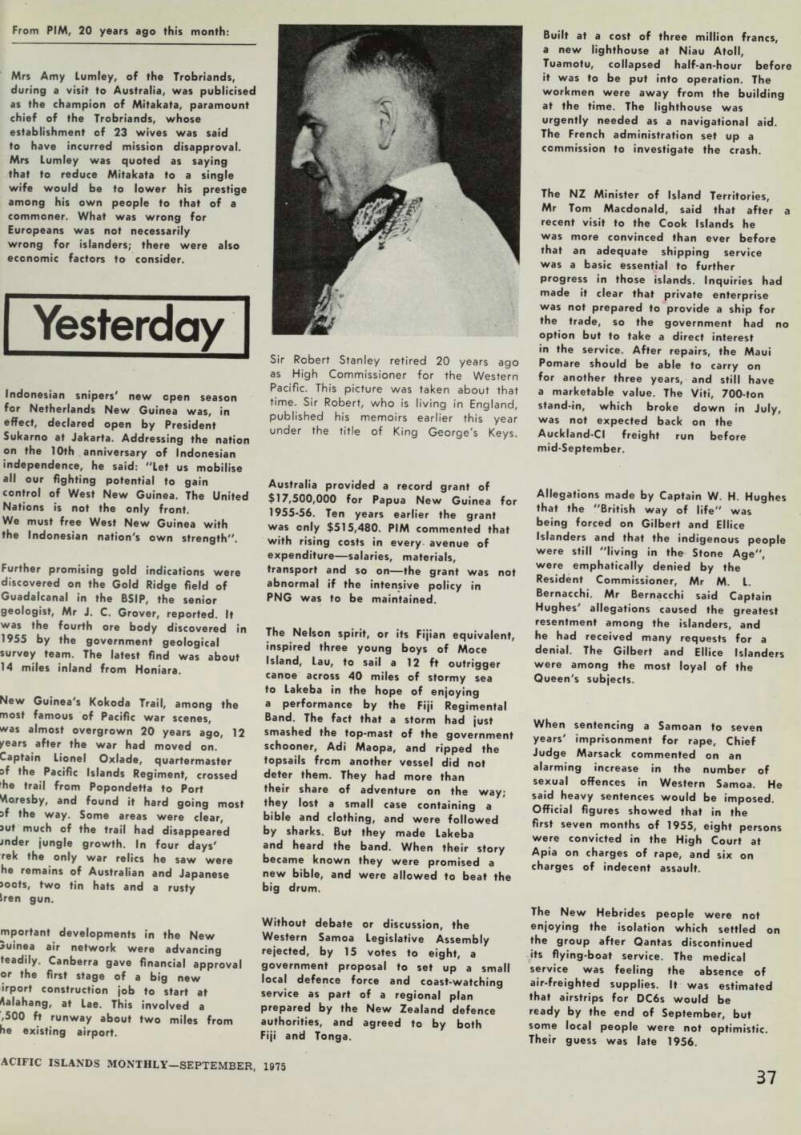
Sir Robert Stanley retired 20 years ago as High Commissioner for the Western Pacific. This picture was taken about that time. Sir Robert, who is living in England, published his memoirs earlier this year under the title of King George's Keys.