Magazine Section
p. 35 · Read in the full issue
Stamp
Stories
Two Islands neighbours, the Re public of Nauru and the Gilbert and Ellice Islands Colony have just pro duced stamps of special interest.
The colourful and imaginative GEIC stamps depict island legends, but the real interest is that the stamps *;ill probably be the last of the com bined colony; as from October 1 the wo groups separate, becoming the Gilberts and Tuvalu respectively.
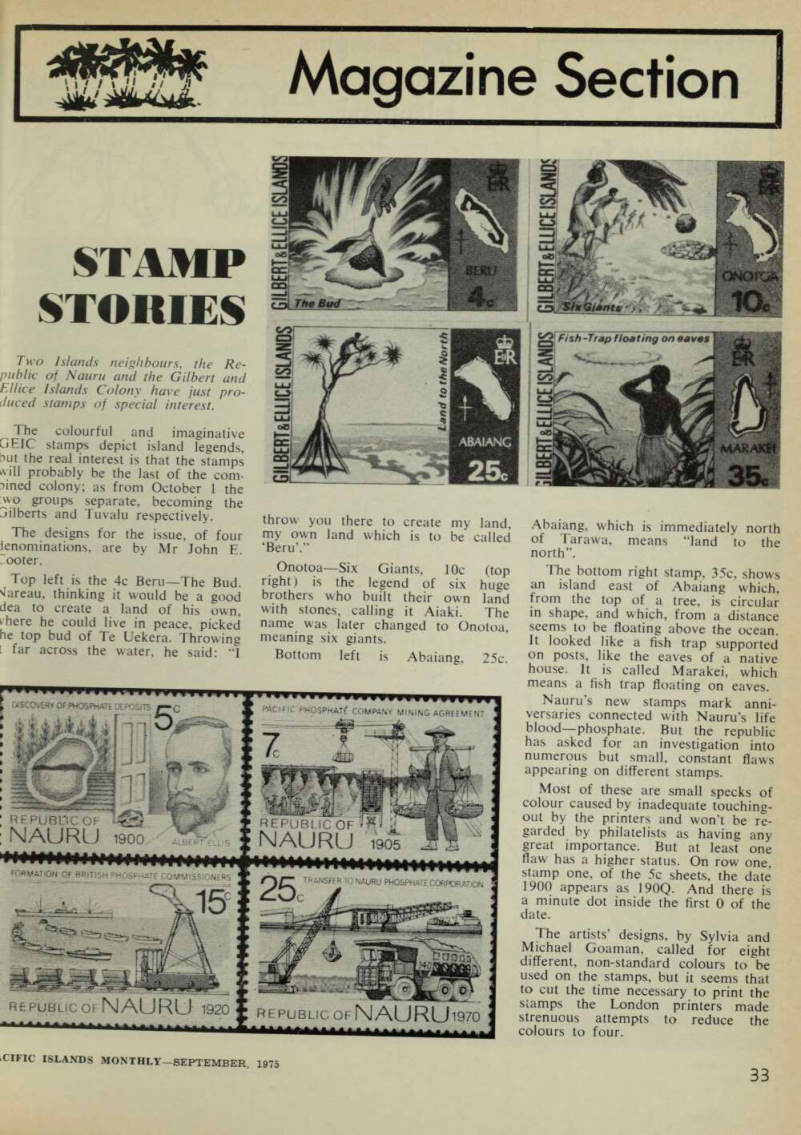
The designs for the issue, of four lenominations, are by Mr John E. rooter.
Top left is the 4c Beru—The Bud. 4areau, thinking it would be a good dea to create a land of his own, yhere he could live in peace, picked he top bud of Te Uekera. Throwing t far across the water, he said: “I
throw you there to create my land, my own land which is to be called ‘Beru’.”
Onotoa—Six Giants, 10c (top right) is the legend of six huge brothers who built their own land with stones, calling it Aiaki. The name was later changed to Onotoa, meaning six giants.
Bottom left is Abaiang, 25c.
Abaiang, which is immediately north of Tarawa, means “land to the north”.
The bottom right stamp, 35c, shows an island east of Abaiang which, from the top of a tree, is circular in shape, and which, from a distance seems to be floating above the ocean.
It looked like a fish trap supported on posts, like the eaves of a native house. It is called Marakei, which means a fish trap floating on eaves.
Nauru’s new stamps mark anni versaries connected with Nauru’s life blood—phosphate. But the republic has asked for an investigation into numerous but small, constant flaws appearing on different stamps.
Most of these are small specks of colour caused by inadequate touching out by the printers and won’t be re garded by philatelists as having any great importance. But at least one flaw has a higher status. On row one, stamp one, of the 5c sheets, the date 1900 appears as 190 Q. And there is a minute dot inside the first 0 of the date.
The artists’ designs, by Sylvia and Michael Goaman, called for eight different, non-standard colours to be used on the stamps, but it seems that to cut the time necessary to print the stamps the London printers made strenuous attempts to reduce the colours to four.